Every winter the same situation happens over North America. Snow is coming down students are looking from their windows with hope and in some place, in town a school superintendent is making one of the choices of the season: will the school be closed the next day?
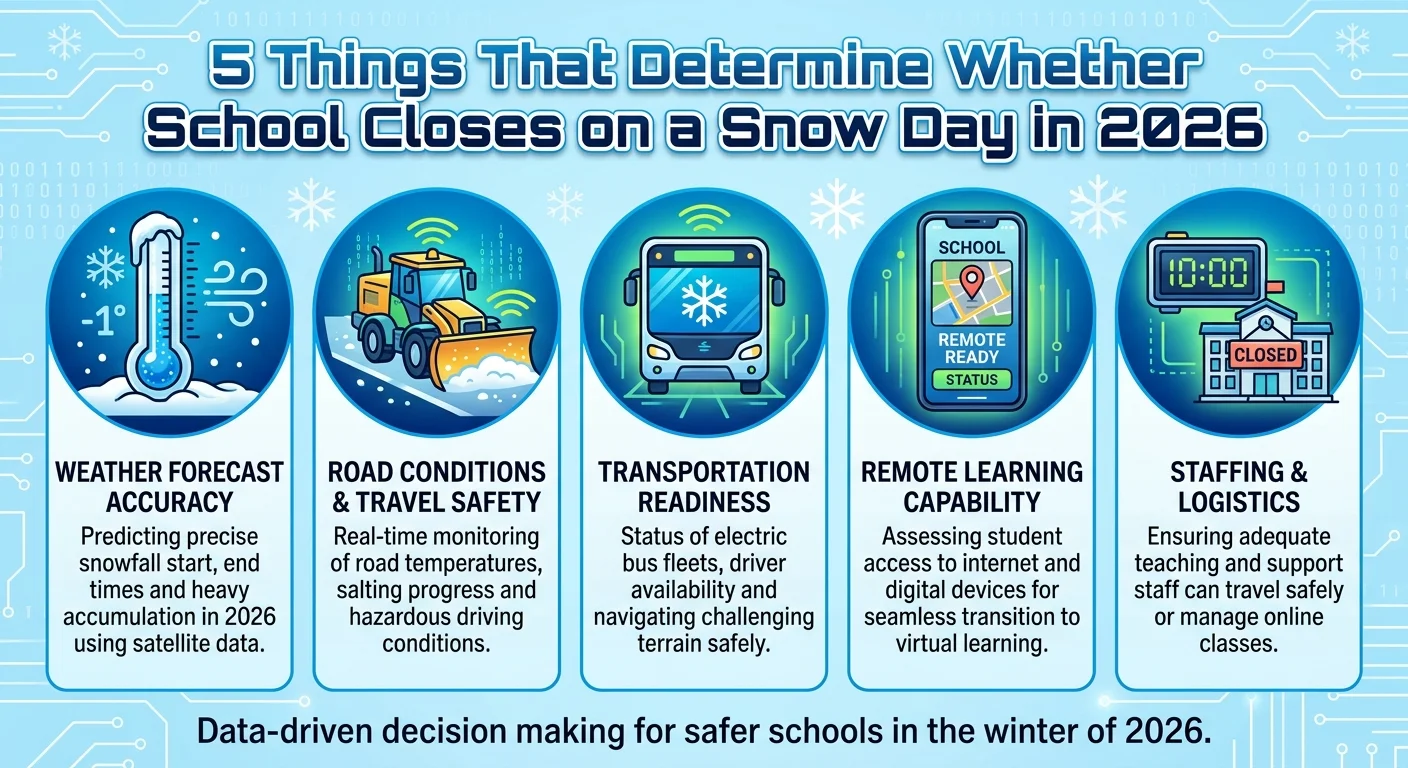
The decision is not random. It is not made without reason. It is based on thinking. This thinking comes from student safety how many kids buses can carry and what the weather actually shows. Knowing the five things that most often decide if school closes helps a lot. It gives you a better idea of what the numbers, on Snow Day Predictor really mean. It also helps you see why the final call ends up the way it does.
Factor 1: Snowfall Amount and Rate
The amount of snow that is expected to fall and how quickly it falls are the two important things when deciding whether to close schools. In every case these two factors determine the outcome. The total snowfall gives a picture of the situation but the speed at which the snow comes down can make a huge difference. A lot of snow in a time can cause sudden problems, like blocked roads, poor visibility and dangerous travel conditions. That’s why school leaders pay attention to both the total amount and the rate of snowfall.
Total accumulation is the baseline metric. In most Northern U.S. school districts, accumulations below 3 inches rarely trigger closures on their own. Accumulations of 3 to 5 inches create borderline conditions where other factors, particularly timing and temperature, become decisive. Accumulations of 6 inches or more, especially in combination with overnight arrival, push most districts toward closure.
Accumulation rate matters much as total snowfall. A storm that drops eight inches, over eighteen hours is much easier to handle than a storm that drops eight inches in four hours. Can make roads impassable faster than crews can respond.
Snow density also plays a role. Wet and heavy snow, which falls when temperatures are close to freezing gets compressed because of traffic. Turns into dangerous ice. Light and fluffy snow, which falls when temperatures are much lower is easier to remove with a plow and treat but moves, with the wind. Makes it hard to see.
Snow Day Predictor weights heavy snowfall of 5 inches or more at a +40% probability contribution, reflecting the data showing that this threshold is where most districts transition from challenging but open to closed.

Factor 2: Storm Timing
Perhaps the most underappreciated factor in snow day decisions is not how much snow falls, but when it falls. Timing is often the difference between a full closure and a 2-hour delay, or between a closure and a normal school day despite significant accumulation.
The optimal closure window for a superintendent is a storm that begins between 10 PM and 2 AM and deposits most of its accumulation before 5 AM. This scenario leaves road crews insufficient time to clear routes before buses need to roll, almost guaranteeing a closure decision.
Delay window is a storm that begins, between 3 and 5 AM and tapers off by 8 to 9 AM. In this scenario delay window of two hours gives road crews the time they need to treat routes while the storm slows down allowing a safe late‑morning opening.
The impactful window is a storm that starts after 8 AM once students are already, in school or after noon when dismissal times can be changed. These storms never lead to school closures before the day starts.. If conditions get worse in the afternoon early dismissal might be ordered.
This is why checking Snow Day Predictor for updates as a storm approaches, rather than relying solely on a forecast made days in advance, gives you the most accurate and actionable result. Storm timing can shift by several hours between a 48-hour forecast and a 12-hour forecast, changing the closure calculation dramatically.
The freezing rain and ice problem.When temperatures stay 32 degrees Fahrenheit or zero degrees Celsius during a time when it is raining or snowing the line between snow and freezing rain is very important. Freezing rain, which's rain that falls as a liquid and then turns to ice when it hits cold surfaces causes black ice that is much more risky for cars and people, than the same amount of snow. A half inch of ice can stop buses from moving make sidewalks hard to walk on and cause power lines to fall. Many districts close for ice accumulation events that would be straightforward to manage as snowfall.
The extreme cold and wind chill problem. Without a lot of snow extreme cold brings serious risks. When wind chill hits -20F or lower frostbite can start on exposed skin in, than 10 minutes. This is a danger. School districts that have students waiting outside for buses face safety concerns. The risk is not just discomfort—it’s a liability. Kids are vulnerable when they stand outside in temperatures. Districts must consider the health and safety of every child. Cold weather can act fast. Parents and schools need to be aware. This is not something to ignore. Many Midwestern districts, particularly in Minnesota, Wisconsin, Michigan, and North Dakota, have explicit cold day closure policies triggered by forecast wind chill values.
Snow Day Predictor adds +20% probability for temperatures below 20F and +10% for winds above 15 mph, capturing both the road safety and the student safety dimensions of extreme cold.
Rural roads are the limiting factor. Urban districts with dense networks of paved, maintained roads can operate through conditions that would shut down a rural district entirely. Rural school districts, where bus routes may cover hundreds of miles of township and county roads, are particularly vulnerable to winter weather because secondary roads are treated after primary highways, often hours later. A rural bus route that passes over a township road that has not been plowed or treated is a non-starter for a transportation director.
Bus capacity and driver availability. School buses are heavy vehicles that can deal with winter weather okay when things are normal.. They can still slide on icy roads or get stuck in a lot of snow. Schools that have buses or take routes with big hills, small roads or tight turns have more chances of problems when its cold. Also the people who drive the buses have the issues on the roads, as everyone else when they go to work.
Pre-treatment effectiveness. Districts and municipalities that pre-treat roads with salt brine before a storm can maintain passable conditions through moderate accumulations. Districts in areas where pre-treatment is routinely applied tend to have somewhat higher closure thresholds than districts where resources limit pre-treatment coverage.

Factor 5: School Level and District Policy
The final factor is one that many people overlook: the specific school level involved and the district's established closure policy.
School level thresholds differ significantly. Elementary schools apply lower closure thresholds than middle and high schools. The reasons are well documented: younger students are more vulnerable to cold at bus stops, less capable of navigating icy conditions, and their parents face greater childcare disruption when school closes unexpectedly. A district may close all elementary schools while keeping middle and high schools open for a moderate winter weather event.
College thresholds are the highest. Universities and colleges rarely close except for truly extreme conditions such as a blizzard depositing over a foot of snow, widespread power outages, or wind chills reaching dangerous levels. The reasoning is that college students are adults capable of making independent safety decisions, and most residential campuses have enclosed connections between buildings that allow students to avoid outdoor exposure entirely.
District closure culture varies. Some districts have a reputation for conservative closure decisions, closing at the first forecast of significant snow. Some groups have a way of staying no matter what, only closing when its really unsafe. This kind of school culture is decided by the principal, affected by the school board and changed by what people, in the community expect.It is also influenced by how many built-in snow days the district has already used in a given winter, as superintendents facing the loss of instructional time and potential makeup days in June apply an incrementally higher bar as the season progresses.
Snow Day Predictor captures the school level variable through its school level selector, allowing you to get a probability score calibrated to whether you are checking for an elementary school, high school, or college.
How These Five Factors Work Together
No single factor determines a snow day in isolation. The most reliable closure scenarios involve multiple factors aligning simultaneously: heavy snowfall arriving overnight, temperatures well below freezing, strong winds creating dangerous wind chills, rural roads untreated, and an elementary school district with a conservative closure culture.
The weakest closure scenarios involve one factor operating at borderline levels. This happens in a district. The area has road treatment infrastructure. These factors together make a school closure less likely.
Understanding how these five factors interact is what makes Snow Day Predictor's probability scores genuinely useful. A score of 75% reflects a situation where several of these factors are aligned in favor of closure. A score of 25% reflects a situation where most of these factors are not at closure-triggering levels.
Check your snow day probability right now at snowdaypredictor.xyz, completely free, for any city or ZIP code in the United States or Canada.