OSRS Construction Calculator
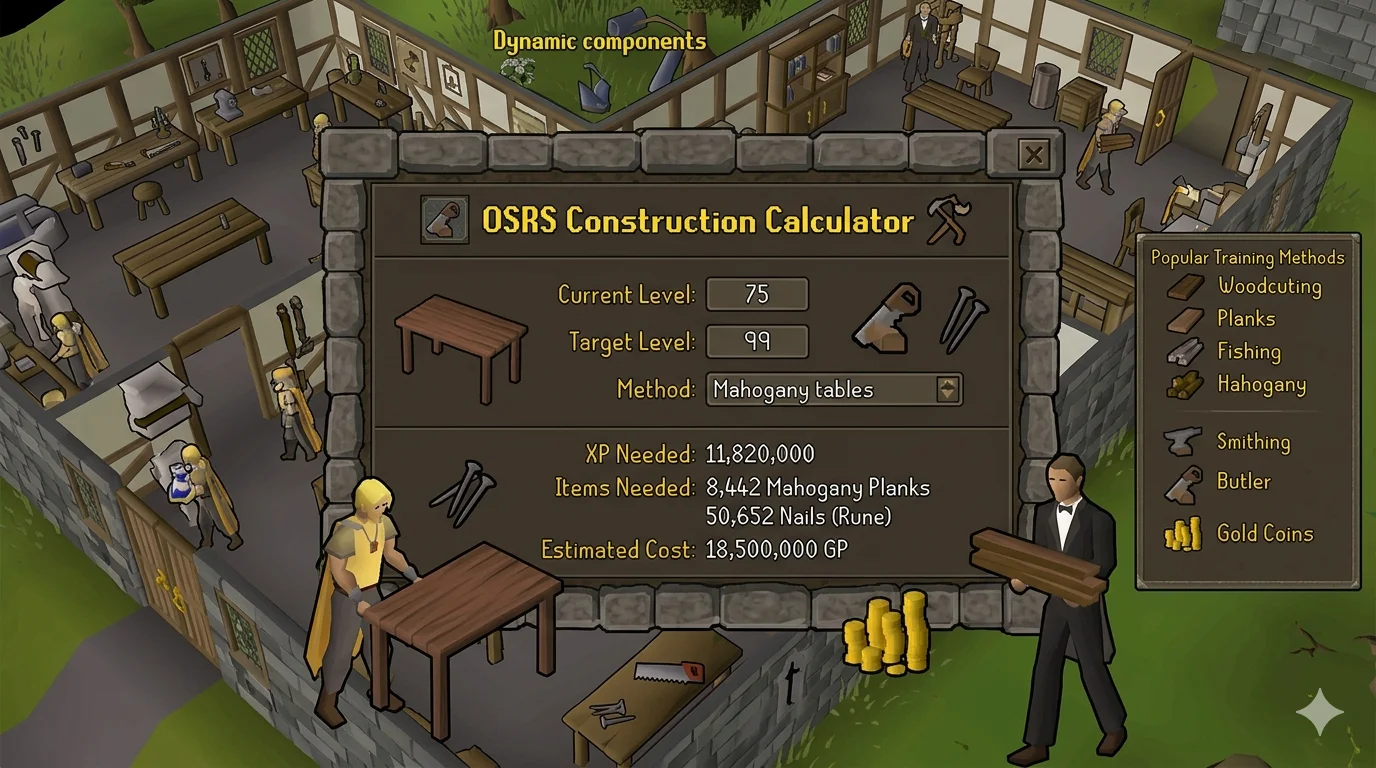
Calculate how many furniture items you need to build to reach your target Construction level in Old School RuneScape. Includes materials required and estimated cost.
Popular Furniture Items
Most commonly built furniture for training
Target Level Distribution
Most common target Construction levels
Calculation Statistics
See how many construction calculations have been made over time
OSRS Construction Guides & Articles
Construction Calculator OSRS | GP Cost & Levels Guide
Construction is the most GP-intensive skill in OSRS and it earns that title honestly. Unlike skills that drain gold while giving you little in return, Construction builds a Player Owned House that functions as a permanent, personal utility hub. The POH replaces teleport items, restores your stats, trains your Prayer, and turns your downtime between boss trips into something genuinely efficient. The gold you pour into planks comes back to you in saved time and saved supplies every single session you play the game.
The key unlocks that make Construction worth the cost: a Prayer Altar for the fastest Prayer training XP in the game, a Portal Nexus for free access to virtually every teleport destination in Gielinor, a Rejuvenation Pool that restores your HP, Prayer, and special attack bar between boss kills, a Combat Ring for safe PvP practice with friends, and a Mounted Glory for instant free Edgeville access whenever you need it. No other skill stacks this many permanent quality-of-life improvements into a single reward structure.
The Rejuvenation Pool: One Unlock That Justifies the Entire Grind
Level 83 Construction unlocks the Ornate Pool of Rejuvenation, and if you spend any meaningful time bossing, this single piece of furniture may be the most valuable thing you build in the entire game. It fully restores your hit points, Prayer points, run energy, special attack energy, and even removes the Vengeance cooldown in one click. Before this pool existed, high-level players would spend thousands of GP per session on restore potions and stat foods just to maintain their bossing cycle. With the pool, you teleport home between kills, click once, and teleport back at full strength. The GP savings over a month of bossing easily surpass what the pool cost to build.
The Most GP-Efficient Path From Level 1 to 99: A Stage-by-Stage Guide
Construction has a clear training progression that every veteran player has burned into memory. Each stage has a method that makes sense for its level range, and skipping ahead costs you more GP than staying patient. Here is the path that most experienced players recommend.
Levels 1 to 19: Getting Off the Ground
The Construction Calculator OSRS tutorial with the Estate Agent in Falador hands you Crude Wooden Chairs for free and pushes you to level 19 at no cost. Do not skip this. Visit any Estate Agent to get started and build chairs in your house until the tutorial ends. You will spend zero GP and arrive at level 19 ready to start a real training method. There is no reason to buy a single plank until you complete this stage.
Levels 19 to 33: Oak Chairs and Your First Planks
Oak Chairs grant 240 XP each and are your entry point into plank-based training. You need approximately 60 oak chairs to reach level 33, which requires around 120 oak planks total. Oak planks are cheap relative to the rest of Construction training, so this stretch costs very little GP. Focus on getting through it quickly rather than optimising too hard. The real training decisions come later.
Levels 33 to 52: The Oak Larder and Its Honest Value
At level 33 you unlock the Oak Larder, which costs 8 oak planks and returns 480 XP per build. This is the best GP-to-XP ratio available at this stage and it stays that way for a significant portion of the early game. You need approximately 230 Oak Larders to reach level 52, which means around 1,840 oak planks. Buy them in bulk on the Grand Exchange and use a butler to run them to your house. At oak plank prices, this stage remains one of the most affordable stretches in the skill.
Levels 52 to 67: Oak Larder or Teak Table, the First Real Decision
Teak Tables unlock at level 52 and offer 540 XP each, a step up from Oak Larders. But teak planks cost more, so the GP-per-XP ratio gets worse even though the raw XP is higher. Many players stay on Oak Larders through this stretch because the GP savings are real, especially if you are already grinding other expensive skills. If you are wealthy or simply want to push faster toward Mahogany Tables, Teak Tables are a clean option. The choice is yours and neither is wrong, but be honest with your budget before committing.
Levels 67 to 99: Mahogany Tables Versus Teak Garden Benches
This is where Construction really becomes expensive. Mahogany Tables give 840 XP each and are the fastest Construction XP in the game. From level 67 to 99, you need approximately 77,000 Mahogany Tables, which requires 3 mahogany planks each, for a total of around 231,000 planks. Teak Garden Benches give 540 XP each but require far more builds to reach 99, around 119,000 in total, and they use 2 teak planks each. The Teak path is significantly cheaper but significantly slower. Most players who commit to level 99 do so on Mahogany Tables because the time saved is worth the extra cost at that stage of the game.
The Mahogany Homes Alternative for Budget-Conscious Players
Mahogany Homes is a Construction minigame that trains the skill at roughly 200,000 XP per hour, about half the rate of Mahogany Tables, but at dramatically lower GP cost. You earn Construction points that you can spend on the Plank Sack, which lets you carry more planks per inventory, and the full Carpenter Outfit, which gives a small XP bonus. Many players who want level 83 for the Rejuvenation Pool but do not care about level 99 find Mahogany Homes to be a perfectly comfortable path. The GP cost from 83 onward via Mahogany Homes is estimated at 20M to 40M total, compared to 100M or more via tables.
Honest GP Cost Breakdown: Every Path to Level 99 Construction
Before you start, know what you are signing up for. Construction costs change with Grand Exchange prices, but the ranges below reflect typical plank prices and should give you an accurate enough picture to plan your bank.
The Mahogany Table Path: Fastest and Most Expensive
Going from level 67 to 99 via Mahogany Tables will cost approximately 150M to 200M GP total, depending on mahogany plank prices at the time you grind. This figure includes Demon Butler fees of roughly 10M to 12M on top of the plank cost itself. It is by far the most expensive route, but it gets you to 99 in the fewest hours and delivers around 900,000 XP per hour at peak efficiency. Players with deep banks, or those who have been merching or bossing for gold, find this method worth the price.
The Teak Path: A Real Alternative at Half the Cost
Training via Teak Garden Benches from level 67 to 99 costs approximately 50M to 80M GP in total plank costs, a dramatic saving over the mahogany route. The trade-off is time: you are looking at roughly 400,000 XP per hour, which means more hours of clicking. For players who are not rushing 99 and want to preserve their bank for other grinds, the Teak path is a practical choice with legitimate merits.
Calculate your playback speed now: Playback Speed Calculator
Where Most Non-Maxers Actually Stop Their Training
The majority of serious OSRS players who do not care about the Construction Cape stop training at either level 83 or level 87. Level 83 gives the Ornate Rejuvenation Pool, which is the most impactful bossing quality-of-life unlock in the game. Level 87 unlocks the Portal Nexus, which consolidates virtually every teleport in Gielinor into a single room in your house. These two unlocks make an enormous practical difference to daily gameplay. Level 99 beyond that is mostly about the cape and completionism, and there is nothing wrong with stopping at 87 and saving 100M GP for something else.
Butler and Servant Costs: The Hidden GP Drain
The Demon Butler charges 10,000 GP per trip and carries 26 items, returning in approximately 7 seconds. The Regular Butler charges 5,000 GP per trip and carries 20 items but is noticeably slower. For serious training sessions, you will use the Demon Butler exclusively. Over a full Mahogany Table grind from level 67 to 99, butler fees accumulate to approximately 10M to 12M GP on top of plank costs. Budget for this from the start or you will be surprised partway through.
| Path | Approx GP Cost | XP per Hour | Time to 99 |
|---|---|---|---|
| Mahogany Tables | 150M to 200M | 900,000+ | Fastest |
| Teak Benches | 50M to 80M | 400,000 | Medium |
| Mahogany Homes | 20M to 40M | 200,000 | Slowest |
Butlers, Planks, and the Training Loop That Makes Construction Click
The butler system is what separates slow, frustrating Construction training from efficient, satisfying sessions. Understanding how butlers work is non-negotiable if you are planning any serious Construction work beyond level 50.
Demon Butler Versus Regular Butler: Which to Hire
The Demon Butler requires level 50 Construction to hire and charges 10,000 GP per trip. He carries 26 items and returns in approximately 7 seconds, which is the fastest servant in the game. The Regular Butler charges 5,000 GP per trip, carries 20 items, and takes noticeably longer to return. For any training session above level 50 that involves planks, the Demon Butler is the correct choice every time. The 5,000 GP difference per trip is negligible compared to the time you lose waiting for the slower butler. Hire the Demon Butler and do not think about it again.
How to Use the Butler to Unnote Planks During Training
The standard Construction training loop works like this: buy noted planks from the Grand Exchange, bank them, then hand them to your butler inside your POH. The butler runs to the bank, unnotes the planks, and returns them to you ready to build with. You build your furniture, the butler takes the next stack of noted planks, and the cycle continues without you ever needing to leave your house. This loop is what enables the high XP rates that Construction is known for. Once you have this flowing, training Construction feels genuinely smooth and efficient.
The Soft Clay Butler Trick for Saving GP Per Hour
When your build cycle outpaces the butler's return time, you can send the butler to collect soft clay from the bank while you finish building. This keeps the butler active and reduces idle trip fees because you are not paying for empty return trips. It is a small optimisation but over hundreds of thousands of builds from level 67 to 99, those small savings add up to real GP. If you want to squeeze every coin out of your training session, learn this trick early.
Construction Level Milestones That Actually Change How You Play
Not every Construction level feels meaningful, but a handful of milestones genuinely transform your account. Here are the ones worth knowing before you start training.
Level 40: Your First Prayer Altar at Home
The basic altar at level 40 lets you restore Prayer points in your POH, saving you trips to Chaos Temple in the Wilderness and the dangers that come with them. It is not the best altar you will build, but it marks the beginning of your house becoming a functional utility rather than just a building site.
Level 47: Oak Altar and a Step Toward the Gilded
The Oak Altar provides better Prayer XP per bone than the basic altar and is a clear stepping stone toward the Gilded Altar at level 75. Many players use this as a functional training altar while they push toward the better version. At this stage your house is already useful for Prayer training on a budget.
Level 50: Unlocking the Demon Butler
Level 50 unlocks the single most important support tool in Construction training. Hiring the Demon Butler at this point transforms your training efficiency and is the reason experienced players often say the skill starts at level 50, not level 1.
Level 70: The Gilded Altar With One Burner Lit
Two lit incense burners on a Gilded Altar grant 350% Prayer XP per bone, the highest Prayer training rate in the game. This setup costs approximately 1.8M GP to build but saves enormous amounts on bones over a long Prayer grind. Most players build this specifically for their own Prayer training or let friends use it for a fee. The Gilded Altar is one of the most impactful Construction unlocks for the broader OSRS community, not just your own account.
Level 75: Portal Chamber for Flexible Teleports
The Portal Chamber lets you set three teleport destinations inside your house, giving you free access to three locations of your choice without carrying tablets or jewellery. It is a meaningful quality-of-life unlock that works well for mid-game players who do not yet need the full Portal Nexus. Three well-chosen destinations cover most common travel needs.
Level 82: Ornate Jewellery Box
The Ornate Jewellery Box stores all of your jewellery teleports in one piece of furniture. This replaces carrying a Glory, Games Necklace, Combat Bracelet, and Ring of Dueling in your inventory or bank tabs. Every teleport these items normally provide is accessible from the box in your house. It is a clean, elegant unlock that declutters your inventory and your bank simultaneously.
Level 83: Maximum Rejuvenation Pool, the Crown Jewel of Construction
The Ornate Pool of Rejuvenation at level 83 restores hit points, Prayer, run energy, Vengeance cooldown, and special attack in a single click. For bossing, this is transformative. Players who push to level 83 report a noticeable increase in kills per hour at almost every boss because they are returning at full strength without spending a single GP on potions between kills. If you are a regular bosser and are asking which Construction level to target first, the answer is 83.
Read our Detroit snow day predictor guide: Snow Day Predictor Detroit
Level 87: Portal Nexus, the Teleport Hub for Serious Players
The Portal Nexus consolidates virtually every major teleport destination in the game into a single room. Slayer tasks, bossing locations, skilling spots, cities, dungeons: all accessible from your house. It replaces dozens of teleport tablets, jewellery charges, and worn items. The Portal Nexus is why most experienced OSRS players target level 87 as their personal Construction goal and then stop. Beyond this point, the remaining unlocks are incremental. The cape is prestigious, but the Portal Nexus is functional.
How OSRS Construction Training Works
- Player-Owned House: Construction lets you build and customize your own house in Gielinor
- Build & Remove: Training involves building furniture items and removing them repeatedly for XP
- Planks: Most furniture requires planks (regular, oak, teak, or mahogany) which can be made at the sawmill
- Butler Service: Hire a butler or demon butler to bring planks from your bank, dramatically speeding up training
- Best Methods: Oak Larders (33-52), Mahogany Tables (52-99) are the most popular training methods
- Cost: Construction is one of the most expensive skills, but provides extremely useful teleports and amenities
Frequently Asked Questions
Mahogany Tables are the fastest Construction training method available, awarding 840 XP per build. Using a Demon Butler to supply noted planks and training in a Dining Room, experienced players consistently achieve over 900,000 XP per hour. The method requires level 52 Construction to build the Mahogany Table and level 50 to hire the Demon Butler. The cost is significant, typically sitting between 150M and 200M GP to go from level 67 to 99, but no other method comes close to matching the raw XP output if speed is your priority.
The total cost depends entirely on the method you choose. Training via Mahogany Tables from level 67 to 99 costs approximately 150M to 200M GP in plank costs alone, plus another 10M to 12M GP in Demon Butler wages. The Teak Garden Bench path costs 50M to 80M GP total and is significantly more accessible for most players. Mahogany Homes brings the cost down to 20M to 40M GP but requires 60 to 70 hours of active gameplay. The early levels from 1 to 33 are essentially free if you follow the tutorial and use oak chairs efficiently.
The Portal Nexus requires level 87 Construction to build. It costs approximately 200 mahogany planks and several limestone bricks in materials, but the real cost is the Construction level itself. A regular Portal Chamber, which supports three teleport destinations rather than the full nexus list, can be built at level 75. If you want partial teleport utility before 87, the Portal Chamber is a useful stepping stone. Most players aim directly for level 87 and the Nexus since it is the final major utility unlock before the Construction cape at 99.
Construction is a members-only skill in OSRS and cannot be trained on free-to-play worlds. There is no free-to-play method for Construction because POH access, plank purchasing, and the entire butler system are all locked behind a membership. If you are a free player interested in Construction, you will need to purchase a bond or subscribe to a members account before any Construction training becomes available. The skill simply does not exist in any form on F2P servers.
You can train without a butler, but it will cost you XP per hour and become genuinely tedious above level 50. Without a butler, you must run to the bank yourself each time your planks run out, which cuts your XP rate roughly in half compared to using a Demon Butler. For early levels under 50, manually banking is acceptable. For the mahogany or teak grind from level 67 to 99, skipping the Demon Butler effectively doubles the time investment. Hiring a Demon Butler costs 10,000 GP per trip, but the XP efficiency more than justifies the expense.
Oak planks offer the best XP per GP ratio among the common training planks, particularly when used for Oak Larders at 480 XP per build. At current Grand Exchange prices, oak planks provide more XP for your coin than either teak or mahogany planks. The trade-off is that the XP per hour is much lower, so you spend more time training. Teak planks sit in the middle ground, offering decent XP rates and moderate cost. Mahogany planks give the worst XP per GP but the best XP per hour. The right plank depends on whether you are optimizing for total cost or total time.
Construction is almost entirely a money sink by design, but there are a few partial exceptions. The Mahogany Homes minigame earns Construction points that can be used to buy the Plank Sack, which sells on the Grand Exchange, and the Carpenter outfit pieces, which also have market value. Some players sell these rewards to partially offset training costs. Additionally, if you have a Gilded Altar and open your POH to the public, other players will sometimes tip you GP for the altar access, though this is inconsistent. Outside of these methods, Construction training does not generate meaningful income on its own.
If you are not going for 99, the three most impactful targets are level 70 for a Gilded Altar with incense burners (best Prayer training XP), level 83 for the Maximum Rejuvenation Pool (best bossing quality of life unlock in the game), and level 87 for the Portal Nexus (replaces virtually every teleport method from a single POH fixture). Between those three, level 83 probably delivers the most tangible day-to-day benefit for active players. If you only ever reach one of these milestones, the Rejuvenation Pool at 83 is the one to aim for.