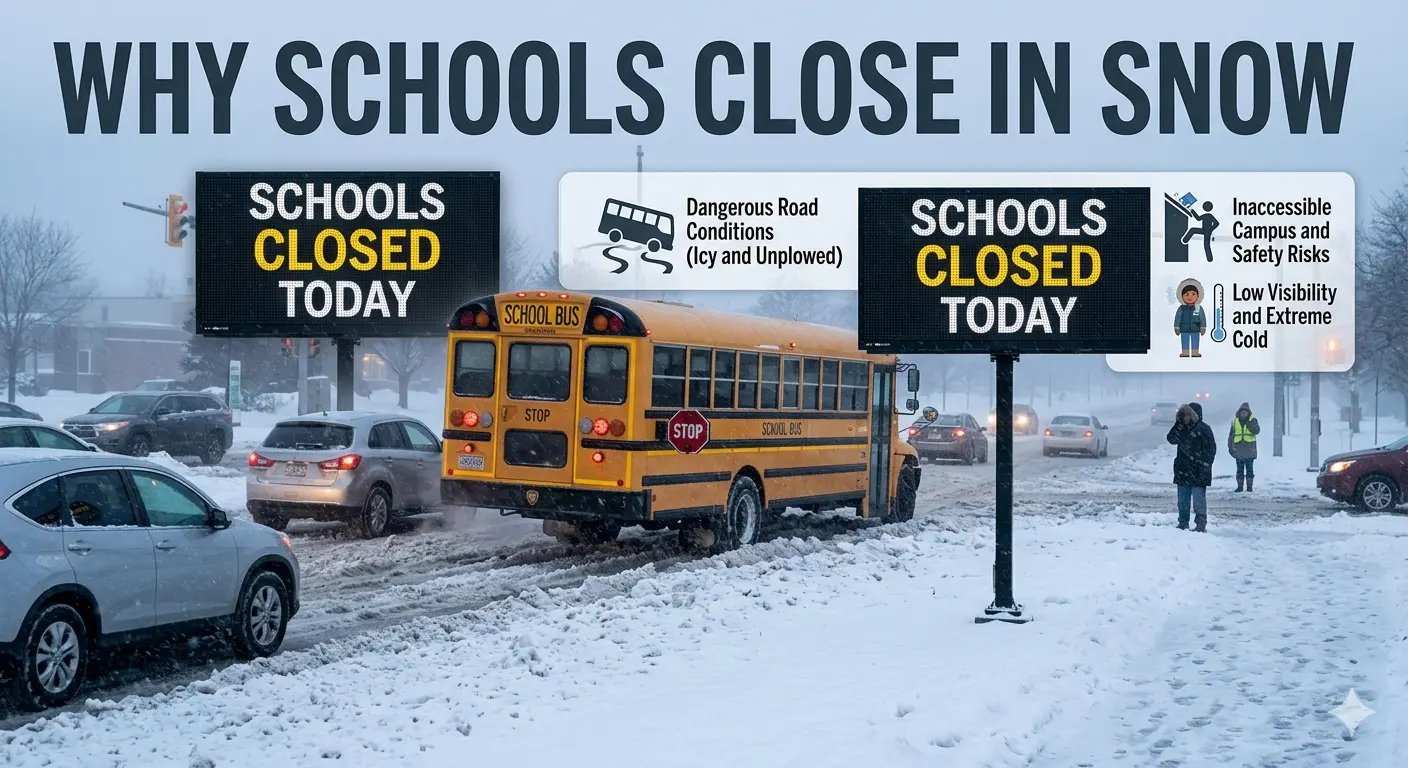
Understanding why schools close in snow is more complex than most people realize. It is not just about how many inches fall overnight. School districts weigh temperature, road conditions, wind chill, the timing of a storm, bus routes, and dozens of other variables before making a call. A snow day calculator or school cancellation predictor brings all those considerations together in one place, giving families a realistic percentage chance of a day off before the official announcement comes.
This guide covers everything you need to know about snow day prediction, from how these tools are built to the science behind school closure decisions, plus tips on how to get the most accurate results from any snow forecast tool you use this winter.
What Is a Snow Day Predictor and Why Does It Matter
A snow day predictor is a digital tool that combines local weather forecast data with school-specific variables to calculate the probability that your school or district will cancel classes due to winter weather. These tools range from simple online calculators that ask for a zip code to sophisticated machine learning applications that analyze years of local closure history alongside live National Weather Service feeds.
The reason these tools matter comes down to planning. When families know there is a 75 percent chance of school closing tomorrow, they can arrange childcare in advance, adjust work schedules, and avoid last-minute scrambles. For teachers, early prediction helps with lesson planning. For administrators, seeing storm probability data early allows them to communicate proactively with families before the morning rush begins.
The original snow day calculator concept became famous in the early 2000s when a young student named David Sukhin built a web tool that would estimate snow day chances from a handful of weather inputs. That simple project sparked an entire category of weather-based school closing predictor tools that millions of people now use every winter season.
A good snow day predictor does not just read weather data. It understands how your local district makes decisions, and that is what separates a generic weather app from a genuine school cancellation tool.
Why Schools Close in Snow: The Real Decision Behind the Call
The question of why schools close in snow is deceptively layered. On the surface it seems straightforward: too much snow means no school. But school administrators actually work through a detailed risk assessment process that begins hours, sometimes days, before a storm arrives.
The single biggest concern for most districts is transportation safety. School buses travel routes that include rural roads, steep hills, bridges, and underpasses. These surfaces freeze and become dangerous long before main city roads are treated. If a transportation director determines that bus routes cannot be safely navigated, that alone may be enough to close schools even if sidewalks in town are merely wet.
Pedestrian safety is the second major factor. Schools in walkable neighborhoods must consider whether students traveling on foot face dangerous conditions. Ice on sidewalks and crosswalks is often more hazardous than accumulated snow because it is harder to see and nearly impossible to treat quickly. When temperatures sit just below freezing after rain or sleet, administrators often decide that even a modest snowfall creates an unacceptable slip-and-fall risk for walking students.
Staff availability plays a significant role as well. A school building needs a full complement of teachers, aides, cafeteria workers, and custodial staff to operate safely. If a storm is forecast to make roads impassable for staff who commute long distances, administrators know they cannot staff the building properly even if local conditions look manageable.
Another dimension of why schools close in snow relates to building conditions. Very low temperatures can cause heating systems to struggle, and frozen pipes are a real concern in older buildings. If overnight temperatures fall dramatically and a school district knows that a particular building loses heat quickly, that factor enters the closure calculation independently of snowfall totals.
Finally, timing is everything. A storm that drops six inches of snow between 10 p.m. and 4 a.m. gives plowing crews time to clear roads before the morning commute. The exact same storm arriving between 4 a.m. and 8 a.m. may force a closure because roads simply cannot be cleared in time. A reliable school closing predictor accounts for storm timing, not just total accumulation.
Rural roads and steep grades freeze faster than main roads and are harder to treat quickly.
Freezing rain and extreme wind chills pose risks independent of total snowfall amounts.
Early morning storms leave no window for road crews to clear routes before buses roll.
Even light snow becomes dangerous when temperatures stay below 20°F for extended periods.
Schools need adequate staff to operate safely. Long commutes in storms reduce availability.
Frozen pipes and heating system failures become likely during extreme cold events.

How a Snow Day Predictor Works: The Science Behind the Calculation
A snow day predictor pulls together several distinct data streams and runs them through a weighted scoring model to produce a single probability percentage. Understanding this process helps you interpret results more intelligently instead of simply accepting or rejecting the number you see on screen.
The foundation of any school closing predictor is the weather forecast itself. Most tools connect directly to National Weather Service data or commercial weather APIs that provide hourly precipitation totals, temperature readings, wind speed projections, and storm timing estimates. This raw data forms the input layer of the prediction model.
On top of that weather layer sits a local context model. Different zip codes have radically different closure thresholds. A school district in Buffalo, New York has infrastructure, equipment, and community expectations built around heavy snowfall. Two inches of snow there might not even generate a delay. The same two inches falling on a school district in Virginia or Georgia, where snow removal equipment is scarce and drivers are unaccustomed to winter conditions, can close schools for a full day. A well-designed snow day calculator by zip code accounts for this regional variation automatically.
The third layer involves historical closure data. Modern snow day prediction tools compare current conditions against a database of past storms and the corresponding district decisions. If a similar storm three years ago closed 90 percent of schools in your county, that historical correlation shifts the probability estimate upward even if current conditions look borderline.
The final output, usually expressed as a snow day percentage or probability score, represents the model's best estimate given all available inputs. Many tools display this as a simple number like 68 percent snow day chances. Others show a range or tier system such as Low, Moderate, High, and Extreme cancellation probability.
Weather Factors That Drive Snow Day Prediction Results
Every snow day forecast tool prioritizes certain weather variables more heavily than others. Knowing which factors carry the most weight helps you read forecast conditions yourself and sanity-check any tool you are using.
Snowfall Accumulation and Rate
Total snowfall is the most obvious input, but rate of accumulation matters just as much. Four inches falling over twelve hours is manageable for road crews. Four inches falling in two hours creates dangerous whiteout conditions and overwhelms plowing capacity. A quality snowstorm prediction model differentiates between these scenarios rather than treating both as identical four-inch snowfall events.
Temperature and Freeze-Thaw Cycles
Snow that falls when temperatures hover around 32 degrees is actually easier to clear than snow falling at 15 degrees. Wet snow at warmer temperatures sticks and is heavy but clumps and plows fairly well. Very cold, dry snow creates icy pack that bonds to pavement. More importantly, temperatures that drop after snowfall causes the surface to refreeze overnight, turning treated roads back into skating rinks by morning. Snow day prediction algorithms weight overnight low temperatures heavily for this reason.
Wind Speed and Wind Chill
High winds cause two distinct problems. First, blowing and drifting snow can close roads that were plowed earlier in the evening, undoing hours of road crew work. Second, extreme wind chills create a health and safety risk for students waiting at bus stops. Many districts have explicit wind chill thresholds in their closure policies. When forecast temperatures combined with wind speeds produce a feels-like reading below negative 20 degrees Fahrenheit, for example, a closure becomes nearly automatic regardless of snowfall.
Precipitation Type Transitions
Storms that transition from rain to sleet to freezing rain to snow create the most dangerous road conditions of any winter weather event. This precipitation type mix leaves a layer of ice beneath any accumulated snow, making treatment extremely difficult. Weather based school closure decisions almost always favor cancellation when a mix event is forecast, and AI weather prediction tools flag these transitions as high risk automatically.
Snow Day Predictor Accuracy: What You Should Realistically Expect
The accuracy of any school cancellation predictor depends on three variables: the quality of the underlying weather forecast, the quality of the local closure history data, and the sophistication of the algorithm connecting the two. Understanding these limitations helps you use these tools as informed aids rather than guaranteed answers.
| Forecast Window | Typical Accuracy | Reliability Level |
|---|---|---|
| Same evening (6-12 hrs out) | 88-94% | High |
| Previous evening (12-24 hrs out) | 78-88% | Good |
| Day before (24-36 hrs out) | 65-78% | Moderate |
| Two days out (36-48 hrs) | 55-70% | Moderate |
| Three or more days out | 40-55% | Informational |
Weather forecast accuracy itself degrades significantly beyond 48 hours. Even the best snow forecast tool is only as good as the meteorological model feeding it. For predictions three or more days in advance, treat any snow day probability percentage as a planning signal rather than a reliable answer.
Accuracy also varies by geography. Snow day calculators for regions with consistent winter weather patterns and long historical records tend to outperform tools used in areas that see irregular or unusual storms. A tool calibrated on five years of Buffalo school closure data will likely outperform a generic national model applied to that same area.
One important distinction separates forecast accuracy from closure accuracy. A weather forecast can be highly accurate while the closure decision still goes unexpectedly. School superintendents occasionally close schools proactively when conditions look borderline, or keep schools open in storms that turned out milder than predicted. The human decision layer introduces variability that no algorithm can fully eliminate.
Snow Day Predictor by Zip Code: Why Location Is Everything
The most meaningful upgrade any snow day prediction tool can offer is genuine zip code specificity. A generic statewide snow probability number is nearly useless. The difference in closure thresholds between neighboring districts in the same state can be dramatic based on terrain, demographics, equipment, and policy.
When you enter your zip code into a snow day chances calculator, the best tools retrieve several layers of location-specific data. They pull local National Weather Service forecast grid data specific to that geographic area rather than a regional average. They also cross-reference your zip code against school district boundaries to identify which specific district serves that location, then apply that district's historical closure patterns to the calculation.
Some advanced snow day predictor by zip code tools also account for local geography. A zip code in a valley surrounded by hills will experience different snowfall totals than a zip code five miles away on higher ground. Orographic lift effects mean that some school districts consistently see heavier accumulation than regional forecasts suggest, and a calibrated local tool accounts for this micro-climate effect.
For families who live near a district boundary, entering multiple nearby zip codes and comparing results can be informative. If you are right on the edge between two districts, checking both sets of historical patterns gives you a clearer picture of which way the decision is likely to go.

AI Snow Day Predictor Tools: How Machine Learning Is Changing Winter Forecasting
The latest generation of snow day prediction technology has moved well beyond simple rule-based calculators. Artificial intelligence and machine learning approaches are now being applied to winter weather forecasting in ways that significantly improve both accuracy and granularity.
Traditional snow day calculators used fixed thresholds. If forecast snow exceeds X inches and temperature drops below Y degrees, assign probability Z. These rules worked reasonably well but failed to capture the complex interactions between variables. A machine learning model, trained on thousands of past storm events and corresponding closure decisions, learns patterns that no human-designed rule set would capture.
For example, an AI snow day predictor might discover through training data that storms arriving on a Monday in a particular district have a 15 percent higher closure rate than identical storms arriving on a Wednesday. That pattern might reflect the fact that weekend snowfall on Saturday and Sunday means road crews have already been working for 48 hours before the Monday storm arrives, reducing their capacity to respond. No human analyst might think to encode that rule, but a machine learning model discovers it naturally from historical data.
Real-time data integration is another area where AI weather prediction tools are advancing rapidly. Modern systems do not wait for a morning forecast update. They ingest live data streams from road sensor networks, airport weather stations, NOAA radar feeds, and social media reports of road conditions, updating probability estimates continuously throughout the night. Families checking a snow day calculator at 9 p.m. and again at midnight will see different numbers as conditions evolve, rather than a static estimate that does not change until the next official forecast cycle.
Mobile applications for snow prediction now push real-time alerts when probability crosses key thresholds. If your personalized snow day chances calculator shows 40 percent probability at bedtime but rises above 75 percent at 2 a.m. as a storm intensifies, a push notification wakes you early enough to make childcare arrangements before the official district announcement comes. This time advantage is one of the most practical benefits that AI weather prediction tools deliver.
How to Read a Snow Day Chances Calculator: Understanding the Percentage
When a snow day predictor shows you a number like 63 percent, what does that actually mean? Many users misread these figures in ways that lead to disappointment or false certainty. The snow day predictor percentage explained simply is this: it represents the probability that school will be closed, not a forecast of how much snow will fall.
A 63 percent probability means that if you faced identical conditions one hundred times, school would close in roughly 63 of those scenarios. It does not mean school will definitely close. It also does not mean the forecast is uncertain. It means conditions genuinely hover in a zone where the closure decision could go either way depending on factors that even the best model cannot fully predict in advance, particularly the subjective risk tolerance of the local superintendent making the final call.
Scores below 30 percent suggest school will almost certainly remain open. Scores above 70 percent suggest closure is the likely outcome. The 40 to 65 percent range is genuinely uncertain territory where families should prepare for both possibilities. Many experienced users of snow day chances calculators have found that checking the tool's output at multiple points throughout the evening gives a better read than a single check, since probability updates as forecast confidence improves overnight.
How to Predict a Snow Day Manually Without a Calculator
Even without a snow day predictor tool, you can develop a reasonable sense of closure likelihood by watching the right indicators. This skill is particularly useful when you are in an area with limited tool coverage or when you want to sanity-check a calculator's output.
Step One: Find the Local Weather Service Forecast
Go directly to weather.gov and enter your zip code. Read the area forecast discussion written by your local meteorologist, not just the automated graphic forecast. The discussion explains forecast confidence levels, timing uncertainty, and the meteorologist's own assessment of whether conditions will reach the threshold for significant impacts. This expert context is more informative than any automated tool.
Step Two: Check the Forecast Timing Carefully
If snow is forecast to begin after 8 a.m., school may well proceed normally. If it begins before 4 a.m. and accumulates before road crews can respond, closure becomes much more likely. Timing is as important as total accumulation for school cancellation decisions.
Step Three: Look at Overnight Low Temperatures
A forecast low below 15 degrees after snow suggests road treatment will be less effective and refreezing is likely. This increases closure probability substantially beyond what snowfall totals alone suggest.
Step Four: Research Your District's History
School districts in colder climates with well-funded road crews tolerate more snow before closing. Southern districts and those with limited budgets for winter maintenance tend to close on smaller accumulations. Knowing your district's typical threshold is the most valuable single piece of information you can have for manual snow day prediction.
Best Snow Day Predictor Websites and What Sets Them Apart
The landscape of snow day prediction tools has grown substantially over the past decade. Several distinct categories of tools now serve different user needs, from quick probability checks to detailed winter storm prediction dashboards.
The original snow day calculator websites built their reputations on simplicity and reliability. You enter a zip code, select a school type, and receive a percentage. These tools remain popular because they are fast and require minimal technical knowledge to interpret. Their weakness is that they rely on fixed weighting models that do not adapt to individual district characteristics over time.
The newer generation of school closing predictor platforms integrates live data feeds and updates continuously. These tools often show historical accuracy records for your specific district, which helps users calibrate their trust in the output. Seeing that a tool has been 87 percent accurate for your school over the past three winters builds justified confidence in its probability estimates.
Weather service apps from providers like Weather.com, AccuWeather, and Weather Underground now include school closure probability features alongside standard winter weather alerts. These platforms benefit from investment in their underlying forecast models, which tend to be highly accurate at the regional level, though they sometimes lack the district-specific historical calibration that specialized snow day tools provide.
For families who want the deepest possible analysis, some regional meteorology blogs and local television weather departments publish school closure outlooks during significant winter weather events. These expert human assessments complement algorithmic tools by providing context and nuance that automated models sometimes miss.
Tips for Getting the Most From a School Closing Predictor
Smart Tips for Better Snow Day Predictions
- Always check the predictor in the evening the night before rather than during the day. Weather model accuracy improves significantly in the 12 hours before a storm, so a 9 p.m. check is much more reliable than a check at noon the previous day.
- Compare at least two different tools for the same zip code. If they agree within 10 percentage points, you have higher confidence. If they diverge widely, conditions are genuinely uncertain and you should prepare for either outcome.
- Set a push notification or alarm to recheck at 5 a.m. on storm days. Many closure decisions happen between 4 and 6 a.m. when administrators make their final call, and probability estimates often shift significantly in those overnight hours.
- Know your district's communication channels. Most districts now announce closures through text message systems, local radio, and official social media accounts. Subscribe to the district's official alert system so you receive direct notification rather than relying on third-party tools alone.
- Do not anchor too strongly on a single percentage. A 55 percent chance of closure is genuinely uncertain. Have contingency plans ready rather than betting everything on one outcome.
- Track accuracy over time for your specific school. Note when the tool was right and when it missed. After a season, you will have a personal sense of how to interpret its outputs for your district.
- When predictions are borderline, pay attention to late-evening weather reports from your local television meteorologist. They have the most current model data and often comment directly on school closure likelihood for the area.
Winter Storm Prediction Trends Shaping the Future of Snow Days
The technology driving winter weather forecasting is advancing rapidly, and these improvements are flowing directly into the snow day prediction tools that families rely on. Several trends are worth understanding as you think about how to use these tools most effectively in coming seasons.
Machine learning models trained on decades of historical weather data are replacing older statistical forecasting methods at major weather agencies. These neural network approaches capture subtle atmospheric patterns that previous models missed, improving snowfall forecast accuracy particularly for intense but localized snowbands that produce dramatically different accumulations across short distances. As these improvements flow downstream into snow day calculator tools, the gap between predicted and actual snowfall will continue to narrow.
The expansion of ground-level sensor networks is adding real-time data that satellite and radar measurements cannot provide. Roadway temperature sensors, surface condition monitors embedded in pavement, and airport weather observation networks all feed data into modern forecasting systems. This ground truth data reduces forecast errors caused by estimating surface conditions from atmospheric measurements alone.
Hyperlocal forecasting, sometimes called neighborhood-scale weather prediction, is becoming accessible for consumer applications. Where traditional forecasts provide one data point per county or forecast zone, next-generation systems produce predictions at the level of individual neighborhoods or even street blocks. For school closure prediction, this granularity is meaningful because it allows tools to assess conditions along specific bus routes rather than averaging across an entire district.
AI-powered school communication platforms are beginning to integrate weather prediction directly into district decision support systems. Rather than administrators checking weather apps and making judgment calls in the early morning hours, these platforms present a synthesized risk score alongside relevant factors, helping school leaders make faster and more consistent closure decisions.
Read More : How to check snow day online
Conclusion: Using Snow Day Predictors Smarter This Winter
Understanding why schools close in snow is not just about meteorology. It is about transportation logistics, building safety, community risk tolerance, and the complex judgment calls that administrators make in the early morning hours of a winter storm. Snow day predictor tools bring all of these dimensions together in a single probability score, giving families a meaningful planning advantage over simply watching the sky and hoping.
The best approach to using these tools is to treat them as informed probability estimates rather than guarantees. Check predictions the night before for the most reliable read, compare multiple tools when conditions look borderline, and always have a contingency plan ready when probability sits in that 40 to 65 percent uncertain zone. As AI weather prediction technology improves and real-time sensor networks expand, the accuracy of snow day calculators will continue to rise, making them an increasingly valuable part of every family's winter preparation toolkit.
Whether you are a student hoping for a day off, a parent arranging childcare, or a teacher planning your week, a well-chosen snow day predictor gives you the best available read on one of winter's most consequential unanswered questions. Use the tools wisely, understand their limitations, and you will be better prepared no matter what the winter brings.