Chaldean Numerology Calculator
Discover the hidden meaning behind your name using the ancient Chaldean numerology system. Enter your full name to calculate your destiny number, soul urge number, and personality number.
Popular Chaldean Numbers
Most common destiny numbers calculated
Number Trait Distribution
How different numbers are distributed among users
Calculation Statistics
See how many numerology calculations have been made over time
Chaldean Numerology Guides & Articles
Chaldean Numerology Calculator: Decode the Vibrations Behind Your Name and Birth Date
From Ancient Babylon to Your Birth Name: Why the Chaldean System Stands Apart
Chaldean numerology originates in ancient Mesopotamia, the region historically known as Babylonia and Chaldea, a civilization that produced some of the earliest recorded astronomical and esoteric knowledge in human history. The Chaldeans, who served as astronomers, astrologers, and interpreters of signs in the Babylonian royal courts, developed a system of number-letter correspondence grounded not in the sequential order of the alphabet but in their observation of vibrational frequencies. They believed that each letter carried a unique energetic signature and assigned numerical values accordingly. This distinction from the Pythagorean system, which simply assigns numbers 1 through 9 in alphabetical sequence, is what many professional numerologists consider the Chaldean tradition's greatest strength.
The three core outputs this calculator produces are the Soul Number, the Outer Personality Number, and the Life Path Number. The Soul Number, derived from the vowels in your full birth name, reflects your innermost self, your private motivations, and the desires you rarely speak aloud. The Outer Personality Number, drawn from the consonants, reveals the face you present to the world and how others experience you before they know you deeply. The Life Path Number, calculated from your full date of birth, represents the broad arc of your destiny, the overarching theme of what you are here to learn, build, and become.
The Chaldean Letter-to-Number Table: The Foundation Every Reading Rests Upon
All Chaldean numerology flows from one foundational document: the letter-value correspondence table. Unlike the Pythagorean table, which marches in perfect alphabetical order from A=1 to Z=8, the Chaldean table distributes letters according to vibrational resonance, and critically, it leaves the number 9 unassigned to any letter. The full Chaldean correspondence is as follows:
| Number | Letters |
|---|---|
| 1 | A, I, J, Q, Y |
| 2 | B, K, R |
| 3 | C, G, L, S |
| 4 | D, M, T |
| 5 | E, H, N, X |
| 6 | U, V, W |
| 7 | O, Z |
| 8 | F, P |
| 9 | (Sacred, unassigned) |
To calculate any number using this table, you assign the Chaldean value to each relevant letter, add all the values together, and then reduce the total by adding its digits repeatedly until you reach a single digit between 1 and 8. For example, if your vowel total is 23, you add 2 and 3 to get 5. If it is 14, you add 1 and 4 to get 5 as well, though Chaldean practitioners note that 14 and 5 are not identical; the compound number 14 carries its own distinct resonance alongside the core vibration of 5.
A Step-by-Step Guide to Calculating Your Three Core Chaldean Numbers
Calculating the Soul Number from Your Birth Name's Vowels
The Soul Number is found by isolating every vowel in your complete birth name as it appears on your birth certificate, including your middle name if you have one. The vowels in Chaldean numerology are A, E, I, O, U, and Y when it functions as a vowel (as in "Mary" or "Kyle"). Assign each vowel its Chaldean numerical value from the table above, sum all values, and reduce to a single digit unless you arrive at 11 or 22, which are preserved as they are. The Soul Number is the most private of the three: it illuminates the inner emotional world, spiritual longings, and the core needs you carry through life regardless of the persona you project.
Calculating the Outer Personality Number from the Consonants
For the Outer Personality Number, you work with all the consonants in your full birth name. Assign each consonant its Chaldean value, sum them, and reduce. This number describes the impression you make on strangers, colleagues, and anyone who encounters you before the deeper layers of your character become known. It is sometimes called the "mask" number, though that framing undervalues it; the Outer Personality is a genuine and important part of your total vibration, not simply a false front.
Calculating the Life Path Number from Your Date of Birth
The Life Path Number requires only your birth date, not your name. Write out the full date numerically (day, month, year), reduce each component to a single digit or master number, and then add those reduced values together, reducing again if necessary. For example, someone born on October 14, 1990 would work with 10 (reduced to 1), 14 (reduced to 5), and 1990 (1+9+9+0=19, then 1+9=10, then 1+0=1). Adding 1+5+1 gives 7. The Life Path Number describes the central theme of your earthly journey, the lessons and purposes that run like a river beneath all the choices you make.
Calculate your chronological age now: Chronological Age Calculator
A Worked Example Using a Common Name
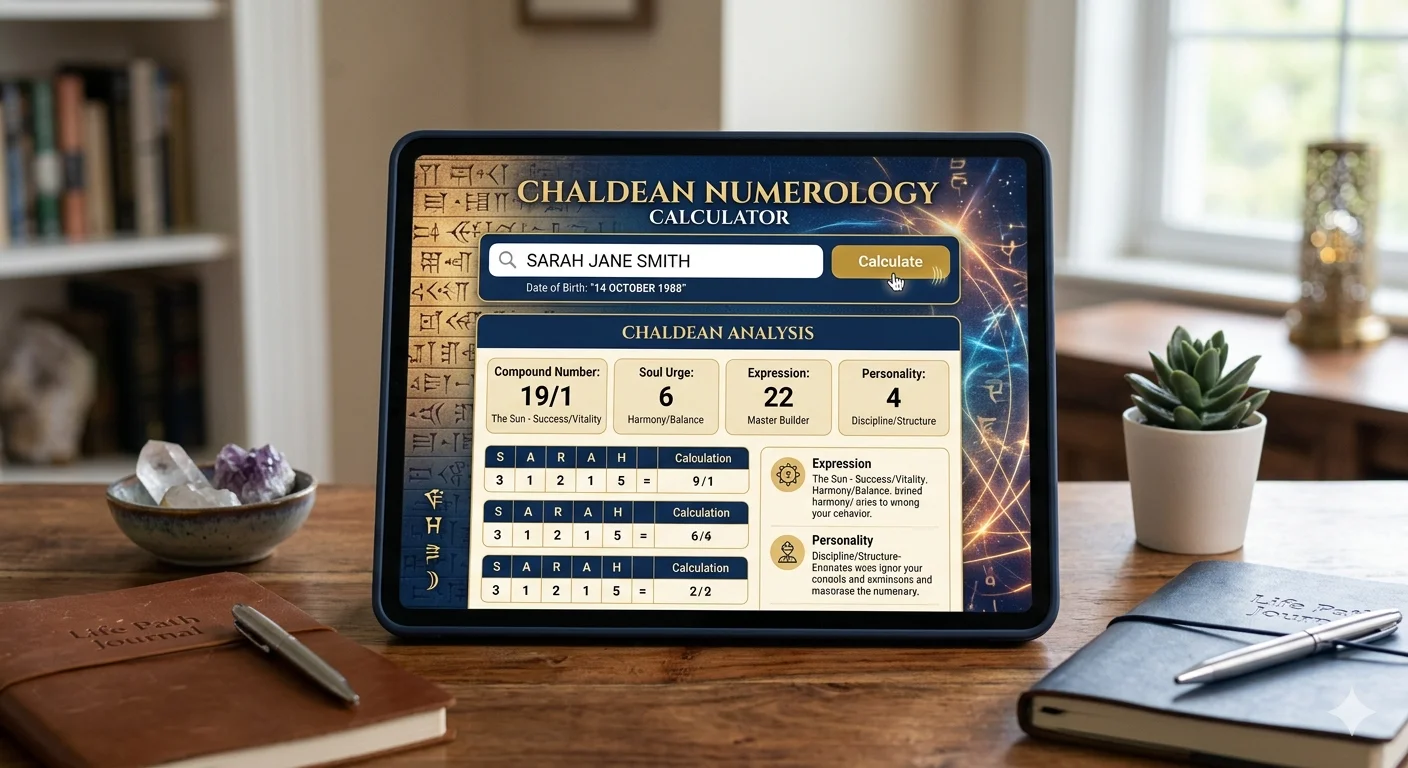
Take the name "James Edward Smith." For the Soul Number, the vowels are A (1), E (5), E (5), A (1), I (1), giving a total of 13, reduced to 4. For the Outer Personality, the consonants are J (1), M (4), S (3), D (4), W (6), R (2), D (4), S (3), M (4), T (4), H (5), summing to 40, reduced to 4. The fact that Soul and Outer Personality share the same root number is itself a meaningful reading: this person's inner world and outward presentation are deeply aligned. It is worth noting that the calculator above uses your full birth name, not a nickname or married name, because the Chaldean tradition treats the name given at birth as the original vibrational blueprint.
Master Numbers and Compound Numbers in the Chaldean Tradition
Chaldean numerology recognises 11 and 22 as master numbers, preserving them from reduction because they carry an amplified double vibration. However, the Chaldean system also assigns interpretive weight to certain compound numbers that appear before final reduction. The compound number 14 speaks to movement, change, and the need to guard against scattered energy. The number 16 carries a reputation for unexpected reversals and the lesson of rebuilding. The number 19 is considered fortunate, a symbol of achievement that honours one's beginnings. These compound readings add a layer of nuance that purely single-digit systems cannot offer.
The Vibrational Meaning of Each Chaldean Number from One Through Nine
Number 1 in the Chaldean Tradition
Number 1 is the vibration of origination, leadership, and singular focus. Those with strong 1 energy in their chart are frequently the first to act, the first to innovate, and the ones others look to when direction is needed. The Chaldeans associated 1 with the Sun, and like that celestial body, a 1 individual draws attention and illuminates the path for those around them. The challenge of 1 lies in learning that strength does not require solitude, and that collaboration does not diminish individual vision.
Number 2 in the Chaldean Tradition
Number 2 governs duality, partnership, and the art of listening. Where 1 asserts, 2 receives; where 1 leads, 2 harmonises. The Chaldeans linked 2 to the Moon, reflecting its association with intuition, emotional receptivity, and cycles of feeling. People with a prominent 2 vibration tend to be gifted diplomats and perceptive counsellors. Their deepest growth often comes through learning that sensitivity is a form of power, not a vulnerability to be concealed from the world.
Number 3 in the Chaldean Tradition
Number 3 is the vibration of expression, creativity, and joyful communication. The Chaldeans connected 3 to Jupiter, the planet of expansion and abundance, and indeed those with strong 3 energy tend to have a natural gift for language, art, and bringing others together through shared delight. The shadow side of 3 is dispersion: when creative energy scatters across too many projects or social obligations, the depth that 3 is capable of can remain permanently unplumbed.
Number 4 in the Chaldean Tradition
Number 4 carries the vibration of structure, discipline, and enduring foundations. Associated in Chaldean tradition with the stable, unyielding qualities of earth and matter, a 4 influence in a chart indicates someone who builds carefully, works steadily, and values reliability above most other virtues. The lesson encoded in 4 is often patience: great structures are not raised in a season, and those under this vibration frequently find their most meaningful achievements arrive after long, methodical effort rather than sudden inspiration.
Check snow day chances by state: Snow Day Predictions by State
Number 5 in the Chaldean Tradition
Number 5 pulses with change, freedom, and sensory engagement with the world. The Chaldeans associated 5 with Mercury, the swift planet of travel and communication, and those who carry this vibration strongly are often drawn to variety, movement, and experiences that push the boundaries of the familiar. Five energy is inherently restless, and while this makes for fascinating, adaptable individuals, the growth path of a 5 frequently involves discovering that the deepest freedom is found within, not through perpetual external change.
Number 6 in the Chaldean Tradition
Number 6 is the vibration of love, responsibility, and the nurturing of others. Linked to Venus in the Chaldean planetary correspondence, 6 carries a warm, magnetic quality that draws others toward it seeking comfort and care. Those with a strong 6 presence often become the emotional anchors of their families and communities. The challenge of 6 is the tendency to give so freely that personal needs go unvoiced, and a 6 individual who learns to receive as generously as they give often undergoes a profound shift in their sense of self-worth.
Number 7 in the Chaldean Tradition
Number 7 is sacred in almost every mystical tradition, and in the Chaldean system it carries the vibration of deep investigation, spiritual inquiry, and the search for hidden truth. Associated with Neptune and the inner life, 7 individuals are frequently drawn to philosophy, esoteric study, and the kind of solitary reflection that allows wisdom to crystallise from experience. The challenge for 7 is avoiding the trap of isolation: the most refined 7 energy moves between periods of solitary depth and engaged, generous sharing of what has been found.
Number 8 in the Chaldean Tradition
Number 8 governs power, material mastery, and the balancing of the earthly and spiritual realms. The Chaldeans associated 8 with Saturn, the planet of karma, time, and consequence, and this number carries a weighty vibration that demands integrity in all dealings. Eight individuals often demonstrate remarkable executive capacity and are drawn to large-scale endeavours. The central lesson of 8 is that true power is built on fairness; those who use 8 energy without an ethical foundation typically experience the very reversals this number warns against when misused.
Number 9 and the Master Numbers 11 and 22
Nine is the vibration that stands apart. In the Chaldean system it is never assigned to letters because it is considered the number of the divine, representing completion, universal compassion, and the full circle of human experience. Nine appears only in Life Path calculations derived from birth dates. Those born under a 9 Life Path are often described as old souls: people with a deep, instinctive empathy and a calling to serve something larger than personal ambition. Master numbers 11 and 22 are recognised as elevated vibrations carrying double the spiritual intensity of 2 and 4 respectively. Eleven is the vibration of the inspired visionary; twenty-two is the master builder who can translate spiritual vision into lasting physical reality.
Read our snow storm school closing prediction: Snow Storm School Closing Prediction
Chaldean and Pythagorean Numerology: Understanding the Fork in the Road
| Feature | Chaldean | Pythagorean |
|---|---|---|
| Origin | Ancient Babylon, pre-600 BCE | Ancient Greece, approx. 6th century BCE |
| Letter assignment | Based on vibrational frequency | Sequential alphabetical order (A=1 through I/R=9) |
| Number 9 | Sacred, not assigned to any letter | Assigned to letters I and R |
| Compound numbers | Carry distinct meanings (14, 16, 19 etc.) | Generally reduced immediately to single digit |
| Common online usage | Less common, often mislabelled | Dominant default on most calculators |
The primary reason most online calculators default to the Pythagorean system is simply that it is easier to implement: assign letters 1 through 9 in alphabetical sequence and you are done. Many of these tools then mislabel their output as "Chaldean," creating genuine confusion for practitioners who discover the discrepancy when results do not match. The Chaldean table requires deliberate research to implement correctly, which is part of why properly built Chaldean calculators remain scarce. As for which system to use: both have long practitioner lineages, and the honest answer is that the tradition you resonate with is the tradition to follow. Those drawn to ancient Mesopotamian esotericism, or who find Pythagorean results less reflective of their inner experience, often find Chaldean readings carry a distinct and immediate recognition.
How Chaldean Numerology Works
- Chaldean Chart: A=1, B=2, C=3, D=4, E=5, F=8, G=3, H=5, I=1, J=1, K=2, L=3, M=4, N=5, O=7, P=8, Q=1, R=2, S=3, T=4, U=6, V=6, W=6, X=5, Y=1, Z=7
- Destiny Number: Sum all letter values in your full name, then reduce to a single digit (1-8) or master number (11, 22)
- Soul Urge Number: Calculated from the vowels (A, E, I, O, U) in your name
- Personality Number: Calculated from the consonants in your name
- Life Path Number: Derived from your date of birth by reducing to a single digit or master number
- Key Difference: Unlike Pythagorean numerology, Chaldean uses numbers 1-8 (no 9) and is based on sound vibrations
Frequently Asked Questions
The core difference lies in how letters receive their numerical values. Pythagorean numerology assigns numbers 1 through 9 in strict alphabetical order, while Chaldean assigns values based on the vibrational frequency the ancient Babylonians believed each letter carried. The result is that the same name produces different numbers under each system. Chaldean also treats 9 as sacred and leaves it unassigned to letters, a distinction with no equivalent in Pythagorean practice. Many experienced numerologists argue that the frequency-based approach makes Chaldean more nuanced and ultimately more precise for name readings.
Nine was considered by the ancient Chaldeans to be the number of the divine, representing spiritual completion and the highest attainment possible in the material world. Assigning it to letters, and therefore to the mundane particulars of a person's name, would have been considered a form of diminishment. Nine can still appear in a completed Life Path Number or as a total during calculation, but it arrives as a final expression rather than being fed in through individual letters. This treatment of 9 is one of the most philosophically interesting features of the Chaldean tradition and a key indicator of whether an online calculator has been built correctly.
The full birth name as recorded at birth is the standard for Chaldean numerology. The Chaldean tradition holds that this name represents the original vibrational blueprint you were given at entry into this life, and no subsequent renaming fully erases that imprint. Many practitioners also calculate numbers for a person's current name or married name to understand the additional vibration now layered over the original, but the birth name reading is considered the foundational one. If you were adopted and given a new name at birth, practitioners differ on whether the biological name or the given-at-adoption name takes precedence, though most prefer the earliest recorded name.
The Soul Number, derived exclusively from the vowels in your full birth name, is considered the most private of the three core Chaldean numbers. It describes your innermost motivations, the things you desire most deeply, and the emotional and spiritual needs that drive you even when you cannot fully articulate them to others. It is sometimes described as what you want your life to feel like from the inside, as opposed to how you want the world to see you (Outer Personality) or what you are destined to learn and accomplish (Life Path). Understanding your Soul Number can illuminate why certain experiences feel profoundly satisfying while others, despite appearing successful, leave you feeling strangely hollow.
Yes, Chaldean numerology recognises 11 and 22 as master numbers and preserves them from reduction. Eleven carries the vibration of inspired vision and spiritual sensitivity elevated beyond the ordinary 2; those under its influence are often drawn to roles that bridge the intuitive and the practical. Twenty-two is the master builder vibration, capable of converting visionary concepts into lasting real-world structures. The Chaldean system also gives interpretive weight to certain other compound numbers such as 14, 16, and 19, recognising that the two-digit total before reduction carries its own distinct resonance alongside the final single-digit root.
Chaldean numerology operates within the broader tradition of esoteric interpretation, and like astrology, tarot, or any other symbolic system, its value is best understood as a tool for reflection and self-inquiry rather than a deterministic forecast. Many practitioners, including professional numerologists who have studied both Western and Eastern systems, report that Chaldean readings tend to produce results that feel more immediately resonant and personal than Pythagorean ones, particularly for name-based numbers. Its reliability depends largely on the quality of the calculation and the depth of interpretation applied. A correctly implemented Chaldean reading at minimum offers a rich symbolic framework for understanding your own tendencies, strengths, and recurring patterns.
Many practitioners consider Chaldean numerology highly applicable to both business names and names given to newborns. For a business, the name's Soul Number, Outer Personality Number, and compound value are read as the energetic qualities the enterprise will project and attract. A business name with strong 8 or 1 energy, for instance, is seen as well-suited to leadership and material growth, while a 6 or 2 vibration might serve a healing or relational practice better. For a baby name, parents sometimes use Chaldean calculation to select a name whose vibration complements rather than clashes with the child's Life Path Number, treating it as one thoughtful input among many in the naming process.