Pokemon Infinite Fusion Calculator
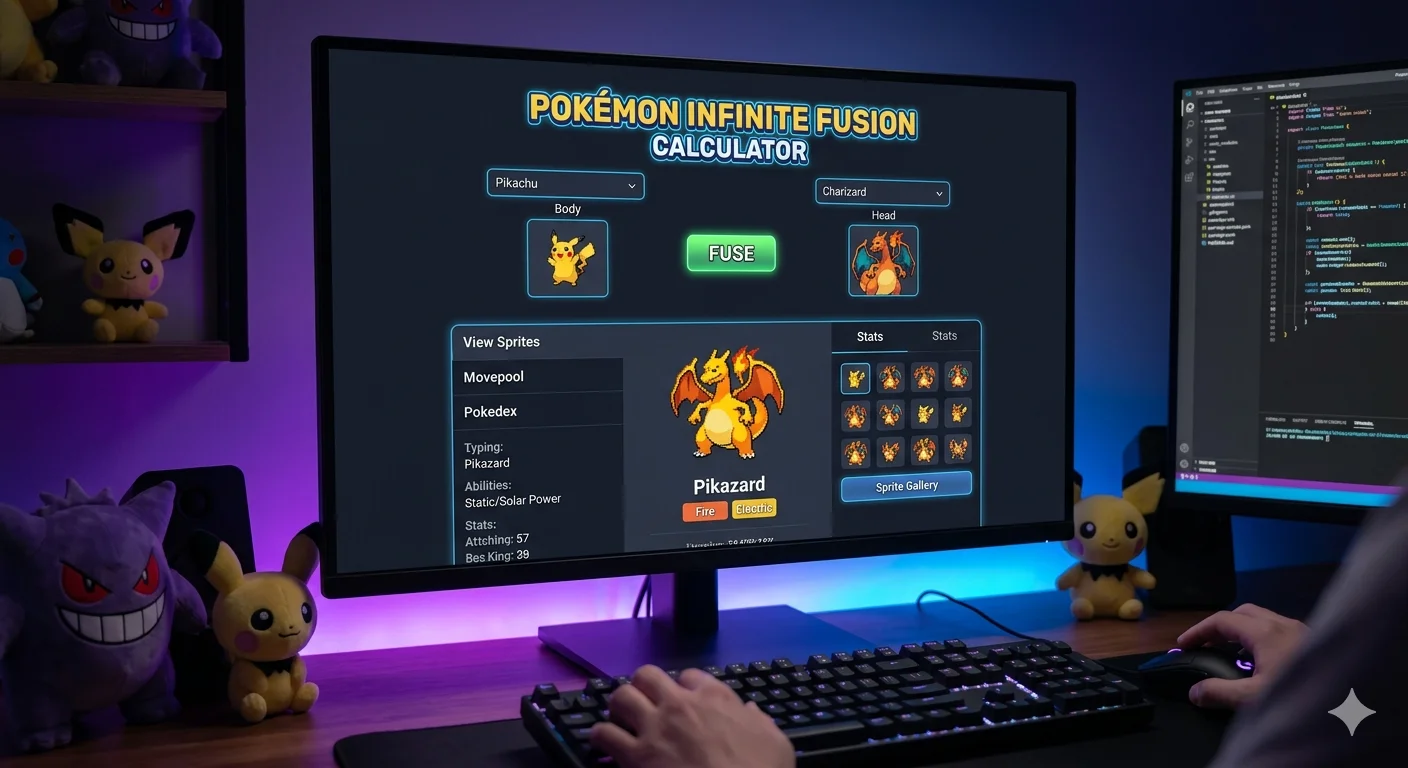
Calculate fused Pokemon stats by selecting a head and body Pokemon. The fusion formula uses weighted averages: head provides SpAtk, SpDef, and Speed while body provides HP, Attack, and Defense.
Popular Fusion Types
Most common fusion type combinations
Fused Stat Distribution
Average stat totals from fusions
Calculation Statistics
See how many fusion calculations have been made over time
Pokemon Fusion Guides & Articles
Pokemon Infinite Fusion Calculator: Build the Perfect Fusion Before You Start
The Exact Stat Formula That Determines Every Fusion in the Game
Understanding how Pokemon Infinite Fusion calculates stats is the single biggest competitive advantage you can have before picking up the game. The formula is consistent, predictable, and once you know it, you can reverse-engineer every fusion decision you make.
Here is what the game actually does when you fuse two Pokemon together. The head Pokemon (the first one you select, sometimes called the A slot) always contributes three stats to the final fusion: HP, Attack, and Speed. The body Pokemon (the second selection, the B slot) contributes the other three: Defense, Special Attack, and Special Defense. Each contributed stat is then averaged with the corresponding stat from the other parent, so the final result sits between the two base values rather than simply copying from one parent.
Typing follows the same head-and-body logic. The head Pokemon determines the primary type of the fusion, and the body Pokemon determines the secondary type. A Water-type head fused with a Fire-type body gives you a Water/Fire Pokemon. Flip the fusion order, and you get Fire/Water instead. This matters for STAB calculations, ability interactions, and how the fusion handles common coverage moves from opponents.
The Pokedex ID for any fusion is calculated using a fixed formula based on the two parent IDs. Swapping the order produces a completely different Pokedex number and, critically, a completely different Pokemon in terms of what moves it learns and what its sprite looks like.
Why Fusion Order is the Most Important Decision You Will Make When Building a Competitive Infinite Fusion Team
Most new players treat fusion like it does not matter which way around they slot their Pokemon. Experienced Infinite Fusion players know this is a mistake that can cripple an otherwise solid team. When you put a high-Speed Pokemon in the head slot, that Speed stat anchors the fusion's offensive profile. When you swap it into the body slot, all that Speed is wasted on a stat category the head Pokemon controls instead. Getting this wrong means a fusion that looks good on paper performs completely flat in battle. The calculator above exists specifically so you can see both orders side by side before you make an irreversible in-game choice.
How to Approach Fusion Building for Every Role on Your Team
Once you understand the formula, you can start building fusions with real purpose. The community has settled on a few well-tested archetypes, and knowing which one you are building toward before you open the fusion screen saves a huge amount of wasted runs.
Building a Sweeper Fusion That Can Actually Clean Up
For a physical sweeper, you want the highest possible Attack and Speed values in the head slot. Your head Pokemon should have elite numbers in those two categories, full stop. What goes in the body slot matters less for the offensive side, but you can still use it intelligently by selecting something with workable Defense and Special Defense so the fusion does not fold on the first hit it takes. The body's Special Attack stat will also be averaged in, so choosing a body with reasonable SpAtk does not hurt a physical sweeper the way you might expect. Run both fusion orders in the calculator and look at the Attack and Speed columns first when comparing results.
Building a Defensive Wall That Holds Through End-Game Fights
Wall fusions flip the priority entirely. Here, the body Pokemon carries the build. You want the highest possible Defense and Special Defense in the body slot, which means selecting the bulkiest wall-type Pokemon you have access to as your second input. The head Pokemon still matters because it sets HP and contributes half of the averaged Attack stat, but for a pure wall, you are looking for a head with high HP above all else. Some of the best defensive fusions in the community use high-HP Normal types or Rock types in the head slot paired with Fairy or Steel body Pokemon for the defensive coverage.
Getting the Most Out of a Mixed Attacker Build
Mixed attackers are the most interesting build type in Infinite Fusion because you are balancing four stat categories simultaneously. You want a head Pokemon with good Attack and Speed, and a body Pokemon with good Special Attack. Defense and Special Defense become secondary, but you still want them to be serviceable. The typing combination matters more here than in any other archetype because a mixed attacker genuinely wants STAB on both its physical and special moves. Use the calculator to find the fusion order that maximises your offensive stats while checking whether the resulting typing gives you natural STAB on your planned move coverage.
Calculate your Pokemon type matchup now: Pokemon Type Calculator
Matching Typing With the Right Ability Parent Is Where the Real Meta Lives
The most overlooked part of fusion planning is the ability. The fusion inherits the ability of one of the two parents depending on the order, and certain ability-type combinations are wildly overpowered. Speed Boost fused onto a Pokemon with strong offenses in the head slot is one famous example. Technician paired with a multi-hit movepool from the body is another. When you are planning a fusion, do not just check the stats. Look at what ability each fusion order produces, because sometimes the weaker-stat order is the correct choice because of an ability that completely changes how the Pokemon functions in battle.
The Best Early-Game Fusions for Players Just Starting Infinite Fusion
New Infinite Fusion players often make the mistake of fusing their starter with whatever looks the coolest visually. The sprite is fun, but the wrong fusion order on your very first combination can leave you with a Pokemon that underperforms through the first three gyms and forces a restart. Knowing what to prioritise early completely changes how the first several hours of the game feel.
For the early game, you want your starter in the head slot if it has the better Attack and Speed stats compared to its fusion partner. Starters in Infinite Fusion tend to have well-rounded base stats, which makes them flexible, but well-rounded still means something. If your starter has noticeably higher Speed than its partner, lead with it as the head Pokemon every time. Fast early-game fusions make the first few gyms significantly easier to manage, particularly because the early gym leaders in Infinite Fusion hit harder than their original game counterparts in some versions.
Planning your fusion choices around the gym leader order is something the community strongly recommends. If the second gym leader uses Water types, having a Grass or Electric typing on your fusion is worth more than a stat advantage in some cases. This means choosing your fusion partner partly on what type it contributes in the body slot, so the final fusion's secondary type gives you coverage you will actually need in the next few hours of the game.
Check snow day chances by state: Snow Day Predictions by State
A significant number of experienced players do restart specifically to optimise their starter fusion. If you reach your first available fusion partner and realise your starter's best stats are Defense and Special Defense rather than Attack and Speed, leading with the partner as the head Pokemon instead of the starter is the correct call, even if it means the starter becomes the body. The calculator above lets you model this decision instantly instead of guessing in-game.
How to Get the Most Accurate Result From This Fusion Calculator
Select your first Pokemon in the Head slot dropdown and your second in the Body slot dropdown, then hit the calculate button. The tool immediately outputs the fused stats for both orders, A/B and B/A, side by side. Read across the stat rows and compare Attack and Speed first if you are building an offensive Pokemon, or Defense and Special Defense first if you are building for bulk. The Pokedex ID shown for each fusion order is the actual in-game ID number that determines which sprite and move pool the fusion uses. Before locking in any fusion decision in your actual save file, always run the reverse order through the calculator. It takes five seconds and regularly reveals that the less obvious order produces a significantly stronger result. Many hours of restarts happen because players skip this check.
Read our snow day predictor percentage guide: Snow Day Predictor Percentage
Pokemon Infinite Fusion Formula
- HP: (2 × Body HP + Head HP) / 3
- Attack: (2 × Body Atk + Head Atk) / 3
- Defense: (2 × Body Def + Head Def) / 3
- Sp. Attack: (2 × Head SpAtk + Body SpAtk) / 3
- Sp. Defense: (2 × Head SpDef + Body SpDef) / 3
- Speed: (2 × Head Speed + Body Speed) / 3
- Types: Head Primary Type + Body Primary Type
Frequently Asked Questions
Pokemon Infinite Fusion currently includes 420 Pokemon, and since every Pokemon can be fused with every other Pokemon in two different orders, the total number of unique fusions is 420 times 420, which comes to 176,400 possible combinations. That number does not include self-fusions, which the game also supports. The sheer scale of that number is exactly why planning tools exist. Nobody is going to eyeball 176,400 possible stat combinations and pick the right one without doing the math first.
The order changes everything, and this is not a cosmetic difference. Swapping which Pokemon goes in the head slot and which goes in the body slot produces a completely different fusion with different stat distributions, different typing, a different Pokedex ID, a different sprite, and potentially a different ability. The head Pokemon always controls HP, Attack, and Speed, while the body Pokemon controls Defense, Special Attack, and Special Defense. Reversing the order reassigns all of those contributions, which is why both orders can feel like completely different Pokemon in practice.
For a physical sweeper, you want the highest possible base Attack and Speed in the head slot. Pokemon with exceptional Speed tiers work particularly well because Speed is one of the three head-slot stats, meaning it carries full weight in the average. Pseudo-legendary Pokemon and certain fast offensive types in the 420-Pokemon roster tend to produce the strongest sweeper fusions when placed in the head slot. Running this calculator with any candidate will show you the resulting Attack and Speed values immediately so you can compare candidates without guesswork.
This calculator is built on the base stat data for the 420 Pokemon included in Pokemon Infinite Fusion and uses the same averaging formula the game applies to every fusion calculation. The core fusion formula has remained consistent across the game's updates, so the stat outputs you see here match what you will find in-game. When major version updates change base stat values or add new Pokemon to the roster, the calculator data is updated to reflect the current state of the game. Always check the version notes if you are playing a bleeding-edge community build, as fan patches can occasionally modify base stats.
The head Pokemon always determines the primary type of the fusion, and the body Pokemon always determines the secondary type. If you fuse a Fire-type head with a Psychic-type body, you get a Fire/Psychic fusion. Swap the order and you get Psychic/Fire, which is functionally the same type combination but with a different primary type designation. For STAB purposes, both types count equally, so yes, a mixed attacker can absolutely get STAB on moves matching either of its types. This is one of the core reasons mixed attacker fusions can be so powerful when the typing and move pool align correctly.
The statistically strongest fusions come from pairing legendary or pseudo-legendary Pokemon with each other, ideally placing the one with higher Attack and Speed in the head slot and the one with higher bulk in the body slot. The Infinite Fusion community has extensively tested many hundreds of combinations, and the current top tier fusions share a common trait: both parents have high total base stats, so even though the averages bring each individual stat down slightly, the final BST still towers over most non-legendary alternatives. Running legendary pairs through this calculator is one of the most useful end-game planning activities before attempting the post-game content.