Gravel Calculator
Calculate how much gravel you need for your project. Enter area dimensions, depth, and gravel type to get estimates for cubic yards, tons, bags, and cost.
Popular Gravel Types
Most calculated gravel types
Common Depth Ranges
Most popular gravel depth choices
Calculation Statistics
See how many gravel calculations have been made over time
Gravel Guides & Articles
Gravel Calculator: How Much Gravel Do I Need?
Whether you are finishing a driveway, laying a garden path, or building a patio base, getting your gravel order wrong costs you time and money. Enter your project dimensions above and this calculator gives you the exact cubic yards and tons you need, in seconds.
The Math Behind Your Gravel Order: Volume, Weight, and Why Both Numbers Matter
Gravel is sold by weight (tons) but measured by volume (cubic yards). Understanding both is what separates a confident order from an expensive guess. Here is how the calculation works, step by step.
Start with your three dimensions: length, width, and depth. Depth is the number that catches most people out because suppliers quote coverage in cubic yards, but homeowners measure depth in inches. You need to convert first.
Concrete example: a 20-foot driveway, 10 feet wide, 4 inches deep.
Step 1: Convert depth to feet. Divide inches by 12: 4 / 12 = 0.33 feet.
Step 2: Multiply all three dimensions to get cubic feet: 20 x 10 x 0.33 = 66 cubic feet.
Step 3: Convert cubic feet to cubic yards by dividing by 27: 66 / 27 = 2.44 cubic yards.
Step 4: Convert to tons by multiplying by the gravel's density. Using standard crushed stone at 1.5 tons per cubic yard: 2.44 x 1.5 = 3.66 tons.
The master formula is:
Volume (cu yds) = (Length x Width x Depth in feet) / 27 Weight (tons) = Cubic yards x Gravel density
This calculator runs those formulas instantly for any project size. Change the depth, length, or gravel type and the result updates immediately.
Order More Than You Think You Need: Why 10 Percent Extra Pays for Itself
Add 10 percent to every gravel calculator order before you call the supplier. This is not caution for its own sake. Gravel compacts under its own weight and under vehicle traffic, reducing the finished depth by 10 to 15 percent compared to its loose volume. Material is also lost at the edges during spreading, and uneven ground requires more fill in low spots than a flat calculation accounts for. A project that calculates to exactly 3.66 tons often needs 4 tons to finish properly. If you run short, a second delivery costs the same flat delivery fee as the first, which is almost always more expensive than the overage you were trying to avoid.
Gravel Depth by Project: How Deep Each Application Actually Needs to Be
Depth is the single biggest variable in any gravel calculation. Use too little and the surface fails. Use too much and you waste money. These are the correct depths for each common project type, based on contractor practice and engineering guidelines.
Gravel Driveways
A driveway needs a minimum of 4 inches and ideally 6 inches of total gravel depth, built in two separate layers. The base layer, 2 to 4 inches of compacted road base or crusher run, handles load distribution. The surface layer, 2 to 4 inches of crushed stone, provides the driving surface.
For a standard two-car driveway measuring 20 feet wide by 50 feet long at 6 inches total depth: convert 6 inches to 0.5 feet, multiply 20 x 50 x 0.5 = 500 cubic feet, divide by 27 = 18.5 cubic yards. Add 10 percent for a final order of approximately 20.5 cubic yards.
Garden Paths and Walkways
Foot traffic paths require 2 to 3 inches of gravel. This depth is comfortable to walk on, provides adequate drainage, and stays in place with edge restraints. For a 50-foot path that is 4 feet wide at 2.5 inches depth: convert 2.5 inches to 0.21 feet, then 50 x 4 x 0.21 = 42 cubic feet, or 1.55 cubic yards. Round up to 1.75 cubic yards including overage.
Patio Base
A solid patio base requires 4 to 6 inches of compacted gravel before any pavers, concrete, or surface material goes down. Compaction is what matters here, not just depth. Loose gravel will shift under the patio surface over time, causing settling and cracking. Compact the gravel base in two lifts with a plate compactor before laying any surface material.
French Drains
French drains need 6 to 12 inches of gravel surrounding the perforated drain pipe. The gravel is the drainage system, not decoration. Use stone sized at 0.75 to 1.5 inches (river rock or clean crushed stone) rather than fine material, which blocks up with sediment over time. The larger void space between bigger stones carries water faster and resists clogging.
Calculate your human age now: Human Calculator
Decorative Garden Beds
Decorative beds only need 1.5 to 2 inches of gravel. This covers the soil for weed suppression and visual effect without the expense of structural depth. For irregular bed shapes, break the area into rectangles and triangles, calculate each separately, then add them together. A curved bed that is roughly 8 feet by 12 feet can be treated as an 8 x 12 rectangle (96 square feet) for a conservative estimate. Multiply by 0.167 feet (2 inches) to get 16 cubic feet, or 0.6 cubic yards.
Playground Safety Surface
Playground gravel must be a minimum of 9 inches deep under equipment with a fall height above 4 feet, per ASTM F1292 impact attenuation standards. This is a safety requirement, not a preference. At fall heights above 7 feet, 12 inches is the required minimum. Pea gravel and engineered wood chips are both approved loose-fill materials under this standard. Do not use crushed stone with angular edges in playground applications because it poses abrasion and injury risk on contact.
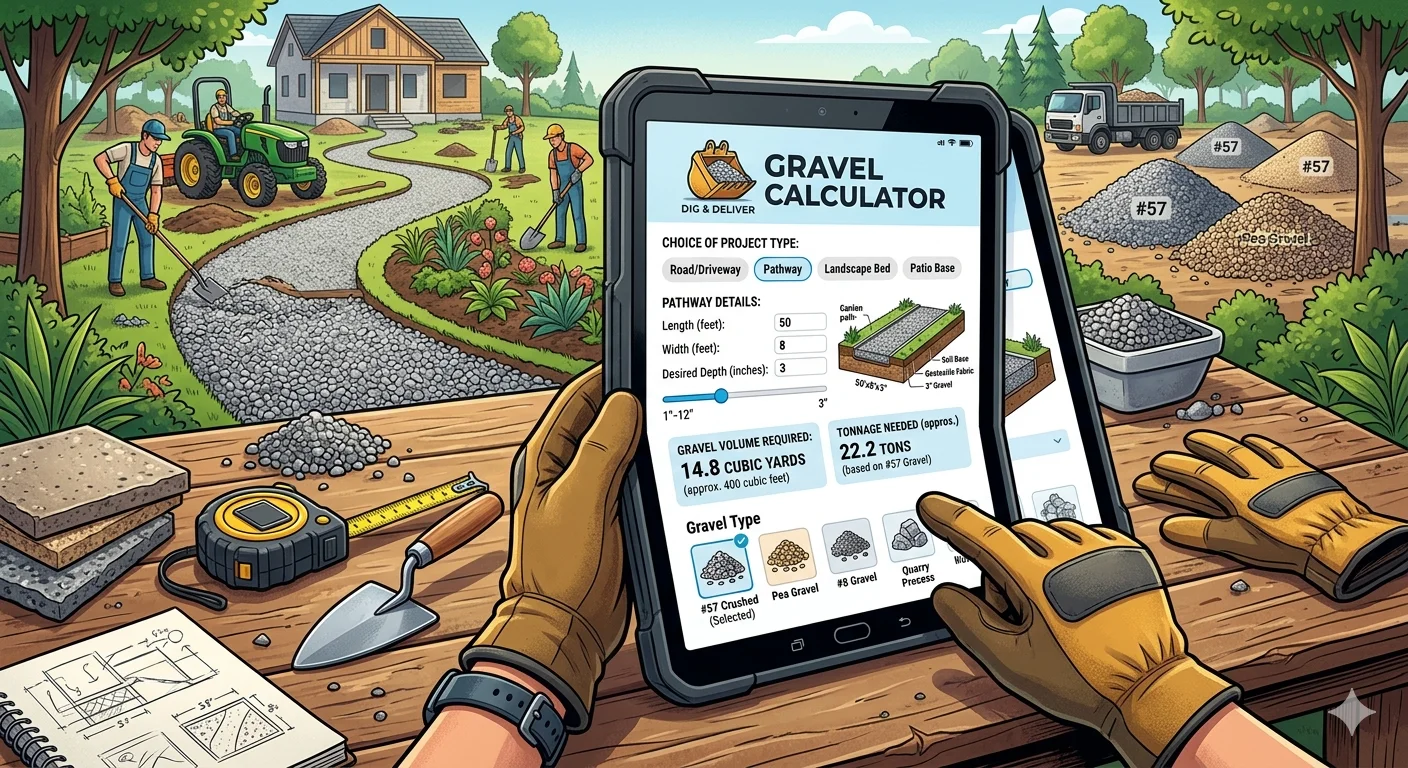
Choosing the Right Gravel for Your Project: A Material-by-Material Guide
Not all gravel performs the same way. Using the wrong material for a project leads to failure, extra cost, or both. Here is what each type is actually suited for, along with the density figure used in weight calculations.
Pea Gravel
Pea gravel is small (typically 0.25 to 0.5 inches), round, and smooth, tumbled by water into its characteristic rounded shape. It looks attractive, drains well, and works nicely around pool surrounds, in play areas, and along garden borders. Its weakness is also its shape: round stones roll freely and do not interlock, which means pea gravel shifts underfoot, migrates at the edges, and offers no structural stability. Density is approximately 1.4 tons per cubic yard.
Crushed Stone Number 57
Number 57 crushed stone is the workhorse of construction gravel. It consists of angular 0.75-inch fragments produced by mechanically crushing quarried rock. Those angular edges are what make it effective: the irregular shapes interlock under compaction and vehicle load, creating a stable surface that resists rutting and displacement. This is the correct choice for driveways, parking areas, and as the base course under concrete slabs. Density is approximately 1.5 tons per cubic yard.
River Rock
River rock is naturally smooth, ranging from 1 to 3 inches, and comes in a variety of earthy colors. It does not compact as effectively as crushed stone, so it is not a good driveway material. It excels in drainage applications (French drains, dry creek beds, swales) because the smooth, rounded stones allow water to move freely through the gaps. It is also a popular decorative element around water features and garden borders. Density is approximately 1.5 tons per cubic yard.
Decomposed Granite
Decomposed granite (DG) is a fine, crushed granite material that behaves almost like a soil. It compacts very firmly when wetted and rolled, making it an excellent choice for pathways, patios, and Xeriscaping projects where a natural, permeable surface is wanted. DG can be stabilized with a polymer binder for added durability. Its fine particles can wash out in heavy rain without proper edging and slight cross-slope for drainage. Density is approximately 1.4 tons per cubic yard.
Road Base and Crusher Run
Road base (also sold as crusher run or dense-grade aggregate) is a blend of crushed stone and stone dust ranging from 0 to 1.5 inches. The mix of coarse and fine material fills voids completely when compacted, creating the hardest and most stable base of any gravel type. Use it under any hard surface: driveways, concrete slabs, paver patios, shed bases. It is not decorative. Density is approximately 1.6 tons per cubic yard, the heaviest common type.
Check snow day chances by state: Snow Day Predictions by State
Lava Rock
Lava rock is a porous volcanic material that is significantly lighter than other gravel types. Its low density (approximately 0.9 tons per cubic yard) makes it easy to handle in bags and it does not put excessive load on planting beds. It works well as decorative mulch, retains heat around heat-loving plants, and does not decompose like organic mulch. It provides no structural value and is strictly a decorative surface material.
Gravel Weight and Delivery Loads: What You Need to Know Before You Order
One cubic yard of typical gravel weighs between 1.4 and 1.7 tons, depending on the material. To convert your cubic yard calculation to tons, multiply by the specific density of the gravel type you are ordering. That figure is what your supplier will use to price your order and load their truck.
Weight matters for three practical reasons. First, delivery truck costs often scale with load weight, so knowing your tonnage helps you compare quotes accurately. Second, standard dump trucks carry 13 to 25 tons per load, and mini dump trucks carry 5 to 7 tons. If your project requires 14 tons, you will need one standard load or two mini loads; that affects both scheduling and cost. Third, if you are spreading gravel on a slope or near a foundation, the bearing capacity of the soil matters, and weight calculations inform that assessment.
Pickup truck users: a standard full-size pickup truck can carry approximately 1 cubic yard of gravel (around 1.5 tons), but you must check your vehicle's payload rating first. The payload rating is on the sticker inside the driver's door. Exceeding it damages the suspension and is unsafe.
Know Your Payload Limit Before You Back Up to the Gravel Pile
Gravel looks lighter than it is. A heaped pickup bed that looks like one yard can easily hold 1.5 tons, which exceeds the payload rating of most half-ton trucks. Check the sticker, not the truck name. If your payload limit is 1,500 pounds, that is 0.75 tons, meaning you can safely carry about half a cubic yard per trip. Take two trips rather than risk a blown tire, damaged suspension, or an unsafe ride home.
What Gravel Actually Costs and When Bulk Delivery Is the Smarter Option
Gravel prices vary by material type, region, and quantity. These are current general ranges in the United States for 2026:
Pea gravel runs to per cubic yard. Crushed stone (Number 57) runs to per cubic yard. River rock is the most expensive common type at to 0 per cubic yard, depending on size and color. Decomposed granite runs to per cubic yard. Road base is the most economical structural material at to per cubic yard. Delivery fees typically add to 0 on top of material costs, depending on distance from the supplier.
Bags vs. Bulk Delivery: When Each Option Makes Financial Sense
Bagged gravel sold at home improvement stores costs roughly to per 0.5 cubic foot bag. At that rate, one cubic yard (27 cubic feet, or 54 bags) costs 0 to 0 in bags, compared to to in bulk plus a delivery fee. The math is clear above a certain volume. Use bags when you need less than half a cubic yard, the project is a small patch or repair, or you lack a vehicle to transport bulk material. Choose bulk delivery when your project requires more than 1 cubic yard. The rule used by experienced landscapers is simple: if you need more than 10 bags, call a supplier instead. Always get two or three quotes from local suppliers before ordering, because prices vary significantly within the same metro area.
Gravel Driveways: A Complete Guide to a Surface Most Projects Get Wrong
A gravel driveway is one of the most cost-effective hard surfaces available, but it is also one of the most commonly installed incorrectly. Proper depth, proper material, and the right layering system make the difference between a driveway that lasts 10 years and one that turns into a rutted mud track after the first winter.
Why Angular Gravel Beats Round Gravel for Driveways
The shape of gravel determines how it behaves under load. Angular, mechanically crushed stone has irregular faces that interlock when compressed by vehicle weight. Round gravel, including pea gravel and river rock, has smooth surfaces that roll and displace instead of locking together. A round-stone driveway pushes outward under tires, creating ruts in the center and spreading at the edges. Never use pea gravel or river rock as a driveway surface. Use crushed stone Number 57 or similar angular material only.
The Two-Layer Driveway System That Professionals Use
An effectively built gravel driveway uses two distinct material layers, not one deep layer of the same material. Layer one is the base course: 2 to 4 inches of compacted road base or crusher run spread and mechanically compacted with a plate compactor. This base locks into the native soil and creates a firm, stable foundation. Layer two is the surface course: 2 to 4 inches of Number 57 crushed stone or similar angular surface gravel. The surface layer handles vehicle contact and sheds water. Installing one thick layer of surface gravel without a compacted base results in a soft, unstable surface that ruts easily.
Driveway Maintenance and Knowing When to Replenish
Gravel driveways need to be replenished every 2 to 5 years, depending on traffic volume and weather conditions. Watch for visible ruts deeper than 2 inches, patches where the original soil shows through, and muddy areas after rain that suggest the gravel layer has thinned. For maintenance top-ups, calculate only the depth you are adding (typically 1 to 2 inches) rather than the full structural depth. Edge restraints, including metal or plastic driveway edging staked into the ground, prevent the surface layer from migrating into grass and landscaping beds over time. They are worth installing at the initial build stage rather than trying to retrofit later.
Read our best snow day predictor online guide: Best Snow Day Predictor Online
How the Gravel Calculator Works
- Volume: Length (ft) × Width (ft) × Depth (in) ÷ 12 = Cubic Feet
- Cubic Yards: Cubic Feet ÷ 27
- Weight (Tons): Cubic Yards × Density Factor (varies by gravel type)
- Bags (50 lb): Total Weight (lbs) ÷ 50
- Cost: Tons × Price per Ton
- Tip: Order 10% extra for compaction and waste
Frequently Asked Questions
A standard two-car driveway measuring 20 feet wide by 50 feet long, built to the recommended 4 to 6 inches of total depth, requires between 12 and 19 cubic yards of gravel. At 4 inches (0.33 feet): 20 x 50 x 0.33 / 27 = 12.2 cubic yards. At 6 inches (0.5 feet): 20 x 50 x 0.5 / 27 = 18.5 cubic yards. Add 10 percent overage, and a practical order falls between 14 and 21 cubic yards. A one-car driveway at 10 feet wide halves those figures.
A cubic yard of gravel weighs between 1.4 and 1.7 tons (2,800 to 3,400 pounds) depending on the material. Pea gravel and decomposed granite sit at the lighter end, around 1.4 tons per cubic yard. Road base and crusher run sit at the heavier end, around 1.6 to 1.7 tons per cubic yard. Standard crushed stone and river rock are typically 1.5 tons per cubic yard. These density figures are what your calculator and your supplier use to convert volume to weight.
Crushed stone Number 57 is the best single-material choice for a driveway surface. Its angular edges interlock under traffic, it sheds water well, and it is widely available. For the best overall driveway system, use crusher run or road base as a compacted base layer (2 to 4 inches) beneath a surface layer of Number 57 (2 to 4 inches). This two-layer system outperforms any single-material installation.
The minimum depth for a functional gravel driveway is 4 inches. Six inches is the preferred depth for regular passenger vehicle traffic. Eight to 12 inches is appropriate for heavy truck access or soft native soil conditions that require additional base depth for stability. Always build in two layers: a compacted base followed by a compacted surface layer. Gravel compacts under traffic and loses approximately 10 to 15 percent of its loose depth after settling, so factor this into your depth target from the start.
One cubic yard of gravel contains between 1.4 and 1.7 tons depending on the material type. To calculate tons precisely, multiply your cubic yard figure by the density of the gravel you are ordering. For crushed stone at 1.5 tons per cubic yard: 5 cubic yards x 1.5 = 7.5 tons. For road base at 1.6 tons per cubic yard: 5 cubic yards x 1.6 = 8 tons. Your supplier may quote by the ton or by the cubic yard. Confirm which unit their pricing uses before comparing quotes.
In 2026, gravel costs roughly to per ton for most standard types in the United States, with significant regional variation. Road base and crusher run are the most affordable at to per ton. Crushed stone and pea gravel fall in the to per ton range. River rock is the most expensive common type at to per ton depending on size and color. Delivery adds to 0 per load regardless of quantity, which is why combining material quantities for a single delivery saves money on larger projects.
For decorative purposes only (garden beds, path borders), gravel can be laid directly on landscaping fabric over native soil. For any structural application (driveways, parking areas, patio bases), a prepared sub-base is essential. This means grading and compacting the native soil, adding a layer of road base or crusher run, and compacting that base before adding surface gravel. Skipping the sub-base preparation results in a surface that sinks, ruts, and drains poorly. Landscaping fabric under the base layer also helps prevent native soil from migrating up into the gravel over time, which extends the life of the surface.
Gravel migrates outward under lateral pressure from vehicle tires and gravity on slopes. The most effective solution is mechanical edge restraints installed before the gravel goes down. Metal or heavy-duty plastic driveway edging, staked firmly into the ground at 12-inch intervals, contains the surface layer and prevents spreading. For existing driveways without edging, the gravel that has already spread into the lawn can be raked back and edging installed against the existing boundary. On sloped driveways, speed bumps made from compacted crusher run or timber timbers set across the width prevent gravel from washing or rolling downhill with each rainfall.