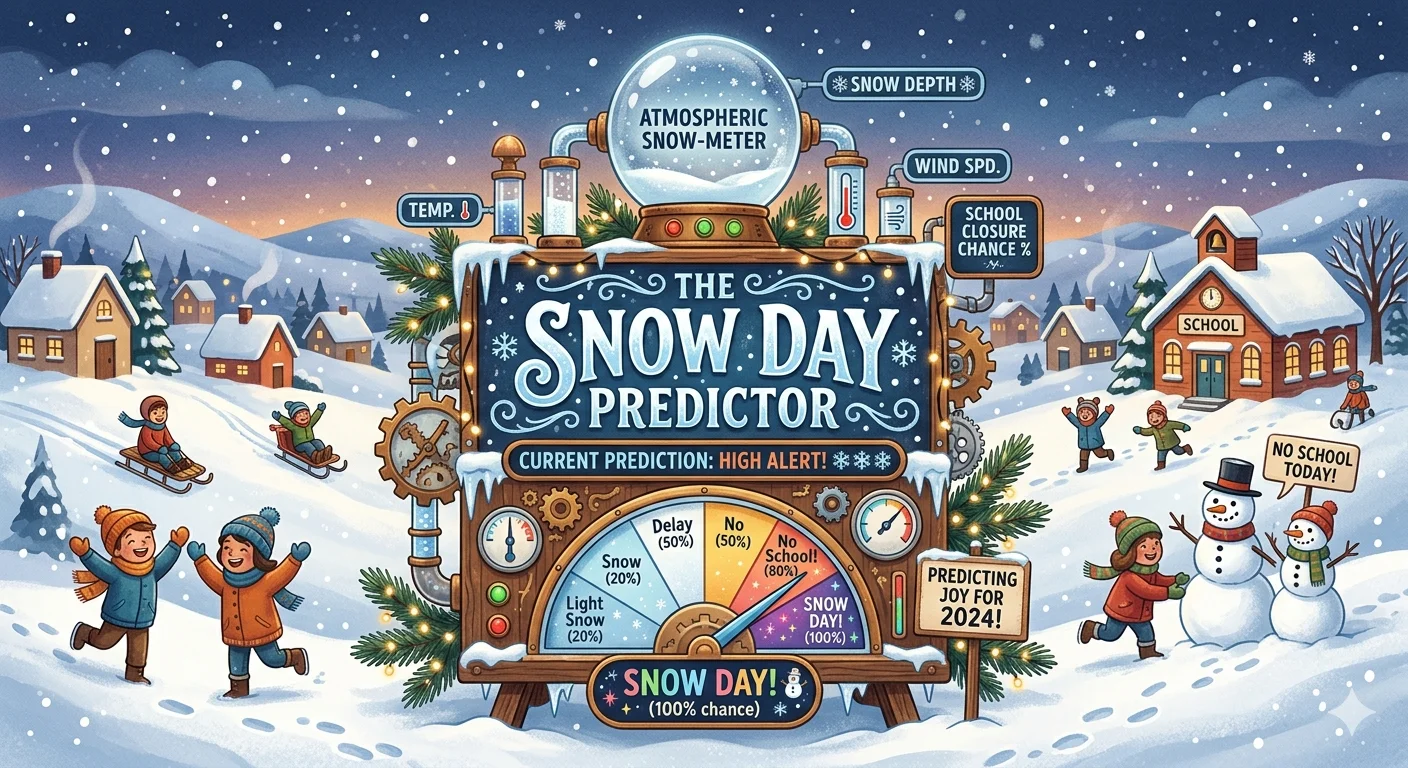
What Is Snow Day Predictor?
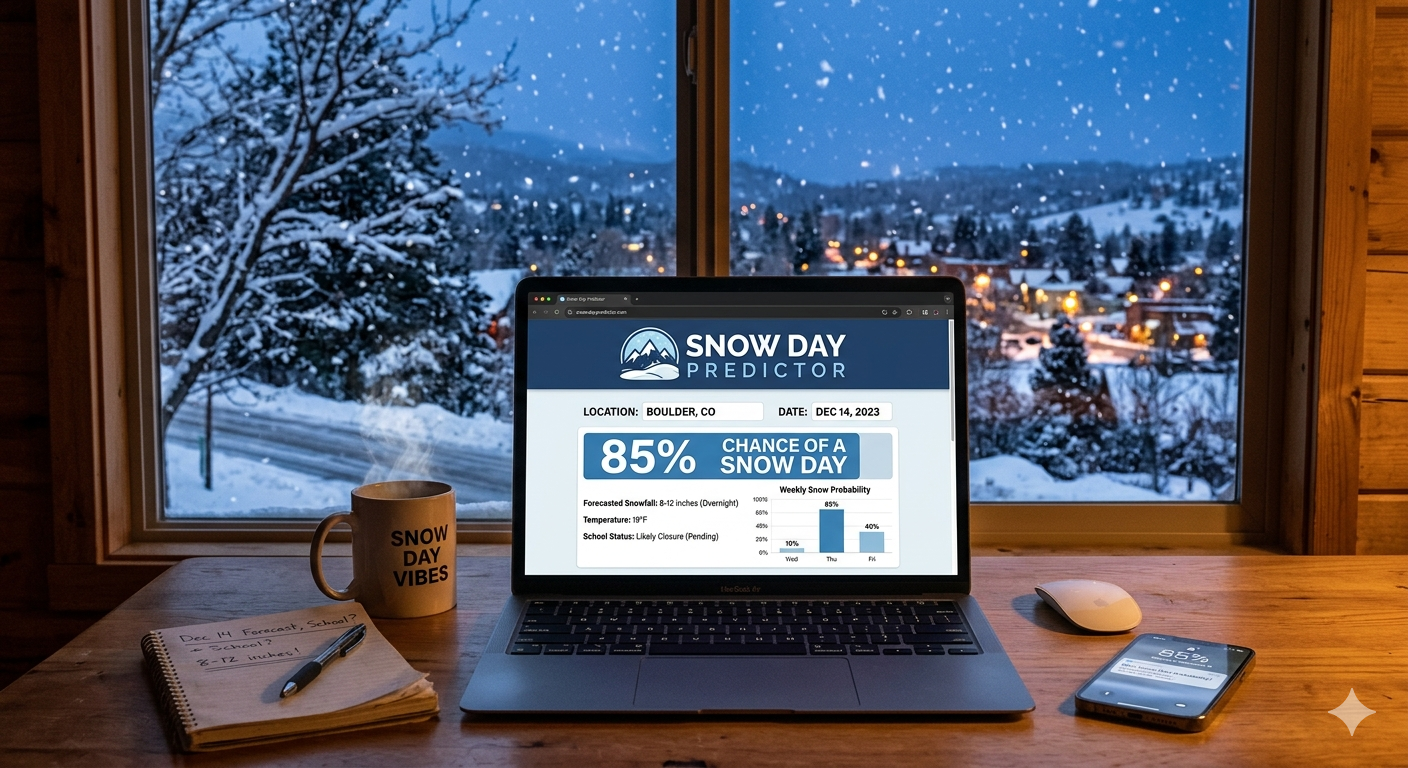
Snow Day Predictor (snowdaypredictor.xyz) is a free, web-based school-closure forecasting tool built for students, parents, and educators across the United States and Canada. Launched in 2025, the platform allows anyone to enter a city name or ZIP/postal code and instantly receive a 7-day rolling probability forecast estimating the likelihood that school will be cancelled due to winter weather.
The tool is positioned as a consumer-facing alternative to traditional closure-notification systems no app download required, no account needed, and no subscription fee. Users select their school level (Elementary, Middle School, High School, or College) to receive a calibrated probability score, since administrative closure thresholds differ meaningfully by institution type.
How Snow Day Predictor Works
Snow Day Predictor pulls real-time weather forecast data from live meteorological APIs and runs it through a weighted probabilistic algorithm. The system evaluates multiple atmospheric and logistical variables simultaneously to produce an estimated closure probability expressed as a percentage.
The Prediction Algorithm Factor Weights
The platform's publicly documented scoring model works as follows:
❄ Snow Day Probability Score: How Each Factor Contributes
The algorithm reflects a well-established pattern in school district behavior: precipitation volume is the single strongest predictor of closure, but extreme temperatures and high winds can push marginal situations over the threshold especially for younger students who wait outside for buses. The weekend exclusion rule ensures the tool never delivers false positives on days when schools are already closed.
Data Infrastructure
The service ingests real-time 7-day weather forecast data from professional meteorological APIs. Modern snow day prediction systems typically pull from sources such as the NOAA National Weather Service, the Open-Meteo API, or commercial providers offering gridded forecast data at hourly resolution. The use of live feeds rather than static climatological averages is what allows the tool to reflect fast-moving winter storm systems accurately.
Key Features of Snow Day Predictor
ZIP Code & City Lookup
Enter any U.S. ZIP code or Canadian postal code or just type a city name for instant hyperlocal results.
7-Day Forecast
Plan ahead for the full school week. See daily snow day probability scores for the next seven days at once.
School-Level Customization
Choose Elementary, Middle School, High School, or College for a probability score calibrated to how each level historically responds to weather.
°F / °C Toggle
Seamless switch between Fahrenheit and Celsius essential for Canadian users and families relocating between countries.
All 50 States + 13 Provinces
Full North American coverage with dedicated state and province pages, plus a top-cities leaderboard showing the most-checked locations.
Shareable Results
Share your snow day probability results directly with family, classmates, or on social media with a single tap.
Calculation Statistics
A public dashboard shows how many calculations have been performed over time, adding social proof and transparency to the platform.
Completely Free
No account, no subscription, no hidden fees. Open to anyone with a browser on desktop or mobile.

Geographic Coverage: USA & Canada
Snow Day Predictor provides forecasts for every U.S. state and every Canadian province and territory. Dedicated state-level pages (e.g., snowdaypredictor.xyz/states/new-york) aggregate regional predictions and surface the most commonly checked cities within each state.
United States All 50 States
Canada All 13 Provinces & Territories
How Accurate Is Snow Day Predictor?
Snow day prediction accuracy is highly dependent on the forecast time horizon and the precision of incoming weather model data. Based on industry benchmarks for this category of tool:
12–24 hours out: 70–85% accuracy (best window)
24–48 hours out: 55–70% accuracy
3–7 days out: 40–55% accuracy (storm-track uncertainty)
The optimal time to check is the evening before a potential storm (6–10 PM), when the latest model runs have ingested the day's observations and forecast uncertainty has narrowed. A second check at 5–6 AM on the morning of the storm captures any overnight model updates and reflects the window during which most superintendents make their final call.
Common Sources of Prediction Error
- Storm timing errors: A storm arriving two hours later than modeled can give road crews enough time to clear surfaces, converting a predicted snow day into a regular school day.
- Precipitation-type transitions: The boundary between snow, sleet, and rain is notoriously difficult to model, particularly across the Mid-Atlantic and interior New England.
- Superintendent variability: Each district has an implicit closure threshold set by leadership culture, board policy, remaining snow days, and institutional risk tolerance factors no weather model can fully capture.
- Spatial resolution limits: A school district spanning multiple elevations may experience dramatically different conditions within its own boundaries.
How to Use Snow Day Predictor Step-by-Step
- Navigate to snowdaypredictor.xyz on any device no download or account required.
- Enter your location — type a city name (e.g., "Buffalo, NY") or ZIP/postal code (e.g., "14201") in the search field.
- Select your school level — choose Elementary, Middle School, High School, or College from the optional dropdown. This calibrates the probability to your institution's typical closure threshold.
- Choose your temperature unit — toggle between °F and °C as needed.
- Click "Check Snow Day Chances ❄️" — the tool fetches live forecast data and returns your 7-day probability forecast within seconds.
- Read your results — each day in the forecast displays a probability score. A score above 70% is generally worth planning around; scores above 85% are high-confidence.
- Share your results — use the built-in share function to send forecasts to family or friends.
Snow Day Predictor vs. Other Tools
Several platforms offer snow day predictions or school closure information. Here is how Snow Day Predictor compares against the landscape:
| Tool | 7-Day Forecast | School-Level Input | Canada Coverage | Free | Probability Score |
|---|---|---|---|---|---|
| Snow Day Predictor | ✔ | ✔ | ✔ 13 Provinces | ✔ | ✔ % score |
| Snow Day Calculator (original) | ✗ | ✔ | ✔ Partial | ✔ | ✔ % score |
| AccuWeather Winter Center | ✔ | ✗ | ✔ | Partial | ✗ Impact scale |
| The Weather Channel / weather.com | ✔ | ✗ | ✔ | Partial | ✗ |
| Local TV Station Snow Day Tools | ✗ | ✗ | ✗ Region-only | ✔ | Varies |
| District Notification Apps (ParentSquare, Remind) | ✗ | N/A | Varies | Varies | ✗ Confirmation only |
Snow Day Predictor's primary differentiator is the combination of a 7-day window, school-level calibration, a clear probability percentage, and full North American coverage — all at no cost. Competing tools tend to excel in one or two of these areas but rarely all four simultaneously.
The Meteorological Science Behind the Tool
Snow Day Predictor sits at the intersection of modern numerical weather prediction and administrative decision-making science. Understanding the underlying meteorology helps explain why the tool's factor weights are set the way they are.
Why 5 Inches of Snow Is the Key Threshold
A 5-inch snowfall threshold (+40% in the algorithm) reflects the operational reality of bus transportation. Most school districts operate yellow bus fleets on fixed routes. Accumulations below 3–4 inches are generally manageable with pre-treatment (salt, brine application) and light plowing. Once accumulations reach 5+ inches especially if falling rapidly overnight road treatment capacity is typically overwhelmed, making safe bus operations untenable by the 6–7 AM departure window.
Why Sub-20°F Temperature Triggers a Second Penalty
Extreme cold (below 20°F / −7°C) creates a distinct hazard: even without significant snowfall, wind chills at bus stops can pose frostbite risks for children waiting outdoors. Many districts, particularly in the Midwest and Northeast, have explicit cold-day closure policies tied to wind chill values. The +20% weighting reflects this documented institutional behavior.
The Role of Wind in Closure Decisions
High winds (>15 mph / 24 km/h) compound both snow and cold risk. Blowing and drifting snow reduces visibility to near-zero for drivers and can quickly re-cover freshly plowed roads. Wind also accelerates the wind chill effect, amplifying temperature risk for bus stop waiting times. The +10% weight for high winds is a conservative but empirically grounded modifier.
Who Uses Snow Day Predictor?
The platform is designed for several overlapping audiences:
- Students (K–12 and College) — The most enthusiastic users, who check forecasts the night before a predicted storm in the hope of a closure announcement.
- Parents and Guardians — Need advance notice to arrange childcare, remote-work scheduling, or alternative transportation.
- Teachers and School Staff — Use the forecast to decide whether to prepare lesson plans for virtual instruction or remote continuation activities.
- Working Adults and Commuters — While the tool is framed around school closures, the underlying weather probability data is useful for anyone trying to assess whether to work from home or commute on a potentially dangerous day.
- Weather Enthusiasts and Hobbyists — Track the tool's predictions against outcomes to benchmark its accuracy versus other forecast services.
Other Tools on Snow Day Predictor
Beyond the core snow day calculator, the platform hosts a suite of 23+ calculators spanning weather, health, and utility domains: