Topsoil Calculator
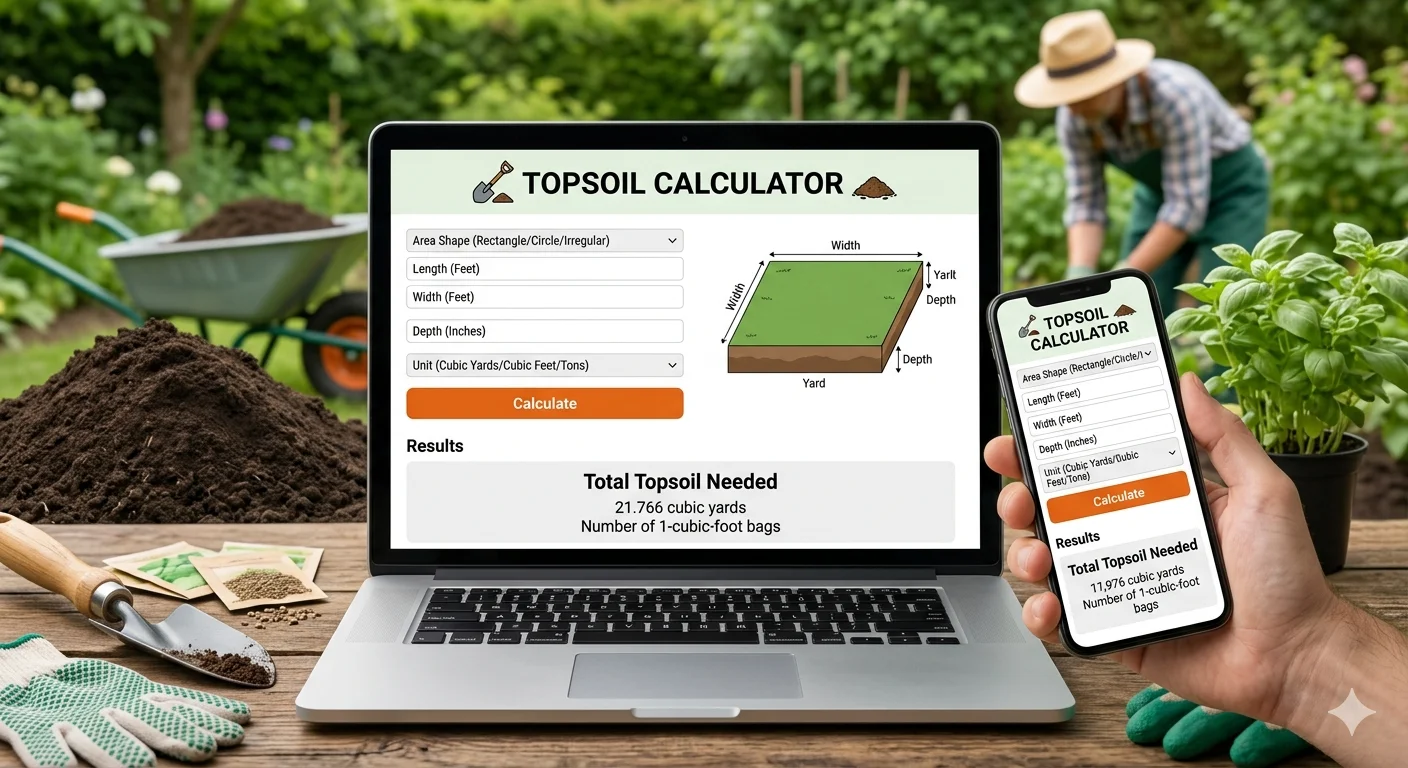
Calculate how much topsoil you need for your project. Enter the area dimensions and depth below to get results in cubic yards, cubic feet, tons, and bags with cost estimation.
Popular Topsoil Types
Most commonly calculated topsoil types
Common Depth Ranges
Most frequently used topsoil depths
Calculation Statistics
See how many topsoil calculations have been made over time
Topsoil Guides & Articles
Topsoil Calculator How Much Topsoil Do I Need?
What is topsoil?
Topsoil is the uppermost layer of earth typically the top 2 to 8 inches of soil and it's the most biologically active part of the ground. It's packed with organic matter, decomposed plant material, fungi, bacteria, and countless microorganisms that feed plant roots and support healthy growth. Without a sufficient layer of quality topsoil, even the most carefully chosen plants will struggle.
Not all soil products are created equal, and it's worth knowing the differences before you buy. Topsoil is general-purpose, natural soil intended for filling, grading, and growing. Garden soil is topsoil that has been enriched with compost and other amendments to support vegetables and ornamentals it's richer, but more expensive, and not suitable for large-volume fill jobs. Fill dirt is subsoil it contains little to no organic matter, is used strictly for leveling and structural fill, and should never be placed where you want plants to grow. Always match your soil type to your project goal.
How to use the calculator
Getting an accurate measurement takes less than a minute. Follow these steps:
- Measure the length and width of your project area in feet (or meters if you prefer metric).
- Decide on the depth of topsoil needed for your project type see the depth guide below.
- Enter length, width, and depth into the calculator above and select your unit system.
- Instantly get your result in cubic yards, cubic feet, and number of bags.
- Add 10% to your total to account for settling, uneven ground, and waste.
Recommended topsoil depths by project
Using the right depth makes a meaningful difference to plant performance and project success. Too shallow and roots will hit infertile subsoil; too deep and you've overspent. Here are the practical guidelines used by professional landscapers:
New lawn from seed
4–6 in
Enough for root establishment. A 400 sq ft lawn at 5 in needs ~6.2 cu yd.
Lawn repair / topdressing
1–3 in
Thin layer to level and revive. 400 sq ft at 2 in = ~2.5 cu yd.
Sod installation
4–6 in
Same base depth as seeding. Sod needs firm, fertile footing to root quickly.
Flower / garden beds
6–8 in
A 10×20 ft bed at 7 in needs ~4.3 cu yd about half a small truckload.
Vegetable garden beds
8–12 in
Deeper for root vegetables. A 4×8 ft bed at 10 in needs ~0.99 cu yd.
Raised beds
12+ in
Fill fully with a topsoil/compost blend. A standard 4×8 ft raised bed needs ~1.2 cu yd.
As a real-world example: a homeowner seeding a new 20×30 ft front lawn at 5 inches deep needs (20 × 30 × 0.417) ÷ 27 = approximately 9.3 cubic yards of topsoil. That's enough to justify a bulk delivery bagged topsoil calculator would require over 330 bags and cost several times more.
Bags vs. bulk: which should you buy?
Buy bagged when...
Your project needs less than 0.5 cubic yards. Small flower pots, a single raised planter, or a repair patch in a garden bed are ideal for bags. Convenient, easy to transport in a car, and no delivery fee.
Buy bulk when...
Your project needs 0.5 cubic yards or more. Bulk topsoil is sold by the cubic yard and delivered by truck. It's dramatically cheaper per cubic foot and the only practical choice for lawns and large beds.
Common bag sizes are 0.75 cu ft, 1 cu ft, and 1.5 cu ft. One cubic yard = 27 cubic feet, so filling 1 cubic yard from bags alone would require between 18 and 36 bags. At roughly – per bag, that's –8 versus – per cubic yard for bulk. The savings for larger projects are enormous.
Topsoil weight: what you need to know before pickup
~2,000 lbs
weight per cubic yard (average)
1–1.5 cu yd
max safe pickup truck load
1,800–2,200
lbs range depending on moisture
One cubic yard of topsoil weighs roughly 1,800 to 2,200 pounds depending on moisture content wet soil is significantly heavier than dry. A standard half-ton pickup truck can safely carry about 1 to 1.5 cubic yards. If your project needs 3 or more cubic yards, overloading your vehicle is a real risk and a bulk delivery truck is the safer, cheaper option. Always confirm your vehicle's payload rating before hauling.
Calculate your trade up now: Trade Up Calculator
Types of topsoil which one do you need?
Walking into a garden center or calling a landscape supplier is far easier when you know what you're asking for. Here are the three most common types:
Screened topsoil
Natural topsoil that has been sifted through a screen to remove rocks, roots, and large debris. This is the go-to choice for lawn establishment, bed preparation, and general landscaping. It has good structure and drains well.
Compost-enriched topsoil / garden mix
A blend of topsoil and composted organic matter. Higher in nutrients and microbial life, making it the best choice for vegetable gardens and ornamental beds where plant performance is the priority. Costs more than screened topsoil.
Unscreened topsoil / fill dirt
Raw, unprocessed subsoil or topsoil used purely for grading, leveling, and raising ground elevation. Not suitable for growing plants. Used to build up low spots before laying proper topsoil on top.
How Topsoil Calculation Works
- Volume (Cubic Feet): Length (ft) × Width (ft) × Depth (inches ÷ 12)
- Cubic Yards: Cubic Feet ÷ 27
- Weight (Tons): Cubic Yards × density factor (approx. 1.0-1.4 tons per cubic yard depending on type)
- 40 lb Bags: Cubic Feet × 62.4 lbs per cu ft ÷ 40 lbs per bag (approximate)
- Cost: Cubic Yards × Price per Cubic Yard
- Tip: Always order 5-10% extra topsoil to account for settling and uneven surfaces
Frequently Asked Questions
It depends on the depth you need. For a 10×10 foot area (100 sq ft) at a 4-inch depth suitable for lawn seeding you need (10 × 10 × 0.333) ÷ 27 = approximately 1.23 cubic yards. At 6 inches deep, that rises to 1.85 cubic yards. At 1 inch (light topdressing), you'd need just 0.31 cubic yards around 8.3 cubic feet, or roughly 11 standard 0.75 cu ft bags. Use the calculator above and enter your actual depth for a precise result.
For a new lawn seeded from scratch, aim for 4 to 6 inches of topsoil. This depth gives grass roots enough fertile soil to establish before hitting lower-quality subsoil. Anything less than 3 inches will produce a lawn that struggles in dry weather and looks stressed during summer. If you're overseeding an existing lawn or topdressing bare patches, 1 to 2 inches is generally sufficient. For sod installation, 4 to 6 inches is ideal sod needs a firm, nutritious base to root within the first few weeks after laying.
One cubic yard equals 27 cubic feet. The number of bags depends on the bag size: 0.75 cu ft bags require 36 bags, 1 cu ft bags require 27 bags, and the larger 1.5 cu ft bags require 18 bags to fill one cubic yard. For any project exceeding 0.5 cubic yards, buying in bulk is almost always more economical. At typical retail prices, bagged topsoil can cost 3 to 5 times more per cubic foot than bulk delivery once you factor in the convenience premium. Our calculator shows both cubic yards and bag count so you can compare options instantly.
A cubic yard of topsoil typically weighs between 1,800 and 2,200 pounds, with the average around 2,000 lbs (roughly one ton). Moisture content is the biggest variable a cubic yard of saturated topsoil can weigh significantly more than dry topsoil. This matters enormously for transport planning. A standard half-ton pickup truck has a payload capacity of around 1,000–1,500 lbs, meaning it can safely carry approximately 0.5 to 0.75 cubic yards. Overloading damages your suspension and is a safety hazard. For anything over 1 cubic yard, arrange for professional delivery.
Yes, in thin layers this is called topdressing. Applying 0.5 to 1 inch of topsoil over existing lawn can improve soil structure, fill low spots, and encourage denser growth. However, if you apply more than 1 to 1.5 inches at once, you risk smothering the grass and killing it. For a major lawn renovation where you want to add 4+ inches of new topsoil, it's better to scalp the existing grass first, till the ground, and then apply your new topsoil layer before reseeding or laying sod. Never dump several inches of topsoil over a healthy lawn and expect it to survive.
Topsoil is natural soil taken from the upper layer of the ground it's your general-purpose landscaping material used for filling, grading, and establishing lawns. Garden soil is a premium blend that combines topsoil with compost, peat moss, or other organic amendments. Garden soil has a higher nutrient content and better moisture retention, making it ideal for vegetable beds and flower borders. It's also more expensive and not practical for large fill volumes. For raised beds or containers, garden soil or a custom mix is the better choice. For large lawn areas, screened topsoil is more cost-effective.
Spring and early fall are the best times to add topsoil, for different reasons. Spring applications benefit from warming temperatures and natural rainfall, giving seeds or transplants the best start. Fall is excellent for lawn topdressing cool temperatures reduce transplant stress, and rain helps topsoil settle and integrate before winter. Avoid adding topsoil in the height of summer heat, as it can dry out rapidly before plants establish. In winter, frozen ground makes spreading difficult and the material won't integrate properly until the soil thaws. For vegetable gardens, adding topsoil in fall and letting it rest over winter is ideal it gives organic matter time to break down.
Bulk topsoil typically costs to per cubic yard depending on type and your location, with screened topsoil averaging – per cubic yard before delivery. Delivery charges vary widely expect –0 for a standard truckload depending on distance. Premium garden mix or organic-enriched topsoil can run –0 per cubic yard. Bagged topsoil at garden centers costs – per bag, which translates to roughly 5–0 per cubic yard three to five times the cost of bulk. Always get at least two quotes from local suppliers. Prices vary significantly by region and season, with spring prices often higher due to demand.