Crosswind Calculator
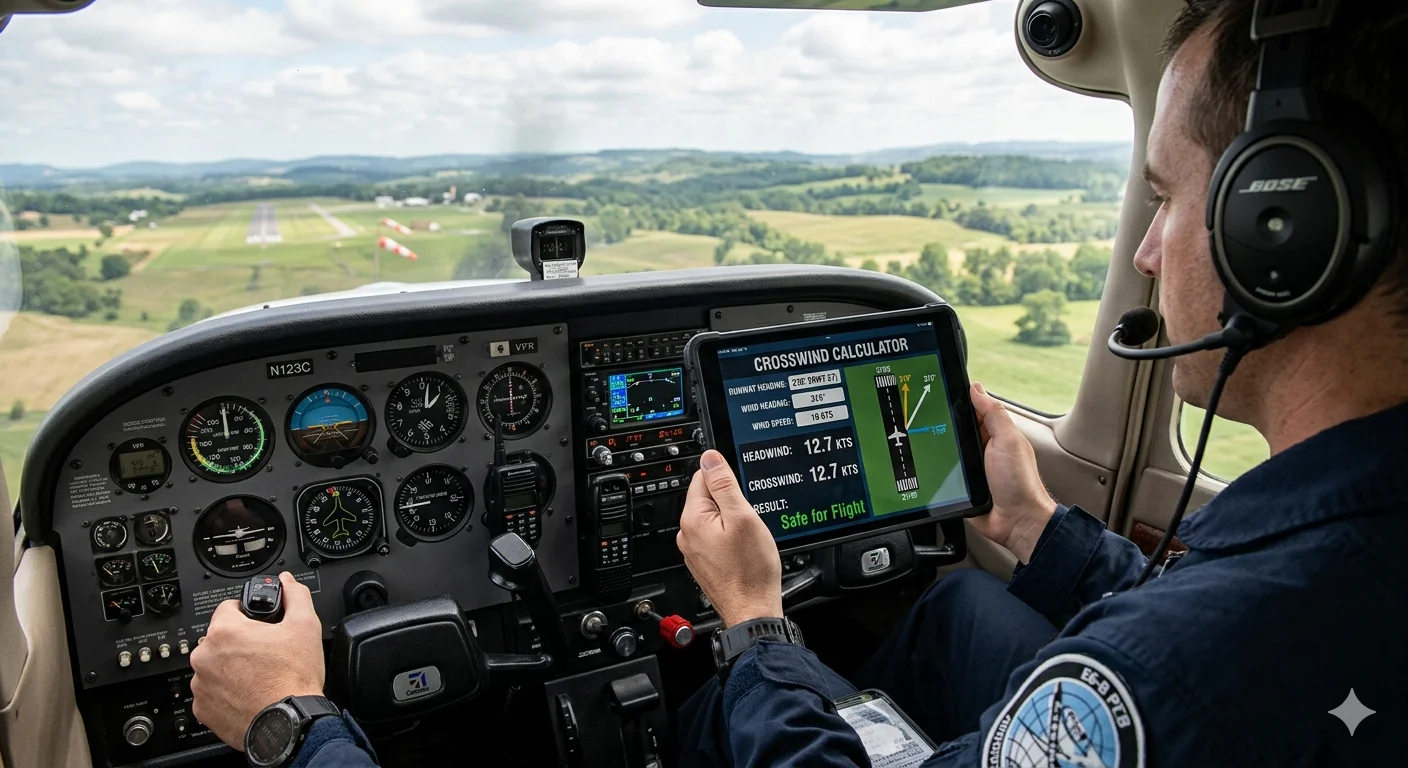
Calculate headwind/tailwind and crosswind components for aviation. Enter the wind speed, wind direction, and runway heading below.
Common Wind Conditions
Typical wind condition distributions for aviation
Aircraft Crosswind Limits
Maximum demonstrated crosswind by aircraft category
Calculation Statistics
See how many crosswind calculations have been made over time
Crosswind Guides & Articles
Crosswind Calculator Know Your Component Before Every Landing
Every wind situation a pilot encounters can be broken into three components relative to the runway in use. A headwind acts directly against the aircraft's forward motion it increases effective airspeed, shortens the ground roll, and is the most forgiving condition for any approach and landing. A tailwind pushes from behind, requiring more runway and reducing climb performance after takeoff. Neither presents the same handling challenge as the third component: crosswind.
Crosswind acts perpendicular to the runway centerline, pushing the aircraft sideways across the pavement. Unlike a headwind, it doesn't slow you down it tries to drift you off your intended track on approach and, critically, impart lateral forces on touchdown that the landing gear and directional control surfaces must absorb. A 30-knot headwind is manageable for almost any properly-rated pilot in the right aircraft. A 15-knot direct 90-degree crosswind, however, demands full attention, precise technique, and an honest assessment of both the aircraft's limits and your own.
The key insight that many newer pilots miss is that wind angle matters far more than wind speed alone. A 20-knot wind blowing at a 45-degree angle to the runway produces only about 14 knots of crosswind component. That same 20-knot wind at a full 90-degree angle produces the full 20 knots across the runway. Choosing the right runway or understanding what the wind is actually doing to your landing starts with this calculation.
The Math Behind the Crosswind Component
The trigonometry is simple, and you don't need a math background to understand what it tells you. The angle between the wind direction and the runway heading is the key variable call it α (alpha).
Crosswind = Wind Speed × sin(α)
Headwind = Wind Speed × cos(α)
α = angle between wind direction and runway heading
The sine function gives you the proportion of wind acting sideways it's zero when wind is perfectly aligned with the runway (0°) and reaches its maximum of 1.0 when wind is perfectly perpendicular (90°). The cosine works the opposite way: it's 1.0 on a perfect headwind and drops to zero on a full crosswind. Between those extremes, both components are present simultaneously.
A worked example: wind reported as 270° at 20 knots, landing on Runway 24 (heading 240°). The angle difference is 30°. Crosswind = 20 × sin(30°) = 20 × 0.50 = 10 knots. Headwind = 20 × cos(30°) = 20 × 0.87 = 17.3 knots. That's a manageable situation for most pilots and that's exactly what this calculator computes for you instantly.
Plug It Into Your Pre-Landing Flow: Using the Calculator in Four Steps
The crosswind calculator is most valuable when it becomes a habit a thirty-second check built into your approach briefing, not an afterthought on short final. Here's how to work it into your workflow.
Pull the Latest Wind Report
Get the current ATIS, AWOS, or METAR for your destination airport. Always use the most recent observation winds can shift significantly in 20 minutes, especially near convective activity or terrain.
Set Your Runway Direction
Enter the magnetic heading of the runway in use. This is the two-digit runway number multiplied by 10 Runway 27 means heading 270°. Confirm the active runway with ATC or ATIS before calculating.
Enter the Wind Numbers
Type in the wind direction and speed from your METAR or ATIS. If gusts are reported, always enter the gust value as your wind speed that's the peak crosswind load your aircraft will experience on final.
Act on What the Calculator Tells You
Compare the result against your aircraft's demonstrated crosswind limit and your personal minimums. If you're close to your limit, brief the go-around option now before you're on final and under pressure to commit.
Decoding the METAR Wind Group Before You Punch In the Numbers
The is only as accurate as the data you feed it. METAR wind reports follow a standardized format, and misreading even one digit can give you a dangerously optimistic picture of what awaits you on final. The wind group always appears early in the METAR, immediately after the observation time.
The format is always: three digits for direction (the heading the wind is blowing from), two or more digits for speed, and the unit indicator either KT for knots or MPS for meters per second. So "27015KT" means the wind is from 270 degrees (due west) at 15 knots. The direction is always magnetic, which means it aligns directly with your runway headings.
When gusts are present, a "G" appears between the sustained speed and the gust value: "27015G25KT" means 15 knots sustained, gusting to 25. For crosswind calculation purposes, always use the gust value. Your aircraft will encounter peak crosswind loads at the gust speed, and that's the figure that matters for technique and go/no-go decisions. Variable winds appear as "VRB" followed by speed when you see VRB, treat every runway as a potential full crosswind runway until conditions stabilize.
METAR Wind Code Quick Reference
| METAR Code | What It Means |
|---|---|
| 27015KT | From 270° (due west) at 15 knots — steady, no gusts |
| 09020G30KT | From 090° (due east) at 20 knots, gusting to 30 — use 30 for crosswind calc |
| VRB08KT | Variable direction at 8 knots — crosswind component is unknown; any runway could be a full crosswind |
| 00000KT | Calm wind — zero crosswind, choose the most favorable runway for other reasons |
| 18012G22KT 160V210 | From 180°, 12 knots gusting 22, variable between 160° and 210° — use extreme ends to check worst-case crosswind |
Your Aircraft's Crosswind Limit: What the Number Really Means and Where to Find It
Every general aviation aircraft has a "demonstrated crosswind component" figure published in the Pilot's Operating Handbook. Understanding what that number actually represents is critical, because it is commonly misinterpreted as a hard structural limit which it is not.
Calculate your Gravel now: Gravel Calculator
The demonstrated crosswind figure is the maximum crosswind at which a test pilot successfully completed landings during the manufacturer's certification flight testing. The word "demonstrated" is deliberate. The aircraft may be perfectly capable of handling higher crosswinds or it may not. No one knows, because it was never tested above that value. Flying above the demonstrated crosswind means entering genuinely untested territory with no manufacturer guidance on what the aircraft will do.
You'll find the figure in Section 2 (Limitations) of your POH for hard limits, or in Section 4 (Normal Procedures) for the demonstrated crosswind guidance. Always check both sections and use the more conservative number.
Crosswind Limit Reference by Aircraft Type
| Aircraft | Demonstrated Crosswind | Notes |
|---|---|---|
| Cessna 172 Skyhawk | ~15 knots | Most common trainer; conservative personal mins recommended for students |
| Piper Cherokee PA-28 | ~17 knots | Low-wing stability helps; still requires solid technique above 12 kts |
| Cirrus SR22 | ~21 knots | CAPS aircraft; higher limit but still demands proper technique |
| Beechcraft Bonanza | ~17 knots | Complex/high-performance; technique matters significantly at limits |
| Boeing 737 | ~33–38 knots | Varies by variant and runway surface condition |
| Airbus A320 | ~38 knots | Fly-by-wire assists; airline ops procedures typically set lower limits |
The manufacturer's demonstrated crosswind is a ceiling your personal crosswind limit should sit well below it, especially early in your flying career. Student pilots and low-time private pilots are well served by a personal limit of 8–10 knots until crosswind landings are consistently stable and centered. Exceeding your personal limit, or the demonstrated limit, raises the risk of directional control loss on the rollout, runway excursion, main gear side-loading, and potential prop strike or wing strike on tricycle-gear aircraft.
Two Techniques Every Pilot Must Have in the Bag for Crosswind Landings
Calculating your crosswind component tells you what you're dealing with. What you do about it on final and in the flare depends on your technique. There are two primary methods, each with specific applications, and skilled pilots know when to use which and how to blend them.
Flying the Crab Approach
The crab technique involves pointing the nose into the wind throughout the approach so that the aircraft tracks straight down the extended centerline despite the crosswind. The fuselage is angled into the wind the crab angle while the wings remain level. This is aerodynamically efficient and imposes no side-loads during the approach itself.
The challenge is the transition: the crab must be removed with rudder in the flare so the nose aligns with the runway heading before the main gear touches. If the decrab is late or incomplete, the aircraft touches down while still crabbing, generating significant lateral side-loads on the gear. The crab method is preferred for jet operations, high crosswind conditions where holding a sideslip would create an extreme bank angle, and IFR approaches where workload is high on final.
The Wing-Low Sideslip Method
The sideslip or wing-low method keeps the nose aligned with the runway throughout the approach. The upwind wing is lowered into the wind, and opposite (downwind) rudder is applied to stop the aircraft from turning. The result is a coordinated slip: the aircraft tracks the centerline while pointing down it, with one wing lower than the other.
Check snow day chances by state: Snow Day Predictions by State
On touchdown, the upwind main gear contacts first, followed by the downwind main, then the nosewheel. This sequence manages side-loads progressively and gives the pilot immediate directional control upon ground contact. The wing-low technique is the standard for general aviation training, small GA aircraft, and any landing where visibility of the runway edge is critical for maintaining centerline. The limitation is that extremely large bank angles may be required in very strong crosswinds, which risks wing contact with the runway.
Choosing the Right Technique for the Conditions
Most flight training programs teach the wing-low method as the default for piston singles and light twins, for good reason: it provides positive ground contact alignment from the moment the wheels touch. Many experienced pilots use a hybrid approach crabbing on the base leg and early final to reduce mental workload, then transitioning to a sideslip in the last few hundred feet for a wheel-aligned touchdown. There is no universal rule on which is "correct," but one principle is non-negotiable: the nose must be aligned with the runway centerline at the moment of touchdown, by any method you choose.
Wind Angle Is the Real Variable Not Speed
Pilots naturally fixate on wind speed a 25-knot wind sounds worse than a 15-knot wind. But when it comes to crosswind component, the angle between the wind and the runway is a far more powerful variable than the speed itself. Consider what happens to a 20-knot wind at different approach angles:
| Wind Speed | Angle to Runway | Crosswind Component | Headwind Component |
|---|---|---|---|
| 30 knots | 0° (straight headwind) | 0 knots | 30 knots |
| 20 knots | 30° | ~10 knots | ~17 knots |
| 20 knots | 45° | ~14 knots | ~14 knots |
| 20 knots | 60° | ~17 knots | ~10 knots |
| 20 knots | 90° (full crosswind) | 20 knots | 0 knots |
The practical takeaway is significant: a 30-knot wind aligned with the runway is less stressful than a 20-knot wind at 90 degrees. This is why runway selection matters enormously. At many airports with two or more runways, the active runway choice can reduce a 17-knot crosswind to an 8-knot crosswind — simply by choosing the runway orientation that puts the wind more on the nose. When the wind favors no runway perfectly, the calculation tells you which choice gives the smaller lateral component. Always run the numbers for both runway options before committing to an approach.
Crosswind Safety: When to Go Around, When to Divert, and Why It's Always Your Call
The go-around is the most underused tool in a pilot's skill set. Many accidents and incidents involving crosswind landings share a common thread: the pilot recognized that the approach was not going well and continued anyway. Recognizing the signs early and committing to a go-around without hesitation is a defining quality of sound aeronautical decision making.
Go-around immediately if you cannot maintain centerline on final with normal control inputs, if the aircraft is experiencing excessive drift that is not correcting, if airspeed is fluctuating outside the normal stabilized range, or if turbulence or wind shear is making a stable touchdown unpredictable. None of these require an explanation to ATC "going around" is a complete transmission.
Read our snow day probability by city guide: Snow Day Probability by City
When the conditions are persistently at or above your personal crosswind limit, or when gusts are reported that would bring you to or past the aircraft's demonstrated crosswind divert. If fatigue is a factor, if the airport layout is unfamiliar, or if the runway surface condition is marginal, the crosswind component you might otherwise accept becomes unacceptable. The stabilized approach standard is a useful anchor: if you are not fully configured and stable by 500 feet AGL, go around. Without exception.
How Crosswind Calculation Works
- Wind Angle: The angle between the wind direction and the runway heading
- Headwind Component: Wind Speed × cos(Wind Angle) — positive means headwind, negative means tailwind
- Crosswind Component: Wind Speed × sin(Wind Angle) — the sideways wind force on the aircraft
- Left vs Right: Crosswind direction depends on whether wind comes from the left or right of the runway
- Gusts: When gusts are present, maximum crosswind and headwind components are also calculated using gust speed
- Practical Use: Compare the crosswind component to your aircraft's maximum demonstrated crosswind limit
Frequently Asked Questions
The crosswind component is the portion of the reported wind that acts perpendicular to the runway centerline. When wind blows from a direction that isn't perfectly aligned with the runway heading, it can be mathematically divided into two forces acting simultaneously: one along the runway (headwind or tailwind) and one across it (crosswind). The crosswind component is the lateral force the one that pushes the aircraft sideways. It's the value that pilots compare against aircraft limits and personal minimums to determine whether an approach is safe to continue, and it varies based on both wind speed and the angle between wind direction and runway orientation.
Your aircraft's demonstrated crosswind component is published in the Pilot's Operating Handbook (POH). Check Section 2 Limitations for any hard published maximum, and Section 4 Normal Procedures for the demonstrated crosswind guidance that was achieved during manufacturer flight testing. Keep in mind that "demonstrated" does not mean "certified maximum." It reflects what was tested, not a performance guarantee. Your instructor or a local CFI familiar with the specific aircraft can help you establish an appropriate personal crosswind limit, which should always be equal to or below the demonstrated value and typically much lower for early-stage pilots.
The crosswind component is calculated using the trigonometric sine function: Crosswind Wind Speed × sin(α), where α is the angle between the reported wind direction and the runway magnetic heading. The headwind component uses the cosine: Headwind Wind Speed × cos(α). Both components are present simultaneously whenever the wind is not perfectly aligned with the runway. The sine function approaches zero when the wind is nearly aligned with the runway and approaches 1.0 (the full wind speed) when the wind is perpendicular. This calculator handles all of that math for you just enter the wind direction, wind speed, and runway heading.
Exceeding your personal crosswind limit or the aircraft's demonstrated crosswind increases the probability of several serious outcomes. Directional control becomes progressively harder to maintain on the rollout as crosswind increases, particularly once the aerodynamic control surfaces lose effectiveness at low speed. Drift at touchdown can impose significant lateral side-loads on the main gear, leading to tire failure, blown struts, or gear collapse. In worst-case scenarios, a runway excursion follows. Beyond the aircraft limits, the risk escalates further because no data exists on how the aircraft behaves the manufacturer never tested it. The consequence is always the same: go around and reassess before committing to another attempt.
Yes and the gust value should always be used for your crosswind planning, not the sustained wind speed. When a METAR shows "27015G28KT," the sustained wind is 15 knots and the gust is 28. On final approach, the aircraft will experience moments of up to 28-knot wind. At the worst-case moment, your crosswind component will reflect that gust speed, not the average sustained wind. Planning against the sustained speed while the gust is 28 knots is the same as planning without full information. Enter the gust value into the calculator and assess that result against your limits. If the gust-based calculation puts you over your personal minimums, treat the condition accordingly.
Headwind is the component of wind that acts directly along the runway in the direction the aircraft is landing it slows ground speed, increases effective lift, and shortens landing distance. Crosswind acts perpendicular to the runway, pushing the aircraft sideways. Both are derived from the same reported wind; it's the runway orientation that determines how much becomes headwind versus crosswind. A headwind is beneficial: it reduces takeoff and landing distances and makes the aircraft more responsive at lower airspeeds. Crosswind is a challenge: it requires active technique to maintain centerline and imposes lateral loads on touchdown. The two components always add up to the total wind effect, and calculating both gives you the complete picture.
Yes, and they should crosswind landings are a required element of flight training under both FAA and EASA regulations, and consistent crosswind competency is a prerequisite for solo operations and certification. The key for student pilots is building experience gradually: begin with light crosswinds of 5–8 knots and work upward as technique improves. Always fly with a qualified CFI until consistent centerline tracking, proper touchdown sequencing, and confident go-around execution are established. Setting a personal crosswind limit typically 8–10 knots for pre-solo students and sticking to it reinforces good decision-making habits from the beginning of your flying career.
The full crosswind component occurs when the wind direction is exactly 90 degrees to the runway heading a perfect direct crosswind. In this case, sin(90°) = 1.0, so the crosswind component equals the full reported wind speed. There is zero headwind or tailwind; all of the wind's energy is directed across the runway. This represents the worst-case crosswind scenario for a given wind speed. For comparison, at 45 degrees to the runway, the crosswind component is approximately 71% of wind speed. The "full" or "maximum" crosswind component is what aircraft limits are typically quoted against if a POH says 15 knots demonstrated crosswind, that figure applies to a direct 90-degree crosswind condition.