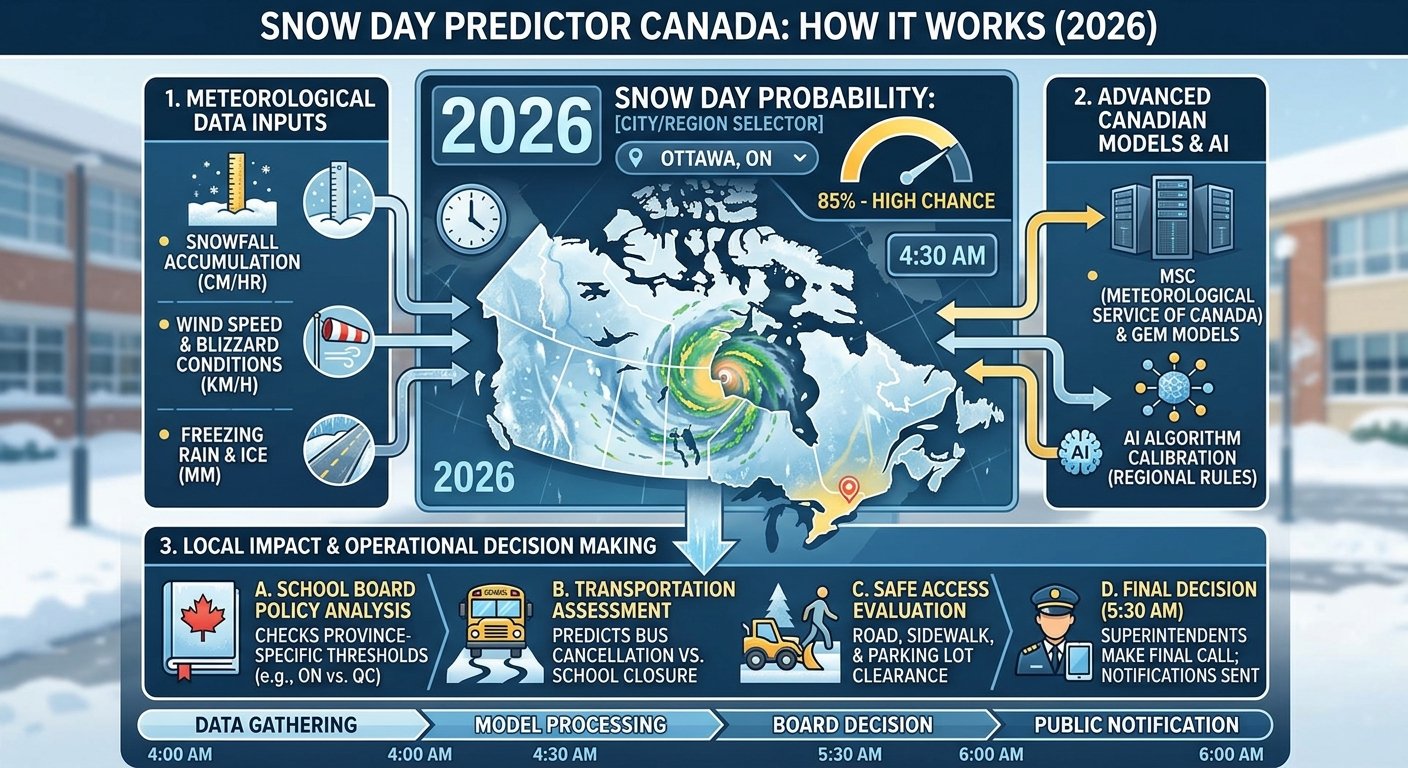
Canada experiences some of the most severe winter weather conditions anywhere in the world, making school closure decisions a regular and high-stakes part of life for students, parents, and educators from British Columbia to Newfoundland. Whether you are dealing with a lake-effect event in southern Ontario, a prairie blizzard in Saskatchewan, or a nor'easter in Nova Scotia, Snow Day Predictor delivers a free, 7-day school closure probability forecast for any Canadian city or postal code across all 13 provinces and territories.
How to Check Canadian Snow Day Chances
Checking your Canadian snow day probability takes less than 30 seconds.
- Visit snowdaypredictor.xyz
- Enter your Canadian city name such as Toronto, Calgary, Vancouver, Edmonton, Ottawa, or Montreal, or type your postal code directly such as M5V 3A1
- Select your school level: Elementary, Middle School, High School, or College
- Toggle to Celsius for Canadian temperature display
- Click "Check Snow Day Chances"
- Receive your free 7-day snow day probability forecast instantly
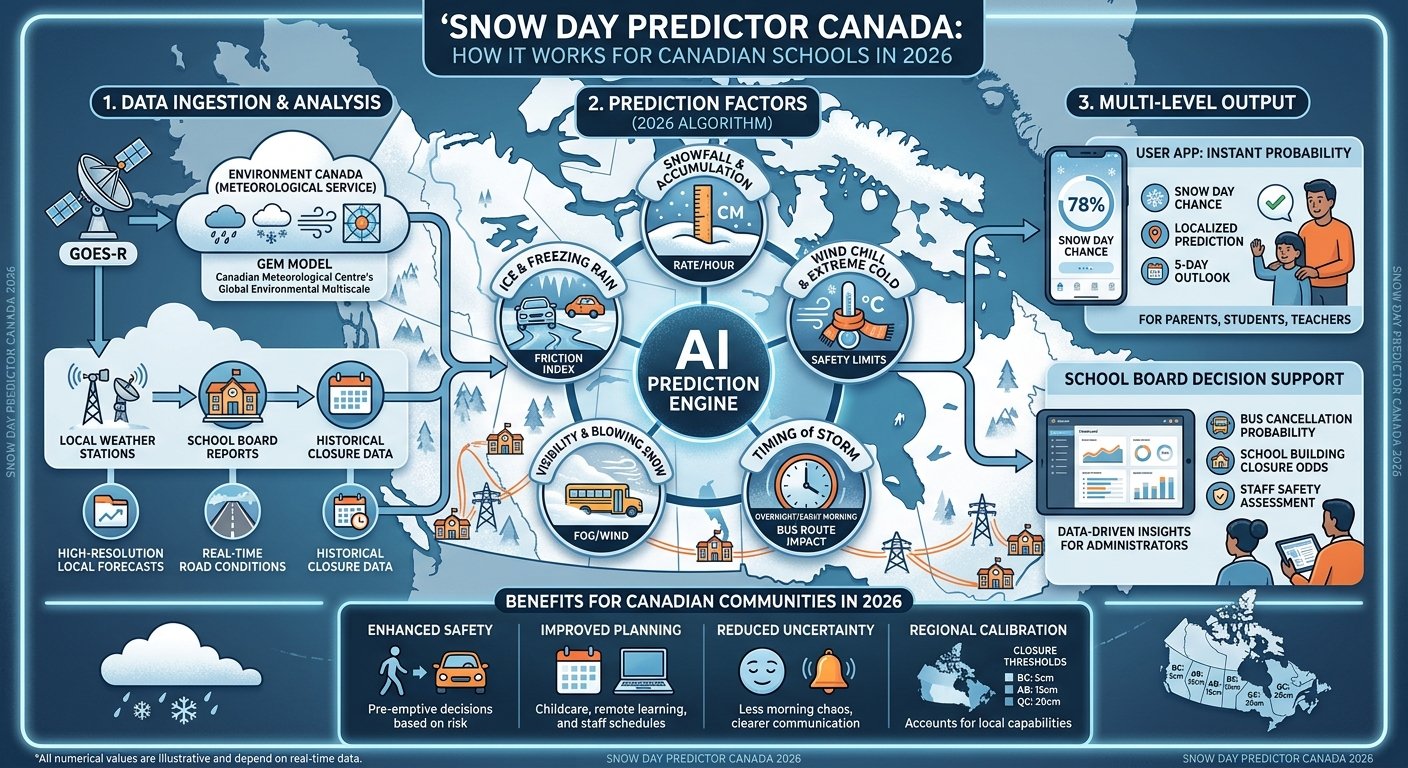
The tool pulls real-time weather forecast data and applies a weighted algorithm to produce a clear percentage score for each of the next seven days.
Ontario: Toronto, Ottawa, and the Great Lakes Region
Ontario is Canada's most populous province and home to its largest school boards, including the Toronto District School Board, which serves approximately 235,000 students and is the largest school board in Canada. Winter weather in Ontario varies dramatically by region, from the relatively mild winters of Windsor and the Niagara Peninsula to the severe cold and heavy snowfall experienced by communities north of Lake Superior.
Toronto sits on the northern shore of Lake Ontario and experiences a mix of lake-effect snow, Alberta Clipper systems, and nor'easter events. The city typically receives 115 to 125 centimetres of snowfall annually, though individual events vary widely. The Toronto District School Board and the Toronto Catholic District School Board make closure decisions independently, meaning one board may close while the other remains open during borderline weather events.
Ottawa, the national capital, experiences significantly more severe winters than Toronto due to its inland location and exposure to Arctic air masses. Ottawa averages approximately 235 centimetres of snowfall annually, making it one of the snowiest capital cities in the world. The Ottawa-Carleton District School Board is well accustomed to operating in winter conditions, applying relatively high closure thresholds compared to southern Ontario boards.
The communities along the Lake Huron and Georgian Bay shores in central Ontario, including Barrie, Owen Sound, and Collingwood, experience intense lake-effect snow events that can deposit 50 to 100 centimetres of snow within 24 to 48 hours. School closures in these regions during major lake-effect events are among the most frequent in the province.
Quebec: Montreal, Quebec City, and Beyond
Quebec presents a unique school closure landscape because education is administered primarily in French through the francophone school board system, with a separate English school board system operating alongside it. Both systems follow provincial guidelines but make independent closure decisions.
Montreal, Canada's second-largest city, experiences an average of approximately 210 centimetres of snowfall annually, one of the highest totals among major North American cities. Montreal's extensive underground city network, which connects over 80 city blocks through underground passages, means that many residents can navigate severe winter weather without going outside at all. However, school children relying on school buses and outdoor routes face the same risks as in any snowy city, and closure decisions reflect those realities.
Quebec City, located further northeast and at higher elevation than Montreal, experiences even more significant winter weather and a well-established culture of operating through substantial snowfall. The city's historic lower town and upper town geography creates elevation challenges for bus routes that factor into closure decisions during major storms.
Alberta: Calgary, Edmonton, and the Foothills
Alberta experiences some of the most dramatic winter weather variability in Canada, driven by its unique geography at the eastern edge of the Rocky Mountains. Calgary is famous for its chinook wind events, warm westerly winds that can raise temperatures by 20 degrees Celsius within hours, turning a bitterly cold winter day into a mild spring-like afternoon. This temperature volatility makes winter forecasting in Calgary particularly challenging.
Edmonton, Alberta's capital city, sits further north and experiences a more consistently cold winter climate without the chinook influence that moderates Calgary's temperatures. Edmonton averages approximately 130 centimetres of snowfall annually and experiences wind chill values below -40C on a near-annual basis. The Edmonton Public School Board and Edmonton Catholic School Board are experienced cold weather operators, with explicit cold day closure policies triggered by extreme wind chill forecasts.
Rural Alberta school divisions, particularly those serving farming communities on the prairies, face additional closure risk from blowing and drifting snow events. Even moderate snowfall combined with strong winds can reduce visibility to near zero on flat, exposed prairie roads, making bus travel genuinely dangerous regardless of accumulation totals.
British Columbia: Vancouver, Victoria, and Mountain Communities
British Columbia presents the most diverse winter weather landscape of any Canadian province. The Lower Mainland, including Vancouver and Victoria, experiences mild, wet winters with relatively rare snowfall events. When snow does fall in Vancouver, however, the combination of the city's hilly terrain, driver unfamiliarity with snow conditions, and limited road treatment infrastructure creates disproportionate disruption relative to the actual accumulation.
Vancouver school districts close at snowfall thresholds that would not cause a second thought in Calgary or Edmonton, typically 5 to 10 centimetres, because the safety risk from inexperienced drivers on steep, untreated hills is genuinely significant. This pattern is similar to what Seattle and Portland experience south of the border.
Interior British Columbia, including Kelowna, Kamloops, Prince George, and the mountain communities of the Columbia and Rocky Mountain ranges, experiences dramatically more severe winter weather than the coast. School districts in these regions operate under conditions that would close coastal districts for weeks, reflecting decades of adaptation to heavy mountain snowfall.
Prairie Provinces: Saskatchewan and Manitoba
Saskatchewan and Manitoba occupy the heart of the Canadian prairies and experience some of the most extreme winter weather conditions in North America. Regina, Saskatchewan, and Winnipeg, Manitoba, consistently rank among the coldest major cities in the world during winter months, with average January temperatures well below -15C and wind chills reaching -40C or below on a regular basis.
Winnipeg, with a population of approximately 750,000, is the largest city in Manitoba and experiences an average of approximately 110 centimetres of snowfall annually, combined with extreme wind chill values that create genuine outdoor safety hazards on a regular basis. The Winnipeg School Division and surrounding divisions have well-established cold weather protocols, with cold day closures triggered by wind chill forecasts below -40C being a regular occurrence in severe winters.
Prairie blizzard conditions, in which moderate snowfall combines with extreme winds to create near-zero visibility, are a specific and extremely dangerous weather scenario unique to the flat, open prairie landscape. These events, known locally as ground blizzards when loose surface snow is picked up and redistributed by strong winds, can produce whiteout conditions with no new snowfall at all, making road travel genuinely life-threatening.
Atlantic Canada: Nova Scotia, New Brunswick, PEI, and Newfoundland
Atlantic Canada experiences some of the most frequent and intense winter storms of any region in North America, driven by its position at the convergence of Arctic air masses, Atlantic moisture, and the warm Gulf Stream waters offshore. Nor'easters are the primary winter storm type, and they arrive with regularity throughout the winter season.
Halifax, Nova Scotia, averages approximately 250 centimetres of snowfall annually, making it one of the snowiest major cities in Canada. The Halifax Regional Centre for Education makes closure decisions for a geographically diverse district that includes urban Halifax, suburban communities, and rural areas, meaning that a single storm can create vastly different conditions across the district depending on elevation and proximity to the coast.
-
Wind Chill and School Closures: Why Extreme Cold Alone Can Cancel School in 2026
-
More Caculators
- USA & Canada States
Newfoundland, particularly the Avalon Peninsula including St. John's, experiences the highest snowfall totals of any major Canadian city. St. John's averages approximately 335 centimetres of snowfall annually and holds records for some of the deepest single-storm snowfall totals in Canadian history. School closures in St. John's are among the most frequent in the country, with some winters producing 15 to 20 or more closure days.
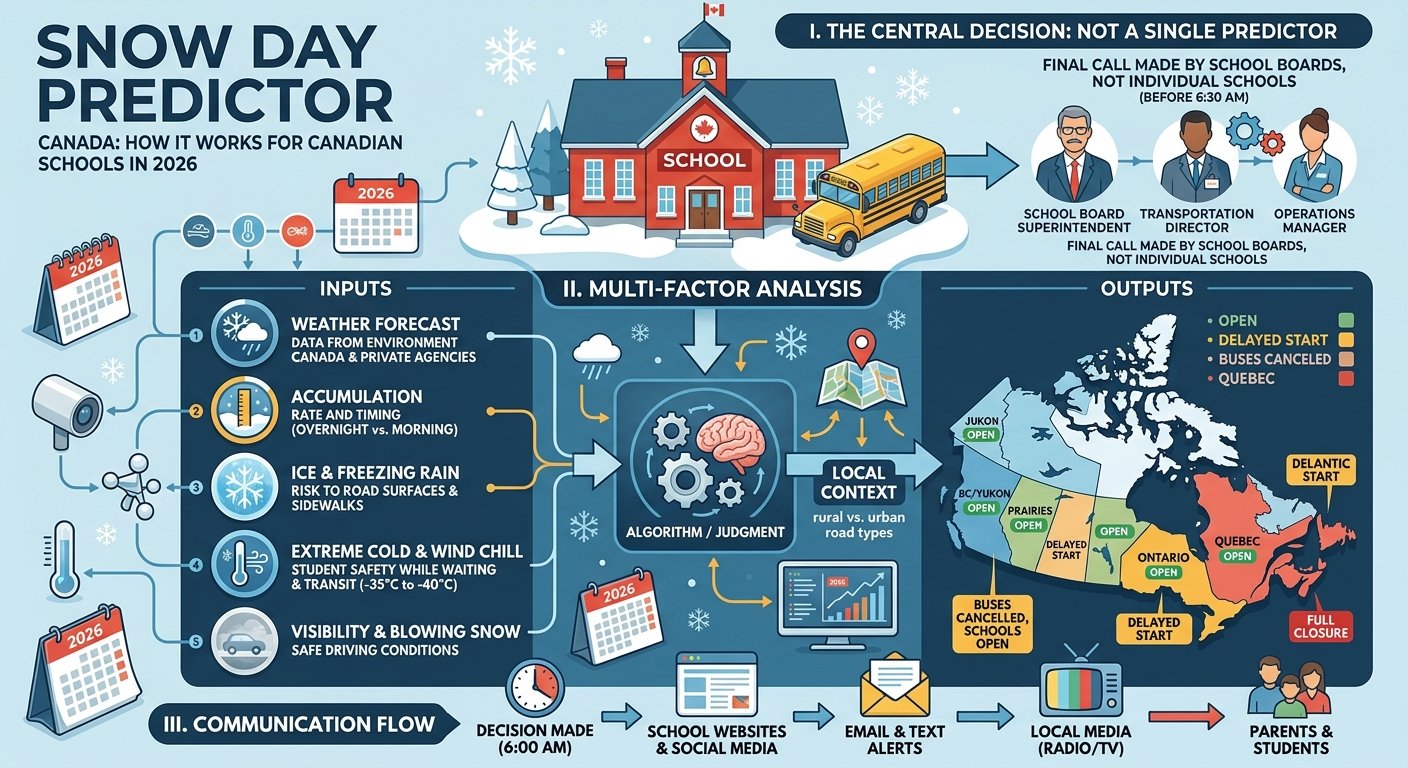
How Canadian School Boards Make Closure Decisions
Canadian school closure decisions follow a process broadly similar to U.S. districts, with some important provincial differences. Education in Canada is a provincial responsibility, meaning each province sets its own guidelines for school operations, calendar requirements, and emergency closure policies.
Most Canadian school boards have transportation departments that begin monitoring road conditions from 3 AM onward on potential storm days, coordinating with provincial transportation ministries and municipal road maintenance contractors. The final closure decision is typically made between 5 AM and 6 AM, with announcements going out via board websites, automated notification systems, and local radio and television stations.
Canadian school boards also face the challenge of operating across much larger geographic areas than typical U.S. districts, particularly in rural and northern regions. A single school board may serve communities spread across thousands of square kilometres, where road conditions can vary enormously within the same board's jurisdiction.
Check Canadian Snow Day Chances Right Now
Whether you are a student in Toronto hoping for a lake-effect snow day, a parent in Calgary watching a chinook forecast disappear, or a family in St. John's preparing for another Atlantic nor'easter, Snow Day Predictor gives you the clearest available picture.
Visit snowdaypredictor.xyz to check Canadian snow day chances for your city or postal code instantly, completely free.