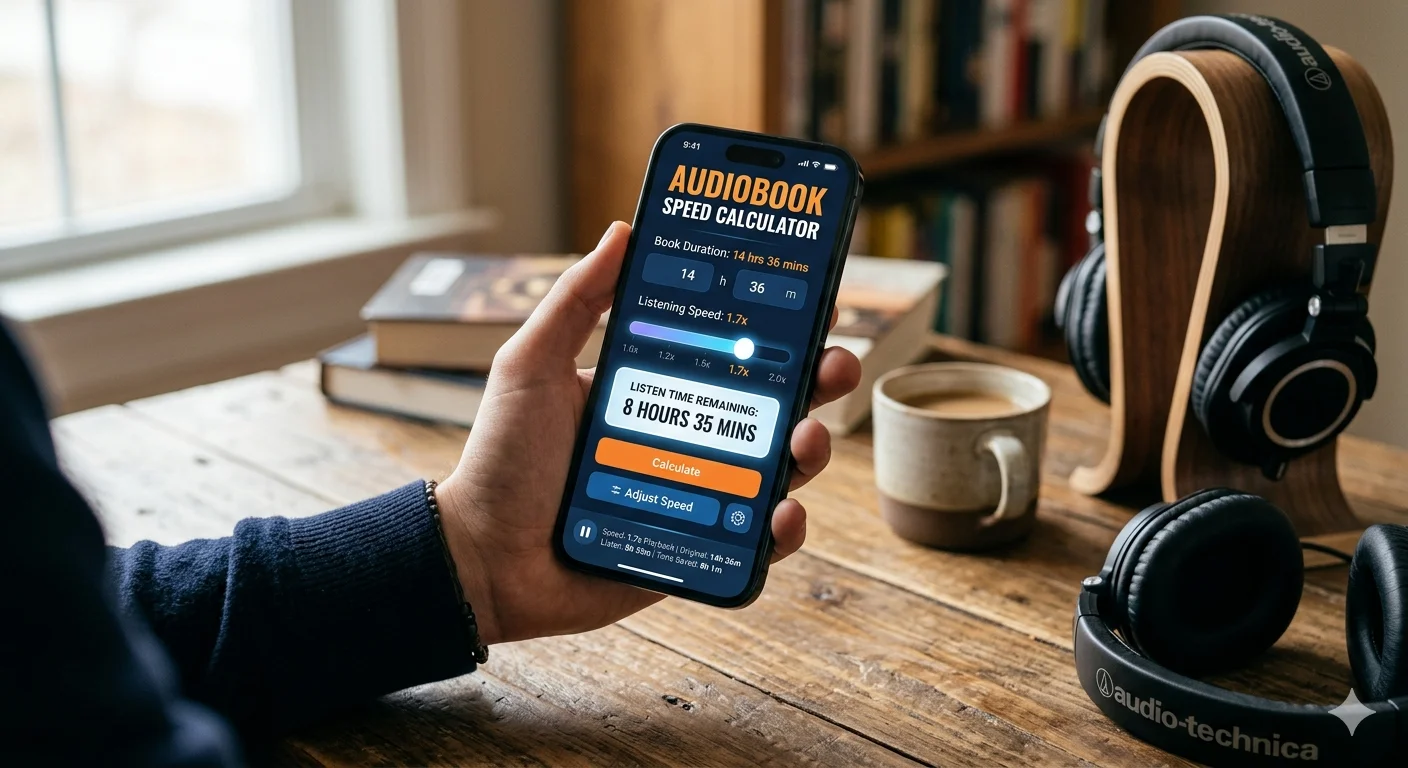
Audiobook Speed Calculator
Calculate how long your audiobook will take at different playback speeds. See adjusted duration, time saved, and estimated words per minute.
Popular Listening Speeds
Most commonly used audiobook playback speeds
Time Saved by Speed
Hours saved per 10-hour audiobook at different speeds
Calculation Statistics
See how many audiobook speed calculations have been made over time
Audiobook Speed Guides & Articles
Audiobook Speed Calculator Finish More Books Without Rushing the Story
You have a reading list that grows faster than you can listen, and you love the books too much to rush them carelessly. This calculator helps you find the speed where more books and a great listening experience actually coexist.
Calculate Your Listening Time
Your First Result in Under 60 Seconds
The calculator above has exactly three fields. Here is what to put in each one so you get a number you can actually plan around.
Look Up Your Audiobook's Running Time
Find the total runtime on Audible, Goodreads, or the platform where you bought your book. It is almost always listed on the product page, usually formatted as "X hrs and Y mins."
Type in the Hours and Minutes
Enter the hours in the first field and the minutes in the second. If your book is listed as "9 hrs 45 mins," type 9 in hours and 45 in minutes. No seconds needed.
Pick the Speed You Plan to Use
Choose from the dropdown. If you are not sure yet, 1.5x is a sensible starting point for most non-fiction. You can run the numbers at multiple speeds to compare before you commit.
See Your New Finish Time Instantly
Hit Calculate and your adjusted listening time appears immediately, along with the total hours you will save compared to 1x. No wait, no sign-up, no email required.
One Division Problem Powers Every Answer
The math behind this calculator is genuinely simple, and you do not need to do any of it by hand. But knowing the logic helps you trust the result.
The formula is: Adjusted Time = Audiobook Length divided by Playback Speed. If a book runs 8 hours and you listen at 1.5x, you divide 8 by 1.5 and get roughly 5 hours and 20 minutes. Audiobook Speed CalculatorThe time you save is just the original length minus that adjusted time.
At 1.25x on an 8-hour audiobook: 8 divided by 1.25 gives you 6 hours and 24 minutes. You save 1 hour and 36 minutes.
At 1.5x: 8 divided by 1.5 gives you 5 hours and 20 minutes. You save 2 hours and 40 minutes.
At 2x: 8 divided by 2 gives you exactly 4 hours. You save a full 4 hours on a single book.
That is the whole calculation. The tool above runs it for every combination of length and speed, so you just read the result and move on to actually listening.
Matching Your Speed to the Book You Are Actually Listening To
No single speed works for every audiobook or every listener. Here is a genuine guide to what each setting does well, so you can choose deliberately rather than just defaulting to whatever the app defaulted to when you installed it.
0.75x When Slowing Down Is the Smart Move
Slower is genuinely better in a few situations. Language learners absorb more when they can catch every syllable. Dense philosophy texts, poetry read aloud, and narrators with thick or unfamiliar accents all reward a slight reduction in pace. If you are listening to understand something rather than simply to get through it, 0.75x is not a step backward. It is the right tool for a specific job.
1x The Narrator's Intended Pace
Normal speed is where professional narrators perform their best. Every pause, breath, and tonal shift is calibrated for 1x. If you are new to audiobooks, start here. If you are deep in an immersive literary novel and the narrator is genuinely wonderful, stay here. There is no shame in listening at the speed the author intended you to experience the work.
1.25x The Invisible Speed Bump
Most listeners cannot reliably tell the difference between 1x and 1.25x once they have been at it for a few weeks. The narration still sounds natural, the emotional beats land, and comprehension stays close to perfect. This is almost always the right first step up from normal speed, and for many fiction listeners, it is where they stay permanently. It is fast enough to matter over a long book, and slow enough that the story never feels clipped.
Calculate your bricks now: Brick Calculator
1.5x Where Most Serious Listeners Live
Surveys of heavy audiobook listeners consistently put 1.5x at the top of the charts. It is fast enough to meaningfully compress a long non-fiction book, yet slow enough that complex arguments still land. Business books, history, biography, self-help, and popular science all tend to work extremely well here. The narrator sounds slightly brisk but rarely robotic, and your brain adjusts within a session or two.
1.75x Power Listener Territory
At 1.75x, you are definitively in power-listener territory. This speed works best when you already know the subject reasonably well, are doing a re-listen of something familiar, or are moving through podcast-style narrative non-fiction with shorter sentences and a conversational tone. First listens on dense or technical material at this speed tend to leave comprehension gaps that only become obvious later, when you realize you cannot quite explain a key argument.
2x The Re-Listen Speed
Two times normal speed is very fast in practice. For a first listen on unfamiliar material, it demands real focus and significant adaptation time. Where it shines is on review: a business book you already read in print, a self-help title you are refreshing before applying its ideas, or simple narrative content you absorbed well the first time. At 2x, even familiar material requires your full attention. Background listening is not possible here.
2.5x to 3x Skimming With Your Ears
These speeds are not really for listening in the conventional sense. They are for skimming: confirming you remember the structure of something, scanning for a specific section, or reviewing material you know so thoroughly that you just need a reminder. Using 2.5x or 3x for a first listen on anything you actually care about will leave comprehension gaps that compound as the book progresses. Save these speeds for books you could already summarize from memory.
Ultimately, the right speed is the fastest you can go while still being able to summarize what you just heard. That number is different for every listener and every book.
How Many More Books Fit in a Year When You Shift One Setting
Think about what that actually means. If you currently finish 12 audiobooks a year at 1x, switching to 1.5x saves you roughly 3.3 hours on every 10-hour book. Over a full year of reading at that pace, those saved hours accumulate into 6 entirely new books. Six books is often one author's complete backlist. It is a trilogy plus three standalones. It is a full year of a friend's reading recommendations you never had time for before.
Extend that thinking a decade out. At 1.5x over 10 years, compared to 1x, you would read approximately 60 extra books. That is not a productivity hack. That is 60 more stories lived in, 60 more sets of ideas absorbed, 60 more authors who got their chance to reach you.
And at 2x the gain is even larger: 24 books a year instead of 12, which over a lifetime of reading becomes an almost incomprehensible library. The point is never speed for its own sake. The point is that more books means more worlds, more knowledge, and more of the authors you have been meaning to get to for years.
Finding the Speed Button on Every Platform You Might Use
Every major audiobook app supports speed adjustment, but none of them put the control in exactly the same place. Here is where to look on the platforms most people actually use.
Audible The Widest Speed Range Available
Audible lets you go from 0.5x all the way to 3.5x, which is the widest range of any major platform. The control is the tortoise-and-hare icon in the bottom player bar. Tap it to cycle through preset speeds, or press and hold on some devices to get finer adjustment. If speed flexibility matters to you, Audible is the gold standard.
Check snow day chances by state: Snow Day Predictions by State
Spotify Audiobooks and Podcasts
Spotify supports 0.5x to 3x for both audiobooks and podcasts. Access the speed control through the three-dot menu on the episode or audiobook player screen. One note worth knowing: on some devices, Spotify resets the playback speed between sessions, so you may need to re-select your preferred speed when you resume a book the next day.
Apple Books
Apple Books supports speeds from 0.5x to 2x in fixed preset steps. There is no fine-tuning between steps. Tap the speed indicator that appears in the player, usually labeled with the current speed like "1x" or "1.5x," and it will cycle through the available options. If you live between 1.25x and 1.5x, Apple Books forces you to choose one or the other.
Google Play Books
Google Play Books offers 0.5x to 2x adjustment via the settings menu inside the player. The interface is clean and the setting persists between sessions, which is a small but genuinely appreciated detail. The 2x ceiling means it is not ideal for listeners who have worked up to higher speeds.
Libby / OverDrive The Free Library App
Libby, the library borrowing app from OverDrive, supports 0.5x to 3x and is completely free to use with a public library card. If you are not an Audible subscriber, Libby gives you the best speed range of any free option. It is worth knowing about regardless of your budget, because many libraries stock major bestsellers and new releases.
If range is everything, Audible leads the pack. If free access is the priority, Libby is the strongest option and is far more capable than most people realize.
Does Listening Faster Actually Mean Understanding Less
This is the honest question every new speed listener asks, and it deserves a real answer rather than cheerful reassurance.
For most people, comprehension stays strong up to around 1.7x speed. Research on spoken-word processing generally puts the threshold for meaningful comprehension loss somewhere between 1.7x and 2x, depending on the complexity of the material and how familiar the listener is with the topic. Dense academic content, philosophy, and unfamiliar technical subjects suffer earlier than conversational non-fiction or narrative fiction.
Above 2x, the picture changes. Familiar topics, books you have read in print before, and simple self-help content are more forgiving. A complex argument you have never encountered before at 2.5x will often leave you with the feeling that you understood it when you probably absorbed less than you think.
The adaptation is real and it does take time. Your brain adjusts to faster speech over roughly two to four weeks of regular practice. The method that works best is incremental: start at 1.25x for two weeks, move to 1.5x for the following two weeks, and continue stepping up by 0.25x increments from there. Forcing yourself to 2x on day one is not actually faster learning. It is just an uncomfortable first day.
A reliable self-check: pause after a chapter and try to summarize what just happened, in your own words, out loud or in your head. If you cannot do it, the speed is too high for that book. Slow down by 0.25x and try again. No judgment, just adjustment.
Planning Exactly When You Will Finish Your Current Book
The calculator gives you adjusted listening time, and that number is more useful than it might first seem. You can turn it directly into a finish date.
Take a 12-hour audiobook listened to at 1.5x. The adjusted time is 8 hours. If you listen for 45 minutes a day, you divide 8 hours by 0.75 (45 minutes expressed as a fraction of an hour) and you get roughly 10.7 days to finish. If you can only manage 30 minutes a day, that same book takes about 16 days.
That means you can now say: "I will finish this before my flight on the 15th" or "I should start this one after my holiday week." You are no longer guessing. You have a number, a date, and a plan. That turns a passive habit into a reading goal you can actually track and hit.
How Audiobook Speed Calculation Works
- Adjusted Duration: Original Duration ÷ Playback Speed
- Time Saved: Original Duration − Adjusted Duration
- Words Per Minute: Base WPM × Playback Speed
- Average Narrator Speed: ~150 words per minute at 1x speed
- Comfortable Speed: Most listeners prefer 1.25x–1.5x for daily listening
- Maximum Comprehension: Studies suggest 2x is the upper limit for most people to retain information
Frequently Asked Questions
The most commonly reported listening speed among regular audiobook listeners is 1.5x. Data from Audible, surveys of audiobook communities, and listening app analytics consistently point to 1.5x as the true center of gravity. It is fast enough to save meaningful time on long books without feeling rushed, and it sounds natural enough that most people stop noticing it within a few listening sessions. Around 20 to 25 percent of listeners prefer 2x or above, while another large group sticks at 1.25x, particularly for fiction.
No, there is no credible evidence that fast listening speed damages cognitive function or causes harm. The brain is remarkably good at processing compressed speech, which is actually a different mechanism from simply speeding up a recording. What can happen at very high speeds on demanding material is incomplete encoding of new information, meaning you may feel like you understood something but retain less than you would at a slower speed. That is a comprehension issue, not a neurological one, and it resolves by either slowing down or choosing more familiar material. Regular speed listeners report no negative effects after years of practice.
For most non-fiction, 1.5x to 1.75x hits the sweet spot between pace and retention. Conversational business books, popular science, and memoir-style narrative non-fiction handle 1.75x well. Dense analytical works, academic history, and philosophy are better suited to 1.25x or 1.5x, where you have enough processing time to absorb the argument rather than just register the words. For non-fiction you are listening to purely for review or reinforcement of ideas you already hold, 2x is perfectly reasonable. Start at 1.5x with any new non-fiction title and adjust from there based on how well you can summarize chapters afterward.
The total runtime is listed on virtually every platform that sells or lends audiobooks. On Audible, it appears on the product page just below the narrator's name, formatted as "X hrs and Y mins." On Goodreads, the audiobook edition usually includes runtime in the edition details. Google Play Books, Apple Books, and Libby all show running time on the book's detail page before purchase or borrow. If you are looking up a book before buying it, Goodreads and the publisher's website are reliable secondary sources. Once you have hours and minutes, paste them into the calculator above and you are ready.
Audible does not charge by hours listened. Its primary model is credit-based: subscribers receive one or two credits per month depending on their plan, and each credit buys one audiobook regardless of its length. A 4-hour novella costs the same credit as a 40-hour epic fantasy. Listening at 2x speed does not change what you pay, and finishing a book faster does not entitle you to an extra credit. Audible also sells books a la carte at list price without a subscription. The listening speed you choose has no bearing on billing in any Audible pricing model.
Most mainstream audiobook platforms cap out at 2x to 3.5x, with Audible's 3.5x being among the highest standard limits. Going beyond what the native app allows is technically possible through third-party apps and audio players that support variable speed playback at extreme rates, but the audio quality degrades noticeably above 3x on most recordings, and comprehension for new material at those speeds is extremely limited for the vast majority of people. Speed readers who train specifically for very fast audio absorption exist, but they represent a tiny fraction of listeners and their comprehension on first-listen material is debated even among researchers. For practical purposes, 2x to 2.5x is the realistic ceiling for most people on content they are hearing for the first time.
A 10-hour audiobook at 1.5x takes exactly 6 hours and 40 minutes. You get there by dividing 10 by 1.5, which gives 6.667 hours, and 0.667 of an hour is 40 minutes. You save 3 hours and 20 minutes compared to listening at normal speed. For context, if you listen for 45 minutes during a daily commute, a 10-hour book at 1.5x takes roughly 9 commute sessions, or about two weeks of weekday listening. The same book at 1x would take about 13 to 14 sessions. That difference is one extra book finished every five to six weeks for a consistent daily listener.
The fastest confirmed listening speeds for anything resembling comprehension-level processing tend to come from speed reading and fast listening practitioners who report functioning at 4x to 5x on highly familiar material. There is no official world record category for audiobook listening speed in the way there is for speed reading. Anecdotally, members of speed listening communities report training up to 4x on non-technical content they know well, though independent comprehension testing at those speeds is rare. The more interesting number is probably the practical ceiling that most people can train to reach with genuine retention: most experienced listeners who put in deliberate practice top out around 2.5x to 3x on new, moderately complex content.