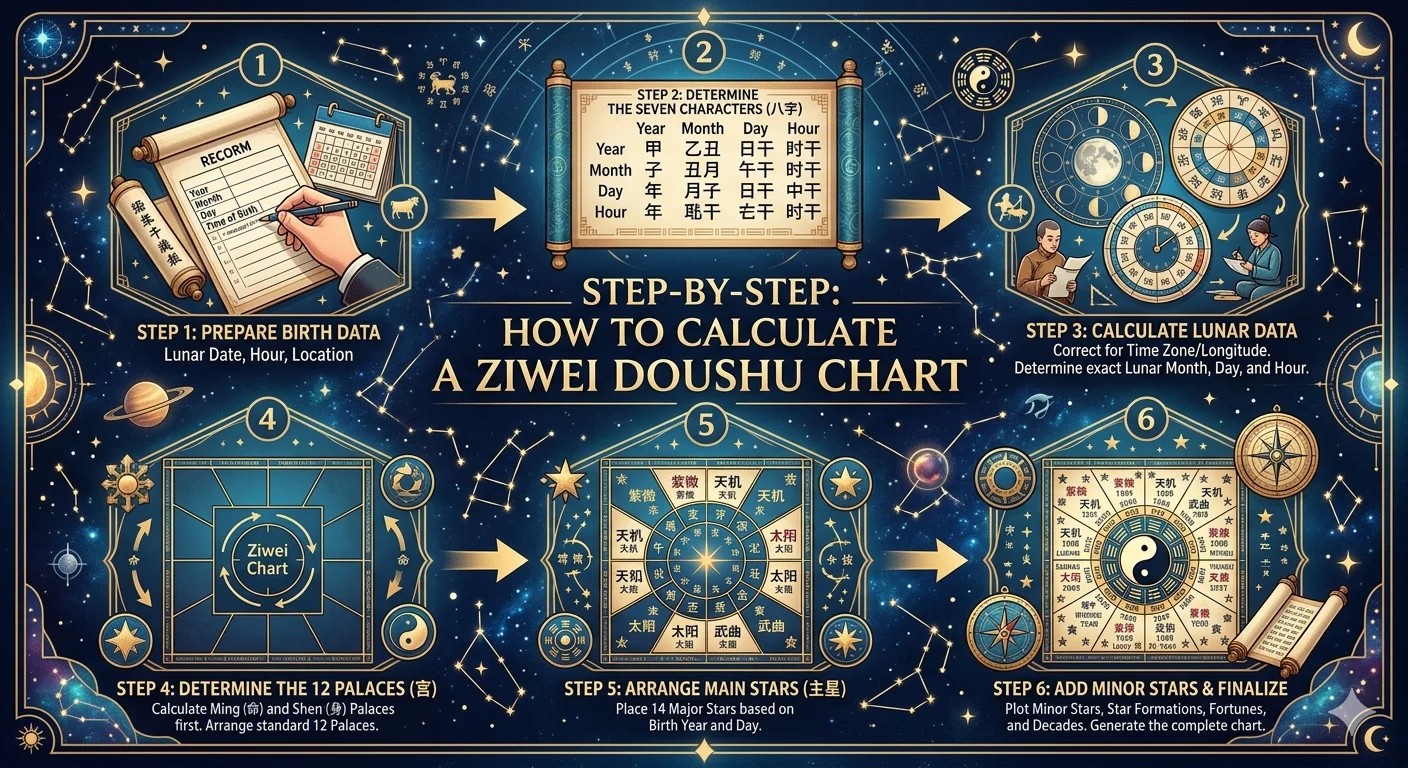
How to Calculate Ziwei Doushu Chart Step by Step: The Complete Guide
If you have ever been curious about what the stars reveal about your destiny, personality, career, and relationships, then Ziwei Doushu is one of the most powerful tools you can explore. Known as Purple Star Astrology, this ancient Chinese system has guided millions of people for over a thousand years. Understanding how to calculate a Ziwei Doushu chart step by step is the foundation of working with this system meaningfully. Whether you are a curious beginner or someone who wants to go deeper into Chinese metaphysics, this guide will walk you through everything from the basics of the chart structure to placing the stars and interpreting the results.
Unlike Western astrology, which focuses primarily on the position of the sun at birth, Ziwei Doushu uses a combination of your birth year, month, day, and hour to construct a twelve-palace life chart. This chart reveals not just your personality but your life path across different time periods. The process of calculating the chart manually can seem complex at first, but once you understand the underlying logic, it becomes a fascinating and deeply rewarding practice.
What Is Ziwei Doushu and Why Does It Matter
Ziwei Doushu, which translates roughly to Purple Star Astrology, is a classical Chinese divination system believed to have originated during the Song Dynasty. The name comes from Ziwei, the Purple Star or Emperor Star, which is the most prominent star in the entire system. The chart constructed through this method is called a Ming Pan, which means Life Plate or Destiny Chart.
The system organizes a person's life into twelve palaces, each governing a specific area of life such as career, marriage, wealth, health, and travel. Stars are then placed into these palaces based on your birth data. The combination of palace and star creates a nuanced picture of your life circumstances, tendencies, and timing.
What makes Ziwei Doushu particularly valuable is its ability to time events. Using a system of major and minor luck cycles, practitioners can identify when certain energies become active in your chart, helping you make better decisions about when to act and when to wait.
The Structure of a Ziwei Doushu Chart
Before you begin calculating your chart, you need to understand its basic structure. A Ziwei Doushu chart consists of twelve palaces arranged in a fixed grid. These palaces are labeled with the twelve Earthly Branches, which are the same branches used in the Chinese zodiac. The Earthly Branches are Zi, Chou, Yin, Mao, Chen, Si, Wu, Wei, Shen, You, Xu, and Hai.
Each of these twelve positions on the chart corresponds to one of the twelve palaces of life. The twelve palaces are:
The Life Palace or Ming Gong, which represents your core personality and destiny. The Siblings Palace or Xiong Di Gong. The Spouse Palace or Fu Qi Gong, representing marriage and romantic partnerships. The Children Palace or Zi Nu Gong. The Wealth Palace or Cai Bo Gong. The Health Palace or Ji E Gong. The Travel or Migration Palace or Qian Yi Gong. The Friends and Peers Palace or Jiao You Gong. The Career Palace or Guan Lu Gong. The Property Palace or Tian Zhai Gong. The Mental or Emotional Palace or Fu De Gong. The Parents Palace or Fu Mu Gong.
The placement of these twelve palaces shifts depending on your birth month, which is one of the first calculations you will make when setting up your chart.
How to Calculate Ziwei Doushu Chart Step by Step
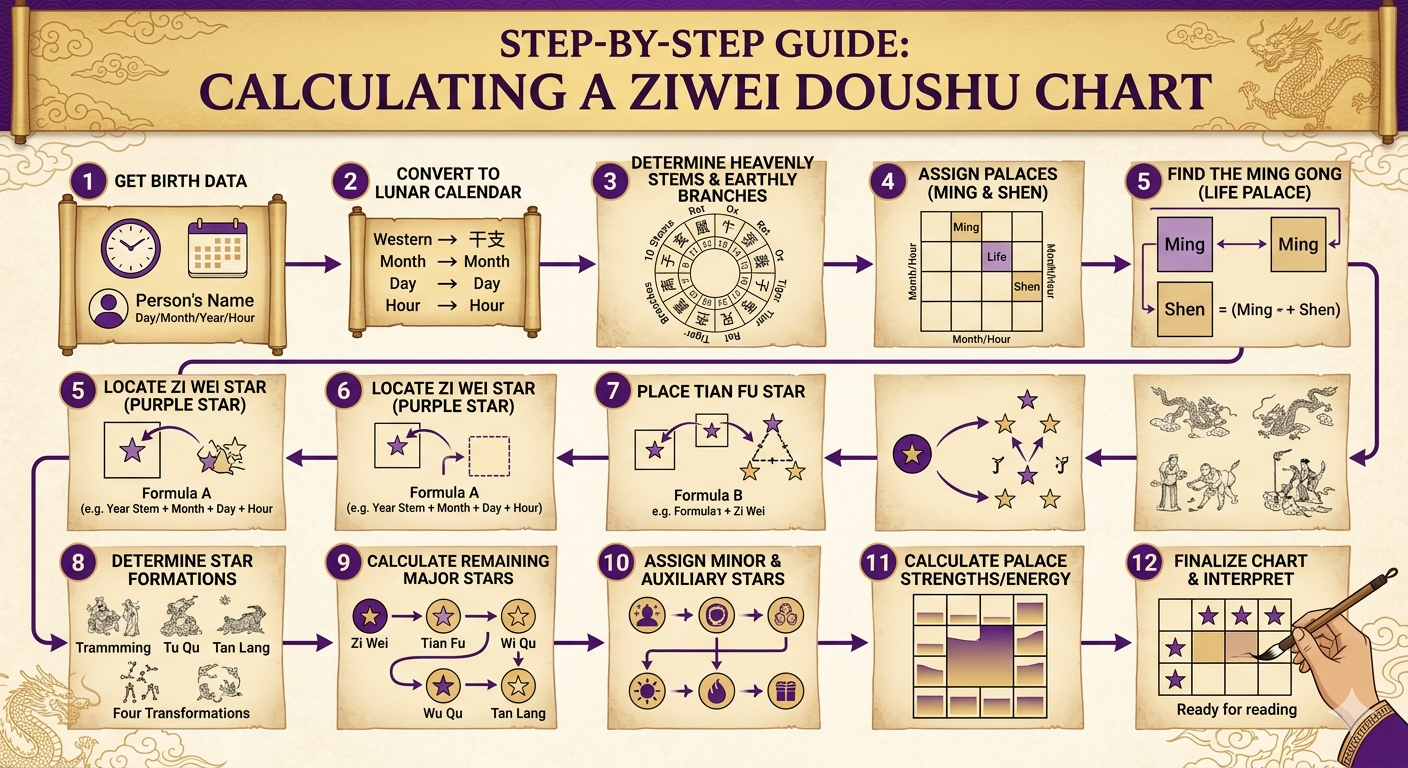
This is the heart of the guide. Learning how to calculate Ziwei Doushu chart step by step involves several sequential calculations. Each step builds on the previous one, so it is important to follow the order carefully.
Step 1: Convert Your Birth Date to the Chinese Lunar Calendar
The first and most essential step is converting your Gregorian birth date to the Chinese lunar calendar. Ziwei Doushu is based on lunar months and the traditional sexagenary cycle, not the Western solar calendar. You will need to know your lunar birth year, lunar birth month, lunar birth day, and birth hour in two-hour increments.
You can use a Chinese calendar converter to find your lunar birth date. The birth hour is assigned a branch from the twelve Earthly Branches in blocks of two hours each. For example, Zi hour runs from 11 PM to 1 AM, Chou hour from 1 AM to 3 AM, and so on around the clock.
Step 2: Determine the Five Elements Phase of Your Birth Year
Your birth year in the sexagenary cycle belongs to one of the five elements, which are Wood, Fire, Earth, Metal, and Water. Each element has a yin or yang polarity and is associated with a specific Heavenly Stem. There are ten Heavenly Stems in total, two for each element. Knowing your birth year Heavenly Stem is necessary for calculating which stars belong in which palaces.
For example, if you were born in a year with a Jia stem, your element is Yang Wood. If you were born in a year with a Yi stem, your element is Yin Wood, and so on through all ten stems.
Step 3: Establish the Life Palace Position
The Life Palace is the starting point of the entire chart. To find it, you use a combination of your lunar birth month and your birth hour. There is a traditional lookup table used in Ziwei Doushu that maps each combination of month and hour to one of the twelve Earthly Branch positions on the chart. Once you locate the Life Palace, all other palaces are arranged in a fixed counterclockwise sequence around the chart grid.
This step requires familiarity with the traditional table, which assigns Life Palace positions based on the relationship between birth month and birth hour. The formula works on the principle that each Earthly Branch governs a specific two-hour window and a specific lunar month.
Step 4: Assign the Twelve Palaces to the Twelve Positions
Once you know where the Life Palace sits on the chart grid, the remaining eleven palaces fill in counterclockwise order. So if the Life Palace is at the position associated with the Yin branch, then the Siblings Palace is at Mao, the Spouse Palace is at Chen, the Children Palace is at Si, and so on around the grid.
This assignment is fixed once you know the Life Palace location. Writing out or drawing a twelve-cell grid and labeling each cell with its corresponding palace name is a helpful way to visualize the chart as you build it.
Step 5: Find the Position of the Ziwei Star
The Ziwei Star, the Emperor Star and the most important body in the entire system, is placed based on your lunar birth day. There are traditional tables that correlate lunar birth days with specific Earthly Branch positions. Once the Ziwei Star is placed, several other major stars from the Ziwei group are placed relative to it in fixed patterns.
The stars that travel with Ziwei and are placed relative to it include Tian Ji, Tai Yang, Wu Qu, Tian Tong, Lian Zhen, Tian Fu, Tai Yin, Tan Lang, Ju Men, Tian Xiang, Tian Liang, Qi Sha, and Po Jun. These fourteen major stars form the core of any Ziwei Doushu chart and carry the most significant interpretive weight.
Step 6: Place the Tianfu Star and Its Group
The Tianfu Star is the second major anchor in the chart. Its position is determined by the location of the Ziwei Star. Specifically, the Tianfu Star always sits in a mirror position relative to Ziwei based on a fixed counting rule. Once Tianfu is placed, the remaining stars in the Tianfu group are distributed around the chart in their traditional fixed patterns.
Each of the fourteen major stars has a specific relationship with the twelve palaces and with other stars. When a strong star lands in a favorable palace with supporting minor stars, the reading for that life area is positive. When difficult stars cluster in important palaces, the reading becomes more complex and nuanced.
Step 7: Determine the Four Transformation Stars
The four transformation stars are Hua Lu, Hua Quan, Hua Ke, and Hua Ji. These are not fixed stars with permanent positions. Instead, they are assigned each year based on the Heavenly Stem of the birth year. Each Heavenly Stem triggers a specific set of four transformations, and each transformation lands on a specific major star in the chart.
Hua Lu represents flowing prosperity and smooth paths. Hua Quan represents authority and ambition. Hua Ke represents reputation, grace, and academic achievement. Hua Ji represents obstacles, complications, or areas that require careful attention.
Finding which major stars carry these transformations and which palaces those stars occupy adds significant depth to the interpretation.
Step 8: Place the Minor and Supporting Stars
In addition to the fourteen major stars, there are dozens of minor stars that provide additional texture to the reading. These include stars like Zuo Fu, You Bi, Wen Chang, Wen Qu, Tian Kui, Tian Yue, Huo Xing, Ling Xing, Di Kong, Di Jie, and many others. Each of these is placed using specific formulas based on your birth year branch, birth month, birth day, or birth hour. The placement rules for each minor star are different and require careful reference to traditional Ziwei Doushu tables.
For example, Wen Chang and Wen Qu, the literary stars associated with academic ability and creative intelligence, are placed based on birth year branch and birth hour respectively. Tian Kui and Tian Yue, the noble helper stars, are placed based on the Heavenly Stem of the birth year.
Step 9: Establish the Decade Luck Cycles
Once the natal chart is complete, the next layer is the timing system. Ziwei Doushu uses decade luck cycles, called Da Xian in Chinese, which activate ten-year periods of life. The starting age and direction of your decade cycles depend on your birth year Heavenly Stem and the yin or yang polarity of your birth year.
Males born in Yang years and females born in Yin years move through the decade cycles in a forward direction, meaning counterclockwise through the chart. Males born in Yin years and females born in Yang years move backward, meaning clockwise. The starting age is calculated from a fixed formula based on your birth day in the lunar month.
Each decade cycle highlights one palace of the chart as the active area of life, bringing that palace's stars and combinations into focus for a full ten-year period.
Step 10: Layer the Annual Stars
The final layer of a complete Ziwei Doushu chart is the annual overlay. Each year, based on the Heavenly Stem of that year, a new set of four transformation stars is generated. These annual transformations fly into the natal chart and activate specific stars and palaces for that year alone. This is how practitioners track year-by-year timing and advise on career moves, relationship decisions, financial opportunities, and health awareness.
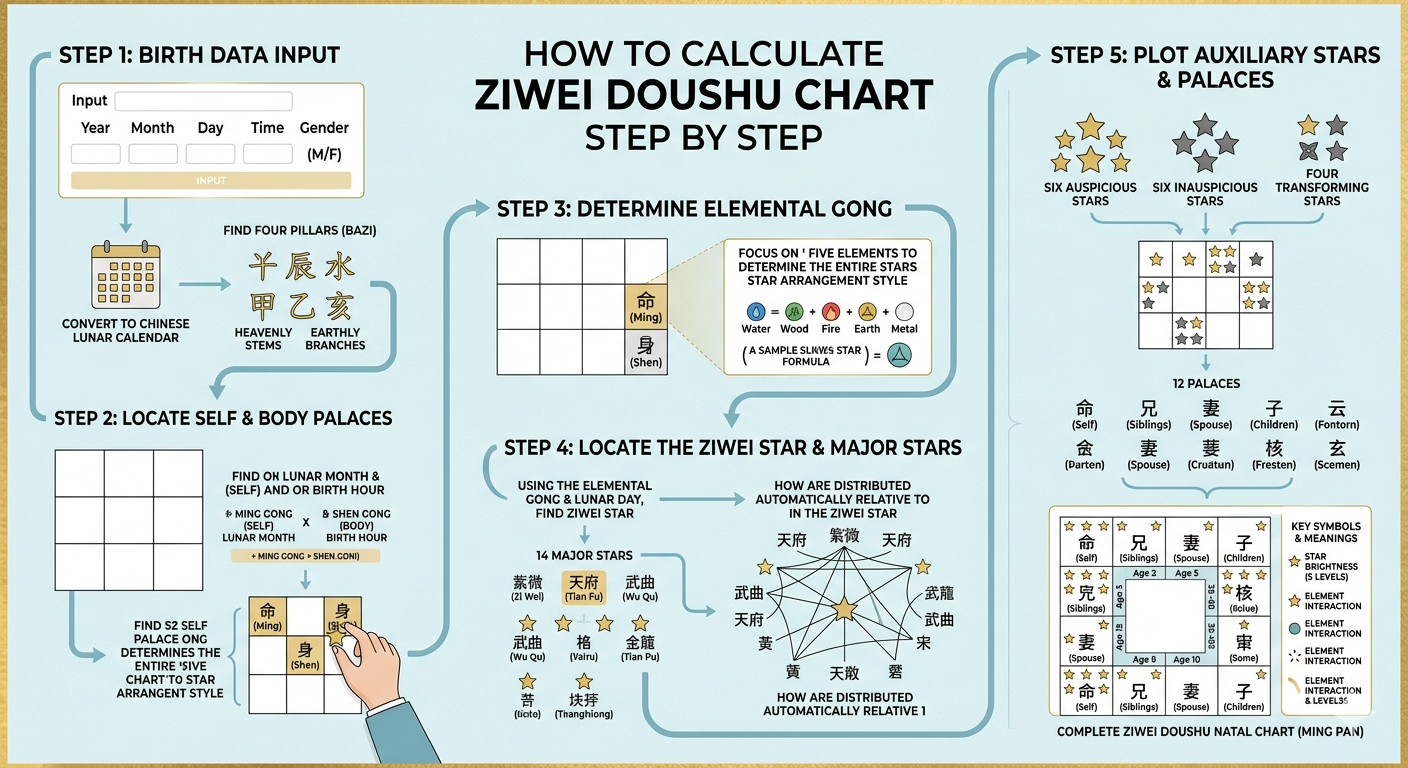
How to Calculate Ziwei Doushu Chart Step by Step Without Mistakes
One of the most common errors beginners make is working with incorrect birth data. Because the entire chart is built from your birth year stem, lunar month, lunar day, and birth hour, any error in these inputs produces a completely wrong chart. Always verify your lunar calendar conversion with more than one source. Also confirm your birth hour carefully, since even being assigned the wrong two-hour block shifts the Life Palace and changes the entire chart.
A second common mistake is misidentifying the position of the Ziwei Star. The traditional day-to-position tables require you to count from a specific starting point, and errors in this step cascade through all the major star placements that follow.
Using a reputable Ziwei Doushu software program or an online chart calculator as a cross-reference while you are learning manual calculations is a wise practice. This helps you catch errors and build confidence before relying entirely on your own hand calculations.
Reading and Interpreting the Chart After Calculation
Once you have placed all the stars and established the palace positions, the interpretive work begins. Each palace is read by examining which major stars occupy it, which minor stars support or challenge those major stars, and which transformations are active in that palace natally or in the current decade or year.
A palace without any major stars is not empty in terms of meaning. It reflects the energies of the opposite palace through a principle of borrowing. Palaces with multiple major stars require careful analysis of how those stars interact, since some stars enhance each other and others create friction.
The Life Palace is typically the first palace examined, as it reveals the person's core character and the broad themes of their destiny. The Career Palace and Wealth Palace are often the next priorities for people seeking practical guidance. The Spouse Palace is closely examined for relationship readings, and the Health Palace receives attention when physical wellbeing is the primary concern.
Read More : how to calculate ziwei doushu chart step by step
How to Calculate Ziwei Doushu Chart Step by Step Using Digital Tools
While understanding the manual process is important for any serious student of this art, the reality is that most practitioners today use software or online calculators to generate their charts instantly. These tools handle all the lookup tables and formula calculations automatically, producing a complete chart from just your birth date and time.
Several reputable platforms exist for generating Ziwei Doushu charts online. When using these tools, ensure the platform allows you to input your birth data in lunar calendar format or confirms that it performs the lunar conversion automatically. Also check that the platform is based on traditional formulas rather than modernized or simplified versions, since the classical system produces the most detailed and accurate results.
Using digital tools to generate the chart and then manually working through the interpretation is a common and effective approach for students at all levels. The chart generation is mechanical and rule-based, but the interpretation requires human judgment, experience, and context.
The Role of the Five Elements in Chart Analysis
The five elements, which are Wood, Fire, Earth, Metal, and Water, underpin the entire Ziwei Doushu system. Each major star is associated with a specific element, and each Heavenly Stem year is also associated with an element. When stars of the same element as your birth year gather in an important palace, or when elemental harmony exists between major stars, the reading for that palace tends to be smoother. When elements clash, the corresponding life area may experience more friction or require more effort.
Understanding elemental interactions adds a significant layer of depth to chart reading and is one of the areas where serious students invest considerable study time.
Conclusion
Understanding how to calculate Ziwei Doushu chart step by step opens a doorway into one of the richest and most sophisticated systems of life reading ever developed. From identifying your Life Palace to placing the Emperor Star and layering the decade timing cycles, each stage of the calculation process deepens your understanding of this ancient art. Whether you approach it as a tool for personal insight, professional consultation, or academic study, the rewards of learning Ziwei Doushu are substantial and lasting.
The process requires patience, careful attention to detail, and a willingness to engage with classical methods that have been refined over centuries. But for those who invest in learning it properly, Ziwei Doushu becomes an invaluable lens for understanding the patterns of a life, the timing of its pivotal moments, and the unique strengths and challenges each person brings into the world. Start with your own chart, study consistently, and trust that the depth of this system will reveal itself gradually as your knowledge and practice grow.