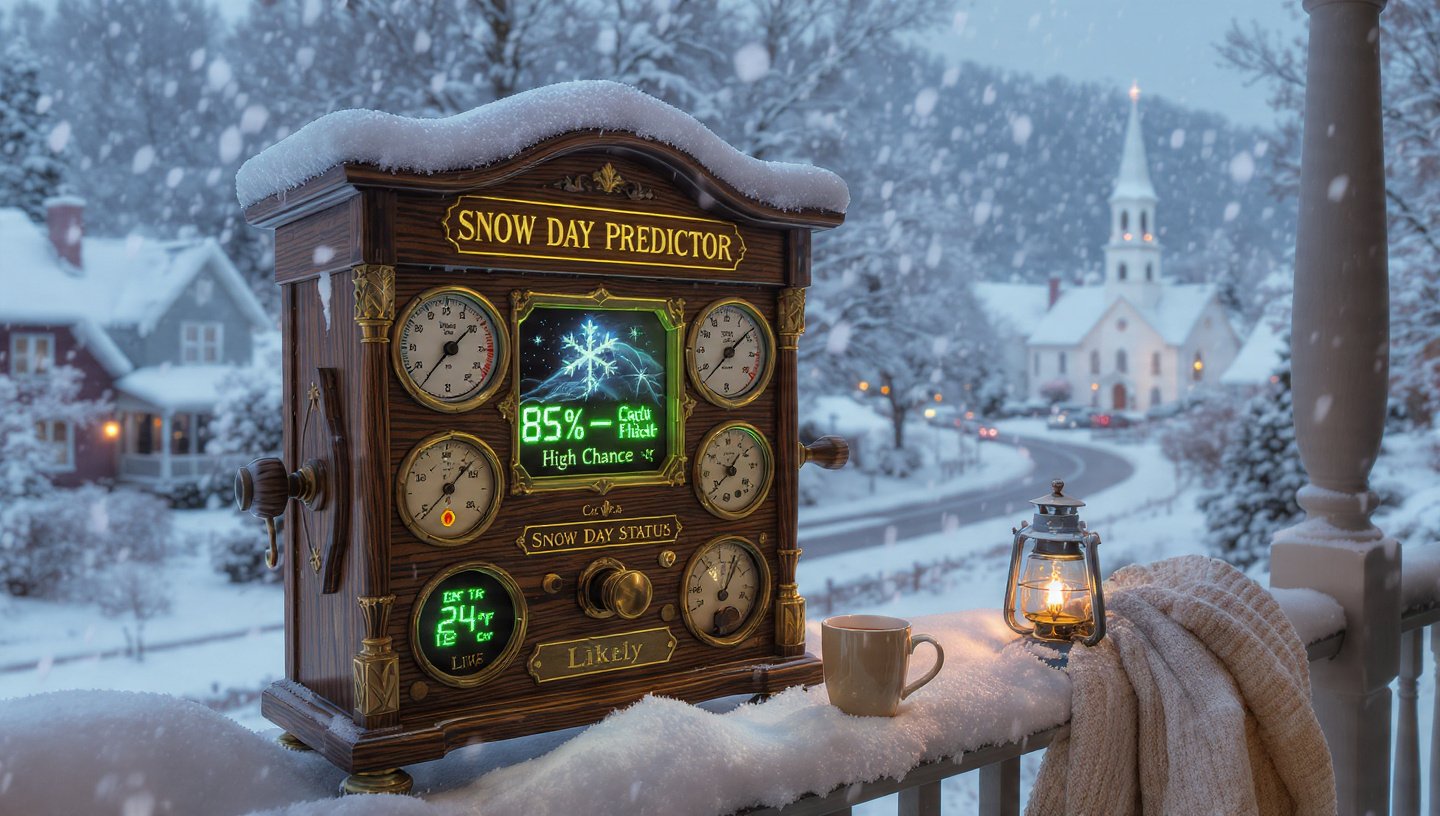
There's a peculiar magic that happens when children across snow-prone regions wake up at 5:30 AM, not out of obligation, but pure anticipation. They're not checking the clock—they're checking their phones, refreshing websites, and waiting for that glorious notification: school is closed due to snow. In the age of digital connectivity, the "snow day predictor" has evolved from superstitious rituals (pajamas inside-out, spoons under pillows) into sophisticated algorithms and crowd-sourced data platforms that attempt to answer the question that keeps students up at night: will tomorrow be a snow day?
The phenomenon of snow day prediction has become a cultural touchstone, a intersection of meteorology, bureaucratic decision-making, and collective hope. But how accurate are these predictors? What actually goes into the decision to close schools? And why has this seemingly simple yes-or-no question spawned an entire ecosystem of websites, apps, and social media accounts dedicated to forecasting the unforecastable?
The Anatomy of a Snow Day Decision
Before diving into the predictors themselves, it's essential to understand what they're attempting to predict. A snow day isn't simply a meteorological event—it's an administrative decision made by human beings weighing multiple variables, often under considerable pressure.
School superintendents typically make the call between 4:00 and 6:00 AM, though some districts announce closures the night before. This decision-maker must consider far more than just snowfall accumulation. Road conditions, temperature, wind chill, ongoing precipitation during bus routes, and the availability of maintenance crews all factor into the equation. A district with excellent snow removal infrastructure might operate normally with six inches of snow, while a region unaccustomed to winter weather might close with a dusting.
The human element introduces unavoidable unpredictability. One superintendent might be more conservative, closing schools with marginal conditions to avoid any risk. Another might keep schools open unless conditions are genuinely dangerous. Some administrators face pressure from parents who rely on school as childcare, while others face criticism for endangering children by keeping schools open. This decision-making variability is precisely what makes snow day prediction so challenging—and so fascinating.
The Original Snow Day Predictor: David Sukhin's Creation
The most famous snow day prediction tool emerged from the mind of a teenager. In 2007, David Sukhin, then a New Jersey high school student, created SnowDayCalculator.com after being disappointed by an unexpected school opening despite snowy conditions. What began as a personal project rapidly became a cultural phenomenon, eventually receiving millions of visits each winter.
Sukhin's algorithm considers multiple data points: predicted snowfall, current temperature, overnight low, snow-day history of the specific school district, day of the week, and even the month (administrators are more likely to close schools in January than March, when they've exhausted many snow days). The calculator produces a percentage likelihood, giving students a quantifiable measure of hope to obsess over.
The genius of Sukhin's creation wasn't necessarily its accuracy—though it performs reasonably well—but its understanding of its audience. Students don't want complicated meteorological charts; they want a simple number that tells them whether to set their alarm. The site's playful interface, complete with confetti animations for high percentages, acknowledges that snow day prediction is as much about shared experience and anticipation as actual forecasting.
The Science Behind the Prediction
Legitimate snow day predictors synthesize data from multiple sources. Modern weather forecasting has become remarkably sophisticated, with meteorologists using everything from satellite imagery to computer models that simulate atmospheric conditions. The National Weather Service, private companies like AccuWeather and The Weather Channel, and specialized forecasting services provide the raw meteorological data that prediction algorithms consume.
However, weather data alone tells an incomplete story. The most advanced predictors incorporate historical patterns specific to individual school districts. Machine learning algorithms can analyze years of data, identifying patterns in administrative behavior. Did this superintendent close schools last year when similar conditions occurred? Does this district have a pattern of closing on Fridays? Has there been a recent snow day that might make administrators less likely to close schools again?
Geographical factors add another layer of complexity. A school district spanning diverse terrain might face vastly different conditions across its boundaries. Rural areas with long bus routes on untreated roads require different considerations than compact urban districts. Elevation differences within a single district can mean the difference between rain and snow, or between passable and dangerous roads.
Temperature matters as much as precipitation. Freezing rain creates far more hazardous conditions than snow, while extreme cold can prompt closures even without precipitation due to frostbite risks for children waiting at bus stops. Wind chill factors into decision-making in ways that pure snowfall measurements don't capture.
The Ecosystem of Prediction Tools
SnowDayCalculator.com spawned numerous imitators and alternatives, each with slightly different methodologies. Some focus on hyper-local predictions, allowing users to input their specific school district for customized forecasts. Others aggregate predictions from multiple sources, creating a consensus forecast. Social media accounts dedicated to specific regions have emerged, often run by meteorology enthusiasts or students themselves, building followings by providing localized snow day predictions and insider information about district decision-making.
Mobile apps have brought snow day predictions into the push notification era. Students can receive alerts when conditions change or when predictions cross certain thresholds. Some apps gamify the experience, allowing users to compete in predicting school closures or to track their accuracy over time.
Weather services themselves have entered the space, with meteorologists at local news stations making their own snow day predictions. These forecasts carry professional credibility but sometimes lack the district-specific historical data that dedicated snow day calculators possess. The best predictions often combine professional meteorology with algorithmic analysis of administrative patterns.
Accuracy: Hope Versus Reality
The uncomfortable truth about snow day predictors is that their accuracy is inherently limited by factors beyond weather forecasting. Even if a predictor perfectly forecasts meteorological conditions, it's predicting human decision-making under uncertainty, often made hours before students would need to travel.
Anecdotal evidence and limited studies suggest that dedicated snow day calculators achieve accuracy rates of 75-85% for clear-cut scenarios—when conditions obviously merit closure or clearly don't. The accuracy plummets for borderline situations, which unfortunately are the exact scenarios where predictions are most desired. When a calculator shows 50-60% likelihood, it's essentially admitting that the decision could go either way.
The predictors face a particular challenge with timing. A storm that arrives at 3:00 AM creates very different conditions than one beginning at 7:00 AM. A superintendent might close schools based on predicted conditions that never materialize, or keep schools open only to have conditions deteriorate after the decision window closes. Some districts have moved to delayed openings as a compromise, but this introduces another variable for predictors to forecast.
False positives—predicting a snow day that doesn't happen—create disappointment but little else. False negatives—failing to predict an actual closure—can mean students wake early and prepare for school unnecessarily. The asymmetry means many predictors err toward over-predicting closures, knowing that disappointed students are more forgiving than those who unnecessarily prepared for school.
The Psychological and Social Dimensions
Snow day predictors tap into something deeper than weather forecasting. They represent a rare moment when children feel they have some control over institutional forces that usually dictate their schedules. The act of checking a predictor is a ritual of hope, a digital age equivalent of the superstitious practices that preceded it.
The shared experience of snow day anticipation creates community. Students compare predictions, debate likelihood, and collectively will their desired outcome into existence. Social media has amplified this communal aspect, with district-specific hashtags trending as students share their predictions and excitement. When a snow day is called, the collective celebration happens online before anyone steps outside.
For adults, snow day predictors evoke nostalgia for this particular kind of anticipation. Parents check predictors not just for practical planning but to reconnect with the magic of unexpected freedom. The predictors themselves often acknowledge this audience, maintaining a playful tone that appeals to the child in everyone who remembers the joy of a surprise day off.
The Climate Change Factor
An emerging complication for snow day prediction is climate change's impact on winter weather patterns. Traditional historical data becomes less reliable as climate patterns shift. Some regions experience fewer snow days overall, while others face more intense but less frequent storms. Warmer winters mean more borderline situations—that treacherous zone where precipitation might be rain, sleet, or snow, and where temperatures hover around freezing.
Some school districts have responded by becoming more conservative with closures, unwilling to risk student safety amid increasingly unpredictable weather. Others have invested in better snow removal infrastructure, becoming less likely to close. Both trends impact predictor accuracy, requiring algorithms to continuously adapt to changing administrative patterns.
The rise of remote learning, accelerated by the pandemic, has introduced another variable. Some districts now implement "virtual learning days" instead of traditional snow days, eliminating closures altogether. Others use remote learning only for borderline situations, adding a three-way prediction challenge: traditional snow day, virtual learning day, or regular school? This evolution challenges the entire premise of snow day prediction while potentially preserving the underlying question of whether students need to physically attend school.
The Future of Snow Day Prediction
Technology continues to advance the sophistication of snow day forecasting. Artificial intelligence and machine learning models can process increasingly complex data sets, potentially identifying patterns invisible to human programmers. Integration with official school district communication systems could allow real-time updates as administrators make decisions.
However, the fundamental challenge remains: predicting human decision-making under uncertainty. Until school closure decisions become fully automated based on objective criteria—an unlikely scenario given the complex factors involved—snow day predictors will remain probabilistic rather than deterministic.
Some districts have moved toward evening announcements for morning closures, giving families more planning time but reducing the drama of early-morning suspense. This shift improves practical outcomes while potentially diminishing the cultural experience of snow day anticipation that predictors celebrate.
Read More : snow day predictor
Conclusion: More Than Just Algorithms
Snow day predictors represent a fascinating intersection of technology, meteorology, psychology, and nostalgia. They're imperfect tools attempting to solve an inherently unpredictable problem, yet they persist because they serve needs beyond simple information: they create shared experience, channel hope, and acknowledge that sometimes the most important forecasts aren't about weather at all, but about the human decisions weather influences.
Whether checking SnowDayCalculator.com, following a regional meteorologist on social media, or using a district-specific app, students continue the age-old practice of hoping for that unexpected gift of freedom. The predictors have simply modernized the ritual, replacing inside-out pajamas with algorithms, but preserving the essential magic: the possibility that tomorrow, the normal rules might be suspended, and a day of unstructured joy might appear as unexpectedly as snow itself.