Introduction
Every winter, students, parents, and teachers find themselves glued to weather apps and school websites, hoping for that magical announcement: school is cancelled. The snow day predictor percentage has become one of the most relied-upon tools during the cold months — giving households a data-driven estimate of whether a snow day is likely to occur. But what exactly does this percentage mean, how is it calculated, and how accurate is it? This article dives deep into the concept of snow day predictor percentages, explaining the science behind them, the tools available, and how you can use them to make smarter decisions when winter weather rolls in.
What Is a Snow Day Predictor Percentage?
Defining the Snow Day Predictor
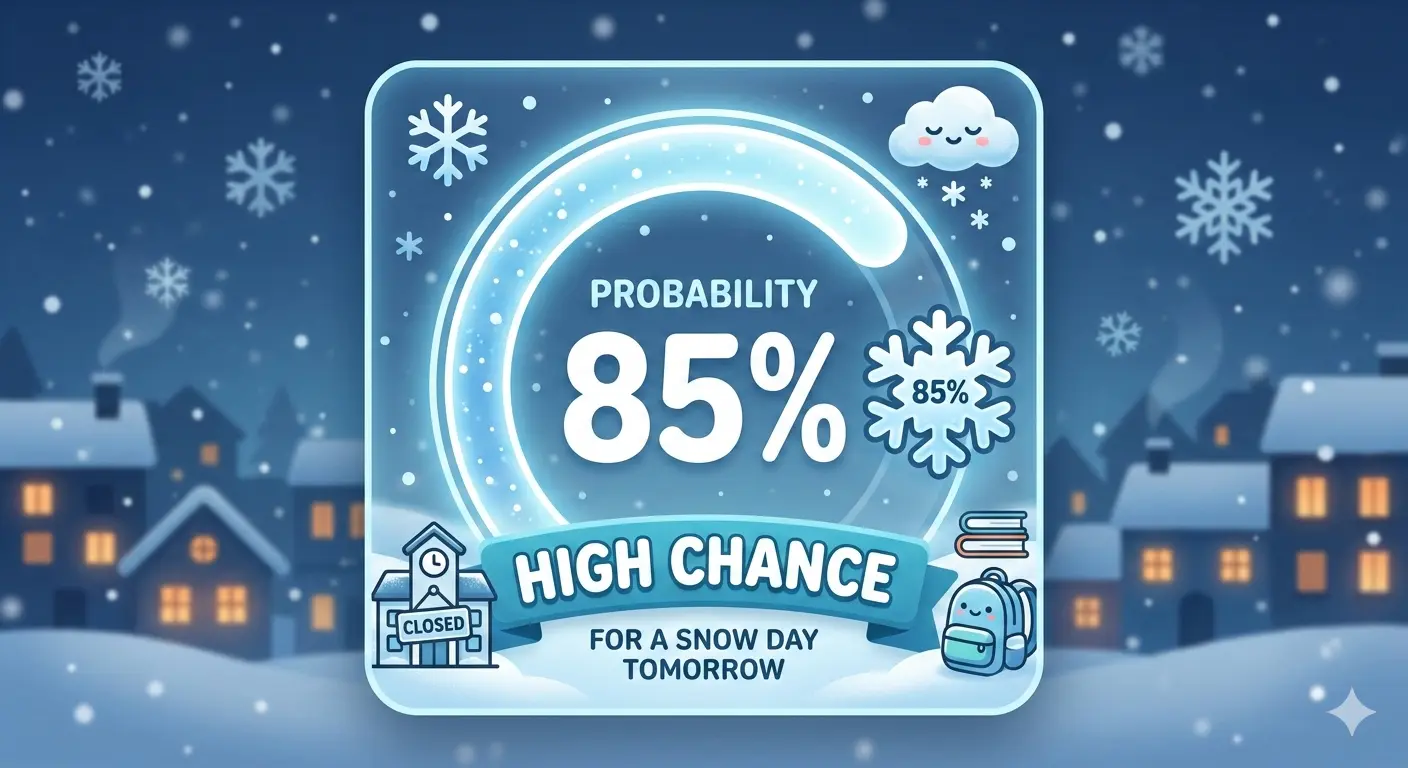
A snow day predictor percentage is a numerical estimate — expressed as a percentage from 0% to 100% — that indicates the likelihood of a school closure or work cancellation due to winter weather conditions. It is not a random guess; it is the output of an algorithm or model that weighs multiple weather-related and geographic variables to arrive at a probability score.
The concept became widely popular with the rise of digital weather tools and consumer-friendly apps. Today, several platforms offer snow day predictor percentages for specific ZIP codes or school districts, making the information both personalized and accessible.
How the Percentage Is Expressed
The snow day predictor percentage is straightforward to interpret:
- 0–20%: Very unlikely that schools or businesses will close. Normal operations expected.
- 21–50%: Possible disruption. Conditions are uncertain, and closures are a real but non-dominant possibility.
- 51–75%: More likely than not that a snow day will occur. Parents and students should begin planning.
- 76–100%: High confidence in a snow day. Officials and families should prepare for closures.
This percentage allows families to plan childcare, commutes, and schedules in advance rather than waiting for last-minute announcements.
How Is the Snow Day Predictor Percentage Calculated?
Weather Data as the Foundation
The most important inputs into a snow day predictor percentage are weather data points. These typically include:
Snowfall accumulation forecasts: The amount of snow expected, usually measured in inches or centimeters, is one of the strongest predictors. Most models apply a sliding scale where higher accumulations (above 4–6 inches) dramatically increase the snow day predictor percentage.
Timing of the snowfall: Snow that falls between midnight and early morning has a much greater impact on school closures than snow falling in the afternoon. A predictor that accounts for timing will assign a higher percentage when accumulation is expected overnight or during the morning commute window.
Temperature and wind chill: Even without heavy snowfall, dangerously low temperatures or high wind chill values can trigger closures. The snow day predictor percentage often factors in extreme cold thresholds defined by local school boards.
Ice and freezing rain probability: Freezing rain and black ice are sometimes more disruptive than snow alone. Many predictors include freezing precipitation probability in their models, which can substantially increase the overall percentage.

Geographic and Demographic Variables
Beyond weather data, the snow day predictor percentage can shift significantly based on location-specific factors:
Region and climate norms: A region that regularly receives heavy snowfall — such as the Upper Midwest or New England — has different tolerance thresholds than a region that rarely sees snow, like the mid-Atlantic South. Predictors adjust accordingly. A 3-inch snowfall in Atlanta might produce a 90% snow day predictor percentage, while the same storm in Buffalo might yield only 10%.
Urban vs. rural settings: Cities with robust road-clearing equipment, salting crews, and infrastructure typically handle winter weather better than rural school districts, where roads may remain hazardous for longer. This affects the local snow day predictor percentage even for similar weather events.
School district history: Some predictors incorporate historical data — how often a specific district has cancelled school under various conditions — to refine their estimates. This makes the snow day predictor percentage more personalized and regionally relevant.
Popular Snow Day Predictor Tools and Platforms
Online Snow Day Calculators
Several websites and apps have become go-to resources for checking the snow day predictor percentage. These tools typically ask users to enter their ZIP code and sometimes their school district name, then return a real-time percentage based on available forecast data.
The most well-known tool in North America is often simply called the "Snow Day Calculator," which uses a combination of National Weather Service data and community feedback to generate its predictions. The platform generates a snow day predictor percentage that is updated multiple times per day as forecast models are refreshed.
Weather App Integrations
Major weather apps and platforms have begun integrating school closure probabilities into their winter weather features. These in-app snow day predictor percentages are derived from the same underlying weather models but are presented in consumer-friendly dashboards alongside temperature forecasts, radar imagery, and hourly breakdowns.
School District Alert Systems
Many school districts now subscribe to automated weather monitoring systems that generate internal snow day predictor percentages used by administrators to make closure decisions. These systems often integrate road condition data from state departments of transportation and real-time temperature readings from local sensors.
Benefits and Uses of the Snow Day Predictor Percentage
For Parents and Families
The snow day predictor percentage gives parents the gift of time. Instead of scrambling for childcare at 6 a.m. after an unexpected closure announcement, families can check the percentage the night before and arrange backup plans when the probability is high. This reduces stress, prevents disruption to work schedules, and allows for a more organized morning.
For Students
Students — particularly high schoolers and college students — use the snow day predictor percentage to manage their academic planning. A high percentage can prompt students to complete assignments ahead of schedule, reschedule study sessions, or simply prepare for a potential day off.
For Teachers and School Administrators
Educators use the snow day predictor percentage as one input among many when making closure decisions. A high percentage at 8 p.m. the night before a school day may prompt administrators to issue early closure warnings, giving families more preparation time. It also helps with scheduling make-up days and communicating expectations around remote learning.
For Businesses and Employers
Beyond schools, the snow day predictor percentage is useful for businesses that need to make staffing decisions when winter storms approach. Retailers, restaurants, healthcare facilities, and logistics companies can use these predictions to adjust shift schedules, activate remote work protocols, or prepare for reduced foot traffic.
Tips and Best Practices for Using the Snow Day Predictor Percentage
Check Multiple Sources
No single snow day predictor percentage is infallible. Different platforms use different data inputs and algorithmic weightings. Cross-referencing two or three sources — a dedicated snow day calculator, a major weather app, and your local National Weather Service forecast — gives you a more complete picture.
Refresh Regularly
Winter weather forecasts can change rapidly. A snow day predictor percentage of 30% at noon can jump to 75% by evening as storm tracks become clearer and updated model runs come in. Make a habit of checking the percentage again in the evening before a potentially snowy school day.

Understand Your Region's Sensitivity
Learn how your local school district historically responds to various snow totals. If your district tends to cancel school with as little as 2 inches, your local snow day predictor percentage will naturally run higher for even modest storms. This regional context helps you calibrate your interpretation of the percentage.
Plan Ahead at the 50%+ Mark
Don't wait for a 90% snow day predictor percentage before making childcare arrangements or adjusting your schedule. Once the prediction crosses the 50% threshold, it's wise to start forming a contingency plan. Waiting too long limits your options.
Combine the Predictor with Official Alerts
Use the snow day predictor percentage as an early indicator, but always follow official school district announcements, emergency alert systems, and local government guidance for confirmed closures. The percentage is a forecasting tool — actual decisions rest with human administrators.
Read More :
Conclusion
The snow day predictor percentage has transformed how families, students, educators, and businesses navigate winter weather uncertainty. By combining meteorological data, geographic variables, and historical patterns, this single number delivers actionable information in an easy-to-understand format. While it is not a guarantee — weather is inherently unpredictable — a reliable snow day predictor percentage arms you with the foresight to plan ahead rather than react. Whether you're a parent arranging childcare, a student hoping for a reprieve from exams, or an administrator weighing a difficult closure decision, understanding how to read and apply the snow day predictor percentage is a genuinely useful winter skill.