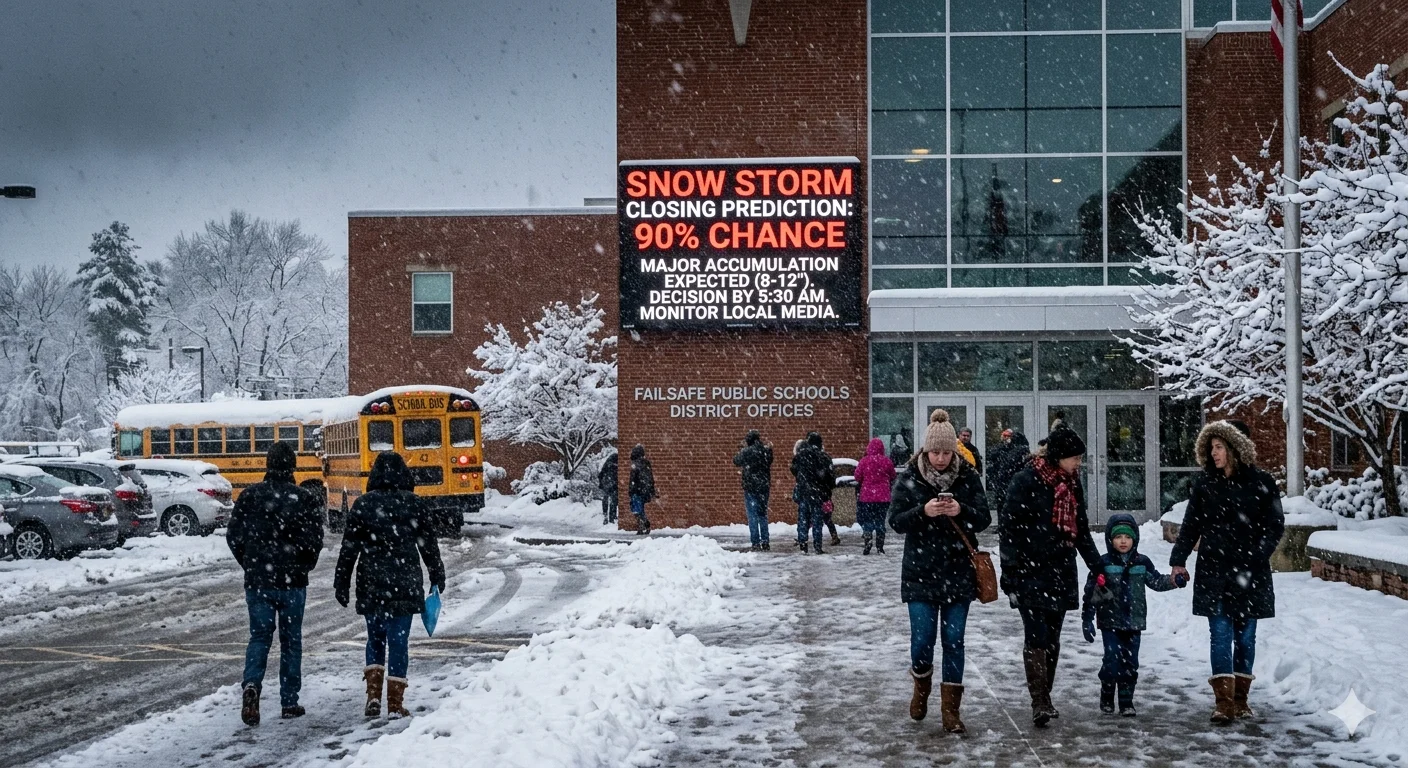
Introduction: Why Snow Day Prediction Matters More Than Ever
Every winter, millions of students, parents, and teachers wake up to the same anxious question: will school be open today? When a major snowstorm rolls in overnight, the uncertainty can feel overwhelming. That is exactly where a snow day predictor becomes one of the most useful tools you can have on your phone or computer. Snow storm school closing prediction has evolved from guesswork and phone tree calls into a sophisticated science powered by real weather data, artificial intelligence, and years of historical patterns. Today, you can check your snow day chances with a few clicks and get a surprisingly accurate picture of whether school will be cancelled tomorrow.
This guide covers everything you need to know about snow day calculators, how school closing predictors work, what factors influence the decision, and how to use the best available tools to stay one step ahead of winter weather. Whether you are a student hoping for a day off, a parent trying to plan childcare, or a teacher preparing lesson plans, understanding snow day prediction will make your winter season a lot less stressful.
What Is a Snow Day Predictor and How Did It Start
A snow day predictor is a digital tool or algorithm that uses weather forecast data to estimate the probability that your local school will cancel classes due to snow or winter storm conditions. These tools take raw meteorological information including expected snowfall totals, temperatures, wind chill, timing of the storm, and road conditions and combine them into a percentage or likelihood score that tells you your snow day chances.
The concept started simply enough. In the early days of the internet, a teenager named David Sukhin built a basic snow day calculator as a fun project. His tool used zip code based weather data and a few simple rules to spit out a probability. Word spread fast among students, and soon the idea caught on. Over the years, dozens of similar tools appeared, each trying to improve on accuracy and user experience. Today, snow day calculators have become a staple of winter weather browsing, attracting millions of visitors every time a significant storm is forecast.
The modern snow day predictor has come a long way from those early days. Today's tools pull live data from the National Weather Service, private weather APIs, and local meteorological stations. They factor in school district policies, historical cancellation records, and even the day of the week. The result is a far more nuanced and reliable estimate than anyone could produce manually.
How Snow Storm School Closing Prediction Works Behind the Scenes
Understanding how a snow day prediction is generated helps you use these tools more effectively. The process begins with raw weather forecast data. A snow day calculator pulls projected snowfall accumulation for your area, typically measured in inches over a 12 to 24 hour period. But snowfall alone does not determine whether school closes. The algorithm also considers several other critical inputs.
Temperature and wind chill play a major role. Heavy snow that falls when temperatures hover around 32 degrees Fahrenheit behaves very differently from snow that falls at 10 degrees. Wet, heavy snow causes more dangerous road conditions and is harder for plows to manage quickly. Extreme cold without any snowfall can also trigger school closings if wind chills drop to dangerous levels for children waiting at bus stops.
Timing is another crucial factor in school cancellation prediction. A storm that drops most of its snow between midnight and 4 AM gives road crews several hours to clear roads before buses run at 6 or 7 AM. A storm that peaks during the morning commute is far more likely to trigger a closing. Snow day calculators weigh the hourly breakdown of a forecast heavily when computing probability.
Wind speed matters too. High winds cause blowing and drifting snow that can close roads even after plows have passed. Gusts above 30 to 40 miles per hour combined with any snowfall significantly raise snow day chances. Some calculators also factor in the presence of ice, freezing rain, or sleet, which are often more dangerous than snow alone and are among the most reliable triggers for school cancellations.
Finally, algorithms consider regional norms and school district history. A school district in northern Minnesota that is accustomed to heavy winters will stay open in conditions that would shut down a district in Virginia or Georgia. Snow day calculators that use zip code data can approximate these regional thresholds and adjust probability accordingly.

Snow Day Predictor Accuracy: What You Should Realistically Expect
One of the most common questions people ask about snow day calculators is how accurate they really are. The honest answer is that accuracy varies quite a bit depending on the quality of the weather forecast, the time of year, and the specific region. Most well-built snow day prediction tools claim accuracy rates somewhere in the 70 to 85 percent range for predictions made 12 to 24 hours before a storm.
Weather forecasting itself is the biggest limiting factor. No matter how sophisticated the algorithm behind a snow day calculator is, it can only be as accurate as the weather data it relies on. Snowfall forecasts are notoriously tricky. A storm that was expected to drop 8 inches might end up dropping 3, or conversely 14. These shifts can flip a snow day prediction entirely.
That said, modern numerical weather prediction has improved dramatically. Forecast models from the European Centre for Medium-Range Weather Forecasts and the American GFS model are significantly better today than they were a decade ago. AI-enhanced weather prediction is pushing accuracy even higher. This improvement directly benefits snow day calculators that tap into real-time forecast feeds.
The closer you get to the storm, the more reliable the prediction becomes. A snow forecast accuracy window of 6 hours before the storm hits is generally tight enough to give a very good estimate of whether school will close. Checking a snow day predictor three days out will give you a rough idea of risk, but the probability number should not be taken too literally that far in advance.
It is also worth noting that school administrators have discretion that no algorithm can fully replicate. A superintendent who lives on a rural road that is always the last to be plowed may be more cautious than one who lives on a main artery. Personal judgment, community expectations, and even economic factors like the number of snow days already used in the calendar year all influence the final call.
Snow Day Calculator Online: Finding the Right Tool for Your Area
Not all snow day calculators are built the same way, and finding one that works well for your specific area can make a real difference in accuracy. The most popular tools are web-based and free to use. You simply enter your zip code or city name, and the calculator fetches local weather data and generates a probability estimate.
The original Snow Day Calculator at snowdaycalculator.com remains one of the most visited tools of this type. It has been refined over many years and uses a combination of temperature, precipitation type, wind speed, and local school history to generate predictions. The site is simple and fast, making it easy to check your snow day chances even from a phone during a storm.
Other platforms have emerged with more sophisticated approaches. Some weather apps now include snow day prediction features built into their winter storm alerts. These integrations are convenient because they keep all your weather information in one place and push notifications when snow day probability crosses a threshold you set.
When choosing a snow day calculator online, look for tools that clearly state where they pull their weather data from. The best ones use NOAA or National Weather Service data combined with data from commercial weather providers. Transparency about the algorithm, even if only described in general terms, is a good sign that the tool is built on solid foundations rather than a rough guess.
Snow Day Predictor by Zip Code: Why Local Data Makes All the Difference
One of the most important features any snow day predictor can offer is zip code level precision. Weather does not fall evenly across a region. A storm that drops 10 inches on one side of a metropolitan area might drop only 4 inches 20 miles away due to lake effect, elevation, or microclimatic variation. A zip code based snow day calculator captures these differences in ways that a city-wide or county-wide forecast cannot.
When you enter your zip code into a school closing predictor, the tool maps your location to the nearest weather observation station and pulls forecast data for that specific grid point. This gives you a much more relevant prediction than a general regional forecast. Families living near mountains, lakes, or coastal areas see this benefit most clearly, since weather conditions in these zones can be dramatically different from nearby inland areas.
Zip code level prediction also allows tools to cross-reference your location with known school district boundaries. The best platforms maintain databases of which school districts serve which zip codes, allowing them to account for district-specific policies and historical closing patterns. This extra layer of data is what separates a truly useful snow storm school closing prediction tool from one that just throws weather numbers at you without context.
How Schools Actually Decide to Cancel Classes During a Winter Storm
To understand snow day prediction, it helps to know what actually goes into the decision on the school district side. Superintendents and transportation directors typically begin monitoring forecasts 24 to 48 hours before a potential storm. They track the same weather models that professional forecasters use, and many districts maintain relationships with private meteorologists who provide tailored forecasts for their service area.
The final decision to cancel school is rarely made far in advance. Most superintendents prefer to wait as long as possible because early cancellations that turn out to be unnecessary are politically costly and disruptive. The typical decision window is between 4 AM and 6 AM on the day of the storm. By that point, road crews have been working for hours, and supervisors can assess actual road conditions rather than relying purely on forecast models.
Key factors that push administrators toward cancellation include active snow accumulation during morning hours, road crews reporting that primary routes are still unpassable, extreme wind chills that would endanger students at bus stops, and forecasts showing that the worst conditions will hit right during arrival or dismissal times. Secondary factors include the number of snow days already used, pressure from neighboring districts, and the time of year in the school calendar.
Some districts use a tiered system of responses. A two hour delay means conditions are bad but expected to improve. Early dismissal means conditions deteriorated during the day. A full cancellation means the forecast and road conditions are severe enough that no safe window for transportation exists. Many snow day calculators now attempt to predict delay probability alongside full cancellation probability, making them more nuanced and useful than ever.
AI Snow Day Predictor Tools: How Machine Learning Is Changing Winter Forecasting
The newest generation of snow storm school closing prediction tools uses artificial intelligence and machine learning to improve accuracy in ways that traditional rule-based algorithms cannot match. AI-powered snow day predictors can identify patterns in historical data that human analysts would never spot, and they can update their probability estimates in real time as new weather observations come in.
Machine learning models trained on years of school closing records can learn the subtle tendencies of specific districts. For example, if a particular district has a history of cancelling school whenever the forecast calls for more than 4 inches of snow, regardless of temperature, the model learns that threshold. If another district almost never closes unless roads are actually icy, the model captures that too. These learned district-level behaviors make AI snow day predictors significantly more accurate than generic tools.
Real-time data integration is another area where AI excels. Modern AI-powered weather apps pull in data from satellites, radar, surface observation stations, weather balloons, and even crowd-sourced reports from users on the ground. Processing all of this data simultaneously and weighting it appropriately to produce a unified prediction is exactly the kind of task where machine learning algorithms outperform traditional methods.
Natural language processing is beginning to play a role as well. Some platforms monitor official school district social media accounts and websites for early signals of cancellation decisions. An AI that notices a district superintendent posting about checking road conditions at 3 AM can subtly increase its closing probability estimate even before any official announcement is made. This kind of contextual signal processing is uniquely possible with modern AI tools.
The accuracy improvements from AI integration are real and measurable. Several platform operators who have publicly shared data report that machine learning enhanced predictions outperform their previous rule-based systems by 8 to 12 percentage points in terms of prediction accuracy. As training datasets grow larger and weather models improve, this gap is expected to widen.
Best Snow Day Predictor Websites and Apps Available Today
The market for snow day prediction has grown into a small but competitive space with several worthwhile options. Here is a rundown of the best available tools and what makes each one useful.
Snow Day Calculator is the original and still among the most popular. Available at snowdaycalculator.com, it offers a simple interface, zip code based lookup, and a clear percentage output. It has been in operation long enough to have accumulated significant historical data that informs its predictions. The site also shows the factors driving the estimate, which helps users understand why the probability is what it is.
Weather Underground, now part of The Weather Company and IBM, offers hyperlocal forecasts down to the neighborhood level. While not a dedicated snow day predictor, its detailed hourly forecasts and personal weather station network make it an excellent tool for assessing conditions that drive school closing decisions.
The Weather Channel app and website includes school closing and delay alerts that aggregate official announcements from thousands of school districts. This is not a prediction tool but a real-time announcement aggregator. Using it alongside a snow day calculator gives you both the predictive probability and the official confirmation when it happens.
AccuWeather has invested heavily in AI-powered forecasting and provides minute-by-minute precipitation forecasts that are highly useful for timing-based prediction. Their school closing tracker is one of the more comprehensive official announcement systems available.
Newer platforms developed specifically around snow day prediction are emerging, particularly as mobile apps. These apps combine push notifications, zip code tracking, and AI prediction into a clean package. Some allow you to track multiple zip codes simultaneously, which is useful for families with children in different districts or parents who want to monitor both home and work locations.

Winter Storm Prediction Tools Beyond School Closings
Snow day calculators are just one application of winter storm prediction technology. The same underlying weather models and data feeds power a wide range of tools that help communities, businesses, and governments prepare for severe winter weather. Understanding this broader ecosystem helps put school closing prediction in context.
The National Weather Service issues winter storm watches, warnings, and advisories that form the backbone of public winter weather communication. A winter storm warning means severe conditions are expected and people should avoid travel. A winter storm watch means conditions are possible in the next 48 hours and preparation is advised. These official designations are major inputs into snow day calculators and directly influence school closing probability.
State departments of transportation use sophisticated weather prediction systems to coordinate plowing, salting, and road condition monitoring. Their real-time data on road surface temperatures, treatment effectiveness, and crew deployment is highly relevant to snow day decisions, though most of this data is not yet publicly integrated into consumer snow day apps.
Commercial weather intelligence firms serve businesses, airlines, utilities, and municipalities with tailored winter storm forecasts and impact assessments. The methodologies developed for these enterprise clients increasingly filter down into consumer tools, raising the overall quality of publicly available snow day prediction.
Snow Day Predictor for Students: Making the Most of the Wait
For students, the snow day predictor has become something of a ritual. Checking the percentage before bed, refreshing it early in the morning, and comparing notes with friends is now a universal part of the winter school experience. But beyond the anticipation, there are practical ways students can use these tools more effectively.
The best time to check a snow day predictor is the evening before a potential storm. By 8 or 9 PM, weather models have typically settled on a consistent forecast, and the probability estimate from a good snow day calculator is usually within a few percentage points of where it will end up. Checking at 6 PM might catch the forecast before it has fully resolved, giving you a less reliable estimate.
Pay attention to the factors the calculator shows you, not just the final number. If the tool says snowfall is projected to be 6 inches but temperatures will be above freezing and the storm arrives after 6 AM, that context tells you the road clearing crews have a better chance of making the roads passable before the first school bus rolls out. A 60 percent probability with those factors is different from a 60 percent probability during an overnight storm with subzero wind chills.
Do not count your snow day before it is confirmed. A probability of even 80 percent means there is a 20 percent chance school will be open. Always have your homework done, your bag packed, and your alarm set. Let the snow day be a bonus rather than an assumption.
How to Predict a Snow Day Manually Without a Calculator
Even without a dedicated snow day calculator, you can make a reasonably informed estimate by following a simple framework used by experienced winter weather watchers.
Start with the snowfall forecast from a trusted source. The National Weather Service forecast for your zip code is free and highly reliable. Look at the expected accumulation and compare it to what your district has historically required to cancel school. In most northeastern and midwestern districts, 6 or more inches is typically enough to trigger serious consideration. In southern districts, even 2 inches can shut everything down.
Next, check the timing. Use an hourly forecast to see when the heaviest snow is expected. If most snow falls between 10 PM and 4 AM, road crews have time to work. If the storm peaks at 5 AM to 8 AM, the roads will be at their worst right when buses need to run.
Check the temperature forecast. Below about 28 degrees Fahrenheit, snow does not melt easily and accumulates faster. Wind chill below minus 10 or 15 degrees Fahrenheit is sometimes a standalone trigger for cancellation even without snow.
Look at wind speed. Gusts above 30 mph create blowing and drifting snow that can close roads even after plowing. Finally, check whether nearby districts have already announced closings. When neighboring districts close, the political pressure on your superintendent increases noticeably.
Weigh these factors together and you will have a reasonable manual estimate. You probably will not be as accurate as a well-designed calculator, but you will understand the situation well enough to make smart decisions.
Snow Day Predictor Percentage Explained: Understanding the Numbers
When a snow day calculator gives you a probability like 73 percent, what does that actually mean? Many users look at this number and interpret it as a firm statement that school will close, but the percentage is really a probabilistic estimate based on the available forecast data.
A 73 percent probability means that across all scenarios consistent with the current weather forecast, roughly 73 percent of them result in school cancellation. The other 27 percent of scenarios lead to school opening normally or with a delay. That 27 percent is real and worth taking seriously.
Probabilities above 85 percent are generally considered high confidence predictions. Probabilities between 50 and 70 percent represent genuinely uncertain situations where the storm could go either way. Anything below 40 percent suggests school is more likely to be open than closed, though conditions may still be worth monitoring.
It is also important to understand that these probabilities are calculated at a specific moment in time based on the best available forecast. As the storm approaches and forecasts are updated, the probability can shift significantly. A 60 percent estimate at noon can become 90 percent by 10 PM if the storm track shifts toward your area. Always check closer to the storm for the most reliable estimate.
Snow Forecast vs Snow Day Prediction: Understanding the Key Difference
A snow forecast and a snow day prediction are related but distinct things. A snow forecast is a meteorological output that tells you how much snow to expect, when it will fall, and what temperatures and winds will accompany it. A snow day prediction takes that forecast data as input and applies additional logic to estimate whether those conditions will actually cause your school to close.
You can have a forecast for 8 inches of snow and still end up with school open if that snow falls slowly overnight, roads are treated effectively, and the storm clears by 5 AM. You can also have school closed on a day with only 3 inches of snow if that snow is accompanied by extreme cold, strong winds, and falls entirely between 5 AM and 8 AM.
This distinction matters because many people check weather apps, see a snowfall forecast, and try to draw their own conclusions without understanding all the relevant factors. A dedicated snow storm school closing prediction tool does this translation work for you. It converts the raw forecast into an actionable probability that accounts for all the factors that actually drive school closing decisions.
Latest Trends in Snow Day Prediction Technology for 2024
The field of snow day prediction is evolving rapidly, driven by advances in AI, weather modeling, and mobile technology. Several exciting trends are reshaping how students and parents access and use these tools.
AI-based snow day predictors are becoming the new standard. Older tools relied on fixed rules and thresholds. New tools use neural networks and gradient boosting algorithms trained on years of historical data to make more nuanced predictions. These AI systems can identify complex nonlinear relationships between weather variables and school closing decisions that no human analyst would think to hard-code into a rule.
Real-time weather data integration is now a baseline expectation rather than a premium feature. The best current tools pull data continuously from weather APIs, updating predictions every hour or sometimes more frequently as storm conditions evolve. This allows users to watch the probability shift in real time as a storm develops or changes track.
Mobile apps have democratized snow day prediction. What used to require sitting at a desktop browser is now available through elegant, notification-friendly smartphone apps. The best apps deliver push notifications when probability crosses a threshold you choose, eliminating the need to manually check. This convenience has dramatically expanded the audience for snow day prediction tools.
Machine learning in weather forecasting more broadly is improving the raw forecast data that snow day calculators depend on. Ensemble modeling, which runs dozens of slightly different simulations and averages the results, has become standard practice at major weather centers. This approach produces more accurate probabilistic forecasts that translate directly into better snow day predictions.
Integration with smart home devices and voice assistants is an emerging frontier. Asking a voice assistant about your snow day chances is becoming possible as providers build skills and integrations around weather-based school closing prediction. This trend is still early but the convenience factor suggests it will grow quickly.

Tips for Using a Snow Day Predictor Effectively
Getting the most out of a snow day calculator requires a bit of strategy. Here are the most useful practices for students, parents, and teachers who want reliable predictions.
Check the predictor in the evening, not immediately after school. Evening is when weather models have ingested the afternoon's observation data and generated their most refined overnight forecasts. A prediction checked at 8 PM is generally more reliable than one checked at 4 PM.
Use more than one source. No single tool has a monopoly on accuracy. Checking two or three different snow day calculators and comparing results gives you a better sense of confidence. If three tools all show probabilities above 80 percent, you can be fairly confident. If they vary widely between 40 and 75 percent, the situation is genuinely uncertain.
Pay attention to the storm timing, not just the snowfall total. A tool that shows you hourly forecast breakdowns allows you to assess the timing yourself. Look for whether the heaviest precipitation is forecast to fall before or during morning commute hours.
Follow your school district on social media. Many districts post updates to Twitter, Facebook, or their website in the early morning hours before making official announcements. These posts can be early signals of what is coming.
Avoid common mistakes like trusting a single prediction made 48 hours in advance, treating any probability below 90 percent as a certainty, or assuming that a snow day is guaranteed just because a neighbor's district closed. Districts often have different thresholds and different road crews.
Read More : Snow Day Predictor Pennsylvania
Conclusion: Making Winter Weather Work for You
Snow day prediction has transformed from a wishful guessing game into a data-driven science that genuinely helps families and educators prepare for winter disruptions. Whether you rely on a classic zip code based snow day calculator, a cutting-edge AI snow prediction app, or simply want to understand how snow storm school closing prediction works, the tools and knowledge available today are more powerful than ever before.
The key is using these resources thoughtfully. Check predictions at the right time, understand what the probability percentages actually mean, and always have a backup plan for the scenarios where the forecast does not pan out as expected. Snow day calculators are remarkably useful, but winter weather remains one of nature's most unpredictable forces.
As AI and weather modeling technology continue to improve, the accuracy of school closing prediction will only get better. For now, the best approach is to use the best available tools, combine them with your own local knowledge, and stay flexible. Winter storms are inevitable, but being caught completely off guard by them does not have to be. A good snow day predictor helps you stay one step ahead of the storm every season.
Also Checkout :