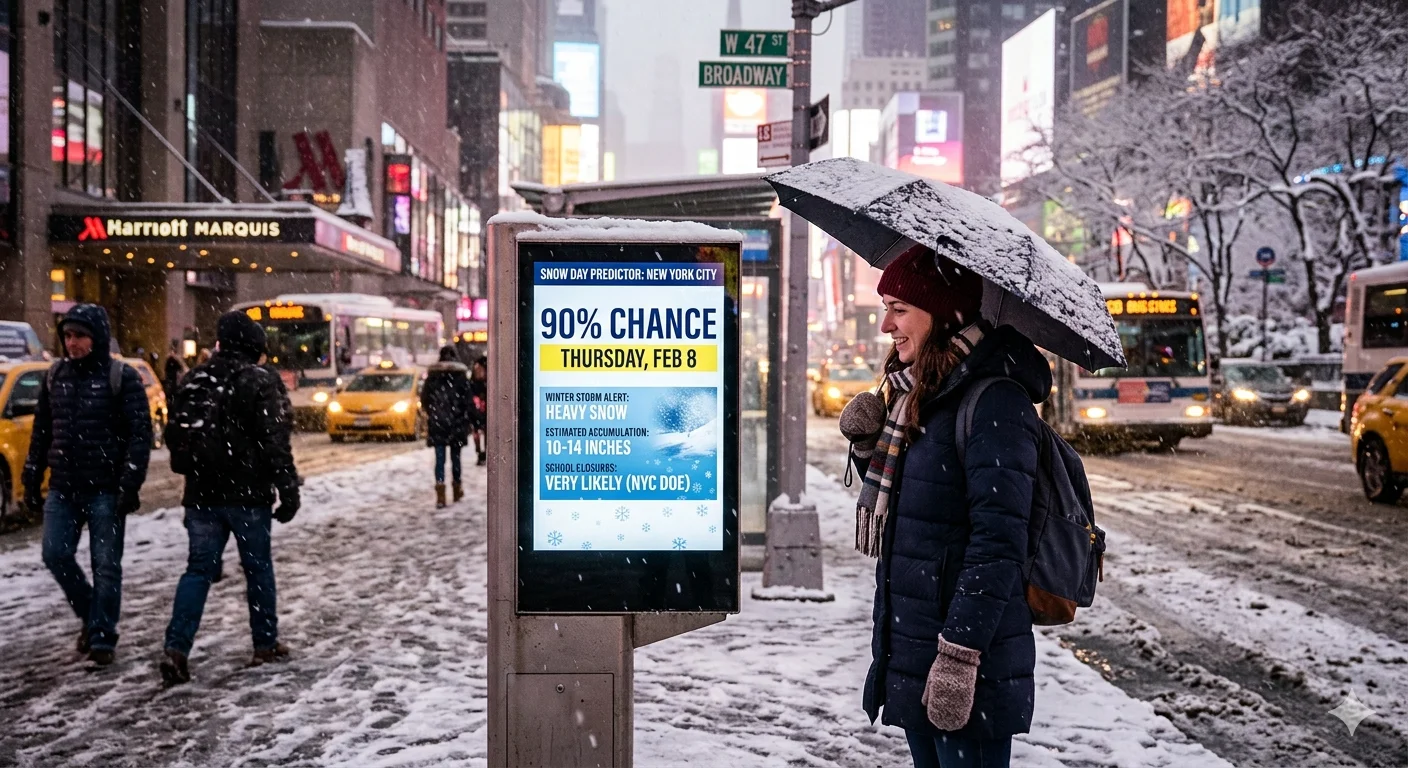
New York State is one of the most weather-diverse states in the entire United States. From the lake-effect snow belts of Buffalo and Syracuse to the crowded streets of New York City, winter weather affects millions of students and families every single year. If you are wondering whether school will be closed tomorrow in New York, Snow Day Predictor at snowdaypredictor.xyz is the fastest, most accurate free tool available giving you a 7-day school closure probability forecast for any city or ZIP code in New York State.
How to Check Snow Day Chances for New York Schools
Using Snow Day Predictor for any New York location takes less than 30 seconds:
- Visit snowdaypredictor.xyz
- Enter your city name — such as New York City, Buffalo, Albany, Syracuse, Rochester, or Yonkers or type your ZIP code directly
- Select your school level — Elementary, Middle School, High School, or College
- Click "Check Snow Day Chances ❄️"
- Instantly receive your 7-day snow day probability forecast
The tool pulls real-time weather forecast data and applies a weighted algorithm to calculate your closure probability as a clear percentage no guesswork required.
New York City Schools: How Does the NYC DOE Decide to Close?
New York City has one of the most watched school closure decisions in the entire country. The New York City Department of Education (NYC DOE) serves over one million students across five boroughs the Bronx, Brooklyn, Manhattan, Queens, and Staten Island. A closure decision in New York City affects more students than the entire population of many U.S. states.
The NYC Schools Chancellor makes the final closure call, typically announced by 5:30 AM on the morning of a storm. The decision factors in:
- Snowfall totals — Generally 6 or more inches overnight triggers serious consideration
- Storm timing — Snow falling between midnight and 6 AM is the most disruptive window
- Road and subway conditions — NYC's transit system must remain operational for staff to reach schools
- Wind and visibility — Dangerous commuting conditions affect the decision even without heavy snow
- Forecast confidence — If models disagree significantly, the Chancellor may delay the decision
Historically, New York City schools close far less frequently than suburban and rural districts, because the city's dense infrastructure subway system, large custodial staff, and walking-distance attendance allows operation under conditions that would shut down a district dependent on bus transportation.
Upstate New York: Buffalo, Syracuse, and the Lake-Effect Snow Belt
If you live in western or central New York, snow days are a fundamentally different experience. Cities like Buffalo, Syracuse, Rochester, and Watertown sit in the path of lake-effect snow a meteorological phenomenon in which cold Arctic air picks up moisture while passing over the relatively warm Great Lakes and dumps extraordinarily heavy, localized snowfall on communities downwind.
Buffalo, New York holds the distinction of being one of the snowiest major cities in the United States, averaging over 90 inches of snowfall annually. Lake-effect events can deposit 2 to 3 feet of snow within 24 hours in a narrow geographic band, sometimes leaving one neighborhood buried while a community 10 miles away receives only a dusting.
For students in these regions, Snow Day Predictor's 7-day forecast is especially valuable because lake-effect warnings can be issued days in advance by the National Weather Service, even when exact snowfall totals remain uncertain.
Syracuse, New York consistently ranks as one of the snowiest cities in the continental United States by annual accumulation. School districts in Onondaga County are experienced at operating through winter conditions, which means closure thresholds are somewhat higher than in less snow-accustomed regions.

Mid-Hudson Valley and Capital Region
The Hudson Valley and Capital Region including Albany, Troy, Schenectady, Poughkeepsie, and Newburgh experience a combination of nor'easter snowstorms, Alberta Clipper systems, and ice storms that make winter weather prediction particularly challenging in this corridor.
Ice accumulation from freezing rain is often more disruptive to school operations than equivalent snowfall, because ice is significantly more dangerous for school buses, walking students, and morning commuters. Snow Day Predictor's algorithm accounts for wind speed and extreme temperatures both of which amplify the risks associated with freezing precipitation events in this region.
Long Island Schools and Snow Days
Long Island Nassau and Suffolk counties presents a unique snow day dynamic. The region sits close enough to the Atlantic Ocean to receive significant nor'easter snowfall, yet its proximity to the coast means that storm tracks shifting even slightly can dramatically change whether a nor'easter delivers 2 inches or 20 inches to a given community.
Long Island school districts tend to close with moderate snowfall accumulations of 4 to 6 inches, particularly because a large proportion of students rely on school bus transportation and the region's flat topography allows snow to accumulate quickly on roads without drainage relief.
Most-Checked New York Cities on Snow Day Predictor
Students and parents across New York State check Snow Day Predictor most frequently for these cities:
- New York City — Five boroughs, over 1,700 public schools
- Buffalo — Gateway to the lake-effect snow belt
- Rochester — Western NY, significant lake-effect exposure
- Syracuse — One of the snowiest cities in the U.S.
- Albany — State capital, nor'easter and clipper exposure
- Yonkers — Westchester County, suburban NYC
- Binghamton — Southern Tier, frequent winter storm track
- Utica — Mohawk Valley, heavy lake-effect and nor'easter snow
- Poughkeepsie — Mid-Hudson Valley
- Watertown — Among the snowiest cities in the entire U.S.
New York Snow Day Statistics
New York State averages approximately 10 to 15 school closure days per year in high-snowfall regions such as Buffalo and Watertown, compared to 2 to 5 days per year in New York City and Long Island. Most school districts in New York build 5 emergency closure days into their academic calendar, with additional days requiring makeup time in June.
The heaviest single snowfall events in New York history have included the Blizzard of 1977 (Buffalo, over 40 inches), the Blizzard of 1996 (statewide, up to 36 inches in some areas), Superstorm Sandy in 2012 (coastal flooding rather than snow), and the November 2022 lake-effect event (Buffalo, over 6 feet of snow in some areas).
Tips for New York Parents and Students
- Check Snow Day Predictor the evening before a potential storm between 6 PM and 10 PM for the most reliable 12-hour forecast
- Check again at 5 to 6 AM on the morning of the storm for updated model data and early district announcements
- Follow your district's official notification system most New York districts use automated phone calls, emails, and apps such as ParentSquare or SchoolMessenger for official closure announcements
- Monitor the National Weather Service Albany, Buffalo, or New York City office forecast discussions for detailed storm analysis specific to your region
Check New York Snow Day Chances Right Now
Whether you are a student in Brooklyn hoping for a day off or a parent in Buffalo trying to arrange childcare before a lake-effect warning, Snow Day Predictor gives you the clearest picture available.
Visit snowdaypredictor.xyz, enter your New York city or ZIP code, and get your 7-day snow day forecast instantly completely free.