Introduction
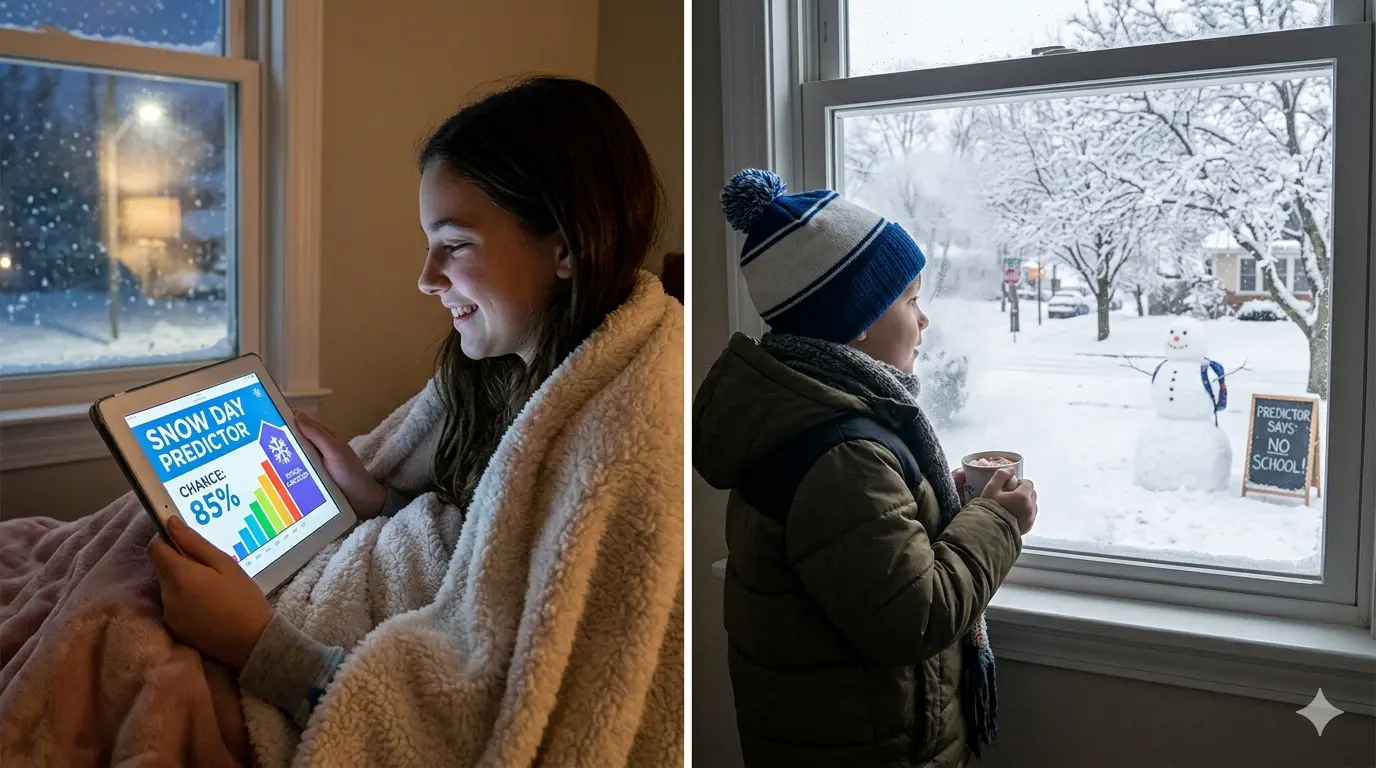
Every student knows the magical feeling of waking up to a snow day — no school, no homework deadlines, just a blanket of white outside the window. But waiting by the TV or refreshing the school district's website can feel like an eternity. That's where a snow day predictor for students comes in. These smart tools use real-time weather data, historical school closing patterns, and local conditions to give students and parents an educated guess about whether school will be canceled. In this guide, we'll explore how snow day predictors work, which ones are most reliable, and how you can use them like a pro to plan your winter days.
What Is a Snow Day Predictor for Students?
A snow day predictor for students is a digital tool — usually a website or app — that estimates the probability of school being canceled due to winter weather. Rather than relying solely on gut feeling or weather forecasts, these tools combine multiple data points to deliver a percentage chance of a snow day.
How These Predictors Collect and Use Data
Snow day predictors typically pull information from several sources simultaneously:
- National Weather Service (NWS) forecasts for precipitation amounts, timing, and temperature
- Historical school closing data from your specific district or region
- Local topography and elevation, which affect how much snow actually accumulates
- Road condition reports and transportation authority alerts
- Wind chill and ice formation data, which can close schools even without heavy snowfall
By combining all these factors, the predictor generates a probability score — often displayed as a percentage — telling students whether a snow day is likely, possible, or unlikely.
Who Uses Snow Day Predictors?
While the name suggests they're built for students, snow day predictors are genuinely useful for the entire school community. Parents use them to arrange last-minute childcare. Teachers use them to decide whether to assign time-sensitive homework. School administrators sometimes even consult weather prediction tools before making official closure decisions. Students, of course, use them to decide whether to set their alarms or sleep in.
The Most Popular Snow Day Predictor Tools for Students
Over the years, several tools have risen to prominence in the snow day prediction space. Each has its own methodology and quirks worth knowing.
The Original Snow Day Calculator
The Snow Day Calculator (snowdaycalculator.com) is arguably the most well-known snow day predictor for students in North America. Created by a teenager named David Sukhin over a decade ago, the tool allows users to enter their ZIP code, select their school type, and receive an instant probability percentage.
The calculator's algorithm factors in forecast data, temperature trends, and regional school cancellation history. Users often report accuracy rates that comfortably outperform simple weather-app guesses. It's free, fast, and requires no account or app installation — making it the go-to starting point for millions of students each winter.
Weather.com School Closing Center
The Weather Channel's school closing section aggregates official cancellation announcements directly from school districts across the United States. While this isn't a predictor in the same sense — it reports actual closures rather than forecasting them — it's an essential companion tool. Students can use a snow day predictor to gauge the probability, then switch to the Weather Channel's closing center to confirm when the official word comes in.
Local TV Station Closings Pages
Most regional TV stations maintain real-time closings and delays pages during winter storms. These pages are updated directly by school administrators and are among the most authoritative sources of confirmed snow days. Students who bookmark their local station's closings page alongside a predictive tool have the best of both worlds: an early forecast and an official confirmation source.
Mobile Weather Apps with School Alert Features
Apps like Weather Underground, AccuWeather, and MyRadar now include hyperlocal forecasting that can be remarkably precise down to a neighborhood level. Some of these apps allow users to set alerts tied to snowfall thresholds, effectively turning them into personalized snow day predictors. When snowfall is forecast to exceed a set amount, the app sends a push notification — giving students advance notice before the district makes its call.

How Accurate Are Snow Day Predictors?
This is the question every student wants answered. The honest answer: it depends, but accuracy has improved significantly in recent years.
Factors That Increase Prediction Accuracy
Several conditions make snow day predictors more reliable:
Geographic consistency — In regions with frequent winter storms (the Great Lakes region, New England, the Upper Midwest), school districts have well-established thresholds for closures. Predictors trained on years of that data tend to be quite accurate in these areas.
Lead time — Predictions made 12–24 hours before a storm are generally more accurate than those made 3–5 days out. Closer to the event, weather models converge and the forecast tightens.
Snowfall intensity — Extreme forecasts (a major blizzard vs. a clear day) are easy to predict. The tricky cases are the borderline storms — 2 to 4 inches overnight — where the difference between a full day of school and a two-hour delay can hinge on road temperatures at 5 a.m.
When Predictors Fall Short
No snow day predictor for students is infallible. Unexpected storm track shifts, rapid overnight temperature changes, and highly localized microclimates can all throw off predictions. Additionally, school closure decisions involve human judgment — a superintendent might close schools out of an abundance of caution even when snowfall is modest, or keep them open when roads clear faster than expected. Predictors can't fully account for the human element.
Benefits of Using a Snow Day Predictor for Students
Using a reliable snow day predictor offers practical advantages that go well beyond satisfying curiosity.
Better Planning and Reduced Anxiety
Rather than lying awake wondering whether school is canceled, students can check a predictor the night before and get a meaningful probability estimate. A 75% chance of a snow day might not guarantee sleeping in, but it allows for sensible planning — keeping homework light, setting a backup alarm, or alerting a parent who needs to arrange alternative childcare.
Helping Families Coordinate Logistics
For working parents, a surprise snow day can be a genuine logistical crisis. A snow day predictor for students gives families 12 to 24 hours of advance notice to explore childcare options, adjust work-from-home schedules, or make arrangements with neighbors and relatives — turning a potential scramble into a manageable situation.
Supporting Student Productivity
Ironically, snow day predictors can help students stay more productive, not less. If a student knows there's an 80% chance of a snow day, they might choose to complete tomorrow's assignment tonight, ensuring they're ahead regardless of whether school happens. This kind of proactive planning is a genuinely useful life skill.
Tips and Best Practices for Using a Snow Day Predictor Effectively
Getting the most out of these tools means using them smartly. Here are some practical best practices.
Check Multiple Sources
No single snow day predictor for students is perfect. Cross-reference the Snow Day Calculator with your local weather forecast and your school district's social media page. When multiple independent sources point in the same direction, your confidence in the outcome should increase.
Understand Probability Language
A 60% snow day probability means there's a meaningful but not overwhelming chance of cancellation. Don't treat it as a guarantee. A 90% probability, on the other hand, is worth acting on. Learning to interpret probability language — rather than treating any number above 50% as a sure thing — will save students from unpleasant surprises.
Follow Your School District's Official Channels
Always pair a predictive tool with your district's official communication methods: automated phone calls, email alerts, the district website, or official social media accounts. Predictors are for planning purposes; the official announcement is the final word.
Check the Predictor the Night Before, Not the Morning Of
Checking at 6 a.m. on the morning of a storm is often too late for meaningful preparation. The most useful window for consulting a snow day predictor is the evening before, between 8 p.m. and 11 p.m., when overnight forecasts have stabilized and school decisions are often being made.
Don't Rely on Word of Mouth
Student group chats are notoriously unreliable sources of snow day information. Rumors spread quickly and are frequently wrong. Always verify through an official channel or a reputable predictor rather than accepting a classmate's screenshot as fact.
Read More : Snow Day Weather Forecast
Conclusion
A snow day predictor for students is more than a novelty — it's a genuinely practical planning tool that takes the guesswork out of winter mornings. By combining real-time weather data, historical school closure patterns, and local conditions, these tools give students and families a valuable early warning system during the cold months. While no predictor is perfectly accurate, using them wisely alongside official school district communications can significantly reduce stress and improve day-to-day planning. Whether you're a student hoping for a free day or a parent coordinating a busy household, bookmarking a reliable snow day predictor before winter arrives is one of the smartest seasonal habits you can build.